






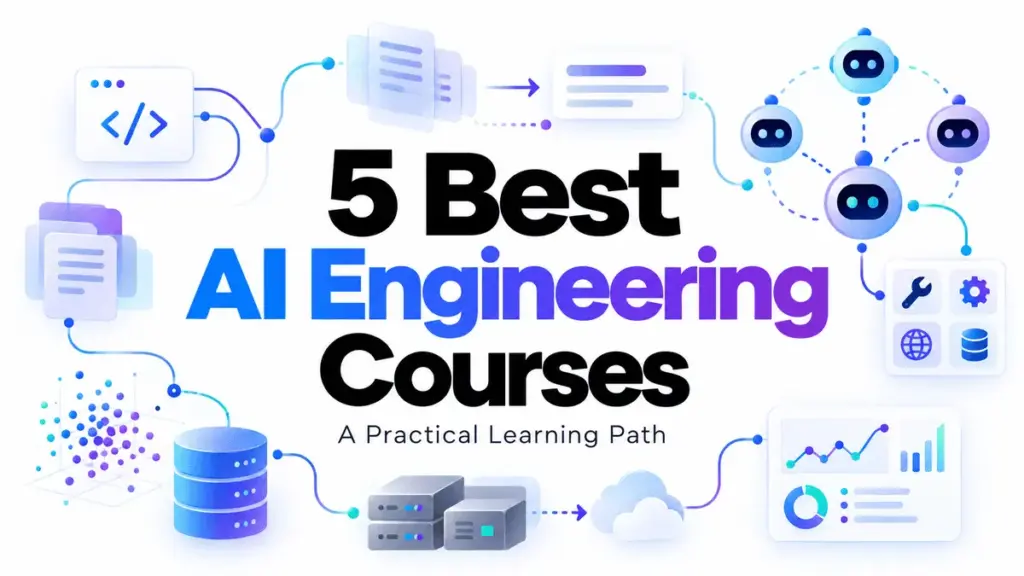
The landscape of software development continues to undergo a rapid transformation as artificial intelligence redefines traditional engineering roles. At the intersection of software engineering, machine learning, and generative AI lies a rapidly expanding discipline known as AI engineering. Rather than training massive foundation models from scratch—a resource-intensive task typically reserved for major research labs—modern AI engineers focus on harnessing existing models and turning them into practical, scalable applications and automated systems.
This specialized work involves integrating model APIs, managing embeddings and vector databases, implementing retrieval-augmented generation (RAG), and orchestrating AI agents and multi-agent workflows. Professionals in the field must also master evaluation systems, model serving, performance monitoring, and production deployment. These engineers build intelligent agents capable of utilizing external tools, coordinating with other digital entities, automating intricate internal workflows, and handling substantial portions of broader business processes.
Despite the high demand and specialized skill set required for these roles, aspiring professionals do not necessarily need to invest in expensive bootcamps or specialized university programs. A wealth of top-tier educational resources is available to the public entirely free of charge and as open-source material, complete with comprehensive lectures, code notebooks, practical exercises, and real-world projects accessible online. A structured learning path comprising five distinct, open-source programs allows students to advance from basic concepts to advanced production techniques.
For individuals who are relatively new to the mechanics of large language models, the Hugging Face Large Language Model Course serves as an ideal starting point. The curriculum begins with the foundational principles of Transformer architecture before gradually introducing students to the broader Hugging Face ecosystem, including core libraries such as Transformers, Datasets, Tokenizers, Accelerate, and the Hugging Face Hub. Learners quickly progress to fine-tuning models, building functional web demos, curating high-quality datasets, and engaging with advanced reasoning models.
Requiring solid proficiency in Python programming alongside optional familiarity with PyTorch or TensorFlow, this program builds a strong theoretical and practical base. By prioritizing how large language models actually function under the hood, students gain a comprehensive understanding before transitioning into higher-level system design areas like RAG and autonomous agents. The course bridges the gap between basic machine learning theory and modern generative AI engineering workflows.
For developers seeking a more hands-on, implementation-focused introduction to the field, the AI Engineer Notebooks repository offers a practical alternative. Designed specifically around the competencies demanded in modern AI Engineer and Forward Deployed Engineer roles, this collection of Google Colab notebooks eschews heavy, abstract frameworks in favor of direct interaction with model APIs.
By design, the curriculum is framework-free at its core, requiring students to construct raw agent loops, RAG pipelines, and evaluation frameworks directly through API calls. This methodology ensures that learners thoroughly understand the underlying mechanics before adopting high-level orchestration libraries. Primarily configured to run using the free Groq API, the project also incorporates optional GPU-based exercises in Colab for computationally intensive topics such as LoRA fine-tuning and self-hosted model inference, all distributed under an open-source MIT License.
Moving from foundational experimentation to production-grade deployment, the DataTalksClub Large Language Model Zoomcamp provides a rigorous, application-driven approach. Rather than focusing solely on model theory, this free, community-driven program emphasizes the construction of complete end-to-end LLM systems. The curriculum addresses contemporary industry demands, including agentic RAG, vector search, system orchestration, rigorous evaluation, production monitoring, and a comprehensive final capstone project.
Participants gain practical experience by building applications incrementally, observing how retrieval mechanisms, autonomous agents, evaluation metrics, and monitoring tools integrate within a unified production architecture. Additional topics such as advanced function calling, hybrid search methodologies, and reranking strategies prepare developers to tackle complex, real-world deployment challenges.
To address the operational challenges that arise after a machine learning model has been successfully trained, the DataTalksClub MLOps Zoomcamp offers specialized instruction in machine learning operations. This free program focuses on bridging the gap between experimental data science and reliable production environments. Students learn how to track rigorous experiments, manage model registries, construct automated data pipelines, deploy scalable models, monitor performance metrics in real time, and automate surrounding infrastructure.
Assuming prior working knowledge of Python, Docker, command-line interfaces, and basic machine learning concepts, the course is structured for self-paced study. It equips data scientists and machine learning engineers with the engineering discipline required to maintain robust software systems in commercial settings.
For advanced practitioners looking to dive deeper into open-source large language models, fine-tuning methodologies, and optimization techniques, Maxime Labonne’s Large Language Model Course offers a comprehensive curriculum. Divided into distinct tracks—including an optional fundamentals section, an LLM Scientist path dedicated to building and improving models, and an LLM Engineer path focused on application deployment—the course covers the full spectrum of open-source AI development.
The repository features practical notebooks demonstrating how to fine-tune models using specialized tools like Unsloth and Axolotl, quantize large models into efficient formats such as GGUF, GPTQ, AWQ, and EXL2, and experiment with advanced model merging techniques. Its strong emphasis on open-source weights and optimization strategies makes it an invaluable resource for engineers seeking to maximize efficiency and reduce latency in production environments.
Industry observers note that while generative AI tools and coding assistants continue to accelerate software development workflows, foundational technical knowledge remains indispensable. Professionals must still comprehend underlying codebases, debug system failures, make critical architectural decisions, deploy resilient infrastructure, and troubleshoot unexpected disruptions. As artificial intelligence reshapes the technology sector, the demand persists for skilled software, machine learning, MLOps, and infrastructure engineers capable of shepherding innovative concepts safely into production.