











Modern software development has reached a critical juncture where the dual pressures of rapid technological advancement—particularly in artificial intelligence—and an urgent global climate crisis are colliding. As digital infrastructure continues to expand, the environmental cost of the underlying compute has become a topic of increasing concern for those who build the systems powering our world. A new collaborative study conducted by GitHub and the Yale Program on Climate Change Communication reveals that developers are not merely passive observers of this trend; they are deeply concerned and are actively seeking the technical agency to mitigate the environmental footprint of their work.
The findings, based on a survey of 1,039 GitHub users, underscore a significant disconnect in the current software ecosystem. While the desire for sustainability is high, the practical path to achieving it remains obstructed by a lack of standardized tools, precise measurement metrics, and clear, actionable guidance. For many developers, the goal of reducing wasted compute is currently an aspiration rather than a standard part of their engineering workflow.
A Clear Mandate for Greener Code
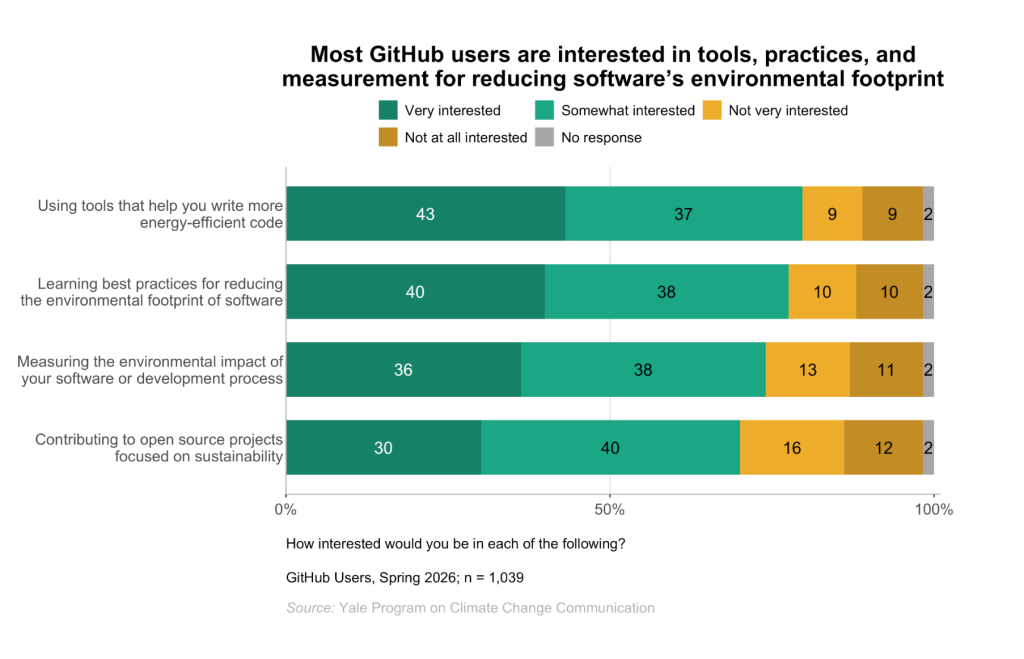
The survey results paint a compelling picture of a workforce that is acutely aware of the climate impact associated with their profession. Eight in ten respondents expressed a strong interest in utilizing tools specifically designed to help them write more energy-efficient code. This sentiment extends beyond mere code optimization; nearly as many developers are seeking best practices for reducing the broader environmental footprint of their software architectures. Furthermore, approximately 75% of those surveyed indicated a desire for robust, standardized ways to measure the ecological impact of their software and development lifecycles.

The data suggests that the technology sector is approaching a tipping point. The challenge is no longer about convincing developers that software efficiency is a virtuous goal; it is about transitioning that interest into a standard engineering practice. This involves integrating the identification of unnecessary compute, the proposal of technical improvements, rigorous testing, and the eventual implementation of these changes into the normal, iterative lifecycle of software maintenance.
Developers’ Perspective on Climate and AI
The survey, which focused on GitHub’s U.S.-based monthly active users, delved into the complex relationship between software development, artificial intelligence, and the broader climate change discourse. The results reveal that GitHub users are significantly more engaged with the climate crisis than the broader American public.

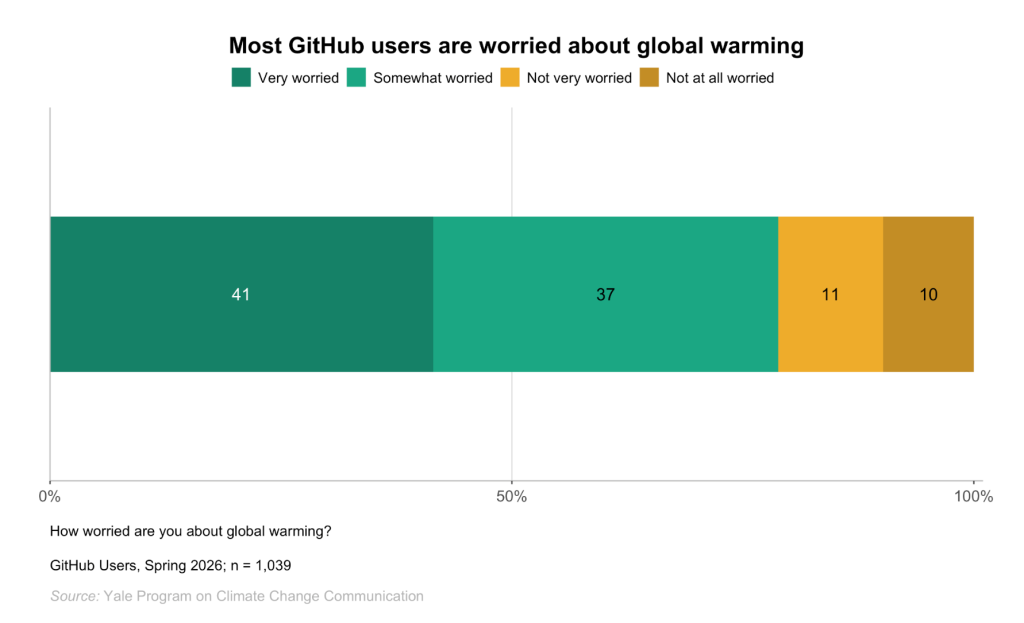
When compared to data from the Yale Program on Climate Change Communication’s "Climate Change in the American Mind" survey, the disparity is stark. Roughly 86% of GitHub users surveyed believe that global warming is occurring, compared to 68% of the general U.S. adult population. Similarly, 82% of developers view the issue as personally important, whereas only 65% of the general population shares that sentiment. The survey also found that 79% of developers are actively worried about global warming, compared to 66% of the general U.S. public.
While it is important to note that these findings describe a specific, self-selected group of GitHub users who opted into marketing communications and thus should not be interpreted as a representative sample of the entire global developer population, the data provides a clear indicator of the priorities held by those who are currently building the next generation of digital infrastructure. They are thinking about the systems they build, the energy those systems consume, and the long-term environmental consequences of their technical decisions.
The Search for a Practical Path to Action
Perhaps the most telling finding in the report is the gap between intention and impact. Only 10% of respondents reported that their current development practices have a "large effect" on reducing their personal environmental impact. In contrast, 63% believe that the effect of their current efforts is small. This reflects a lack of confidence in the available tools and methodologies rather than a lack of willpower.
Developers are essentially asking for the same levels of rigor and transparency in sustainability as they expect in other critical areas of engineering, such as security, performance, and reliability. In open-ended responses, developers highlighted a need for concrete help in areas such as estimating the footprint of repositories, optimizing CI/CD workflows, identifying dormant or unnecessary GitHub Actions, and benchmarking AI-driven compute against more traditional workloads.
A recurring theme in the feedback was a warning against "greenwashing" within the software space. Developers are wary of making environmental claims without empirical evidence. They understand that software efficiency is nuanced; runtime speed does not always correlate directly to lower energy usage. Factors such as hardware specifications, workload distribution, the geographical location of the server, the time of day, and the local electricity grid’s carbon intensity all play significant roles in the final environmental outcome. Consequently, developers are calling for measurement tools that provide meaningful context rather than vanity metrics.
Targeting Measurable Waste
To move toward a more sustainable engineering culture, the industry must start with the waste that can be objectively identified and quantified. Efficiency is, at its core, a hallmark of high-quality software engineering. By reducing the compute required to achieve a successful result, developers can simultaneously lower infrastructure costs, reduce latency, and improve overall system performance.
The report suggests that developers focus on four primary areas where measurable waste often hides: code efficiency, data processing, network transmission, and the frequency of execution for automated tasks. However, the right metric for success depends entirely on the specific change being implemented. Execution time, CPU utilization, memory allocation, and data transfer volumes can all serve as useful proxies for computational demand.
Crucially, the report emphasizes that developers should be transparent about the limitations of their metrics. A pull request that optimizes a search algorithm from an O(n²) complexity to a hash-map lookup should include before-and-after measurements for a representative workload, clear instructions on how to reproduce those tests, and a summary of any trade-offs regarding memory consumption or long-term maintainability. This data-driven approach creates a far more compelling engineering case than simply labeling a change as "greener" without supporting evidence.
Leveraging AI for Efficiency
As the industry explores the use of AI, it is becoming clear that AI itself can be a powerful tool for discovering efficiency opportunities. GitHub’s Agentic Workflows are designed to automate the often-laborious process of auditing large repositories for performance gains. For instance, the "Daily Efficiency Improver" workflow is an open-source tool that scans repositories for potential optimizations across code, data handling, and frontend performance.
This tool is designed to assist, not replace, the human developer. It prioritizes changes that can be empirically measured, runs existing test suites, and generates draft pull requests that present the evidence and trade-offs for human maintainers to review. The agent does not have the authority to merge changes; it merely acts as a scout, identifying potential areas for improvement.
For developers interested in this approach, the workflow can be integrated via the GitHub CLI. However, the report cautions that any such automation should be treated with care. Before enabling automated workflows, developers are advised to review permissions, model configurations, and the potential for increased compute costs. Every recommendation generated by an agent should be treated as a hypothesis, subject to the same rigorous benchmarking and testing as any other code change.
The final evaluation rests on five key questions that every pull request should answer: Does the change deliver the intended result? What is the measured impact on performance? Is the change reproducible? What are the architectural trade-offs? And finally, does the evidence support the claim of improved efficiency?
By integrating these practices into the standard engineering loop, organizations can move from abstract concern to tangible, sustainable action. As the research shows, the interest among developers is already present; the next phase of the industry’s evolution will be defined by the development of the tools, metrics, and workflows that allow them to turn that interest into code that is as efficient as it is effective. The full report, "Software Developers on Climate Change, AI, and Sustainable Software," provides a roadmap for this shift, encouraging teams to start small, measure precisely, and ensure that every efficiency gain is rooted in sound engineering principles.