










For many newcomers diving into the fast-paced worlds of data science and artificial intelligence, the fundamentals of Python are frequently treated as little more than a waiting room. The common strategy among beginners is to rush through the basics as quickly as possible in order to arrive at the prime-time libraries and advanced frameworks where the real work is widely assumed to happen. It is an entirely understandable plan for anyone eager to build machine learning models or deploy cutting-edge neural networks. However, this hurried approach often produces a very specific kind of practitioner: one who can follow a tutorial or a boilerplate script precisely, but who becomes completely stranded the moment the incoming data deviates even slightly from the tutorial parameters.
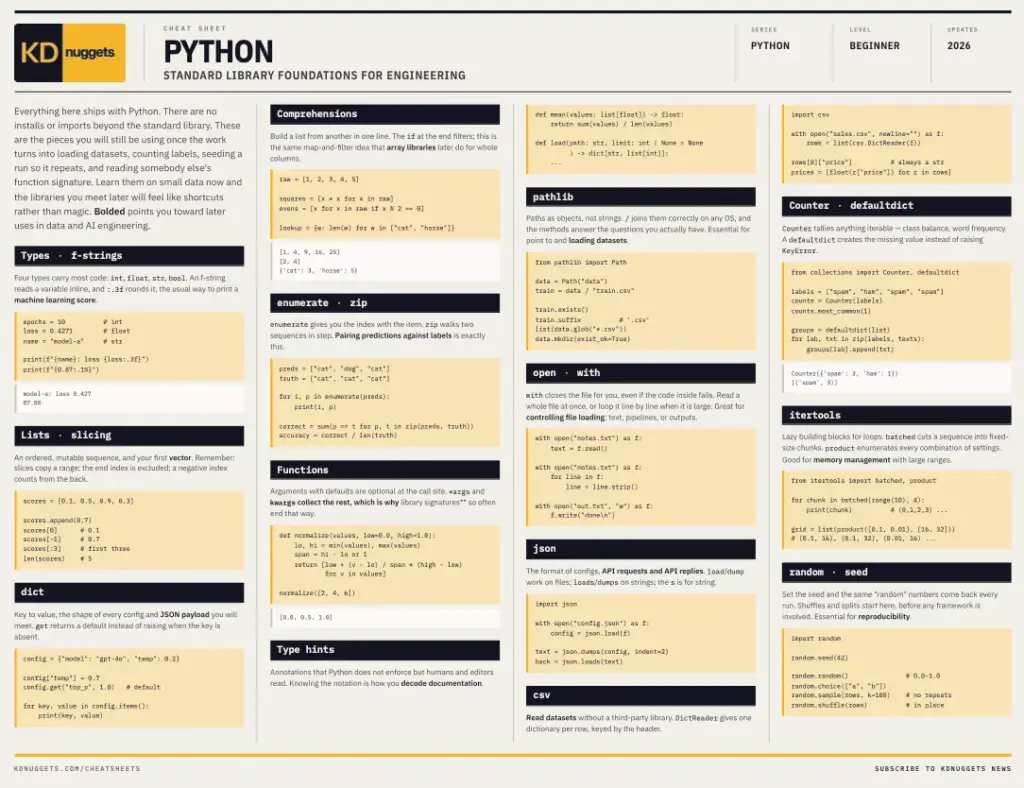
Addressing this persistent industry hurdle, KDnuggets has officially released its latest educational resource, designed to bridge the gap between superficial syntax memorization and true engineering comprehension. The newly published Python Foundations for Engineering cheat sheet carefully gathers the vital material that cannot and should not be left behind during the early stages of a developer’s journey. Almost none of the core concepts highlighted in the cheat sheet are eventually replaced by a framework later on in a professional career. Instead, these foundational concepts are simply scaled up, given faster machinery underneath, and wrapped in a nicer user interface, but the fundamental logic and operations remain entirely the same.
A data transformation written across a handful of native items in standard Python represents the exact same underlying operation that a massive array library applies to a column of ten million rows. Consequently, even if a developer first encounters a computational idea on a small, local dataset, the vectorized version encountered later in an enterprise environment remains entirely understandable without requiring a mental translation. It ceases to be merely a piece of syntax that a programmer blindly copies and pastes while crossing their fingers for a successful compile. This distinction matters most when something inevitably breaks in a production environment, because attempting to debug complex software pipelines without a firm grasp of the underlying fundamentals is a fool’s game that wastes valuable engineering hours.
Beyond the execution of code, there is an additional layer of professional value that directly relates to how developers read and interpret documentation. Function signatures, optional arguments, collected arguments, and type annotations—which the Python interpreter itself never strictly enforces but which are utilized extensively throughout technical documentation—form the universal notation that every library a developer will ever encounter uses to describe itself. Not being conversant in this specific style of modern programming prose means that reference documentation effectively remains closed off and intimidating. Every minor technical question then transforms into a desperate quest for somebody who has walked the path before, or worse, becomes an excuse to rely blindly on generative artificial intelligence tools like ChatGPT to supply an answer that presupposes an actual, working understanding of the underlying problem.
What ultimately remains when the glamorous layers of specialized frameworks are stripped away are the foundational concepts that quietly underpin the vast majority of any real-world working project. These essential tasks include finding files on a system and opening them safely, seamlessly moving between the diverse data formats that configuration files and application programming interface traffic actually arrive in, thoroughly counting what is inside a dataset before trusting any grandiose claims made about it, and properly fixing a random seed so that an experimental result can be reliably reproduced by teammates and auditors alike. Far from being trivial preliminaries to the real engineering work, these competencies turn out to represent a remarkably large share of what daily software and data engineering actually entails.
Demonstrating the enduring power of standard, out-of-the-box programming tools, everything featured on the newest KDnuggets cheat sheet ships natively with Python itself. There is nothing extra to install, no complex dependencies to pin down, and no frustrating version drift to manage across different development environments. By focusing heavily on these core, native capabilities, the new resource aims to foster a more resilient generation of data and AI practitioners who understand not just how to run code, but why that code behaves the way it does.