






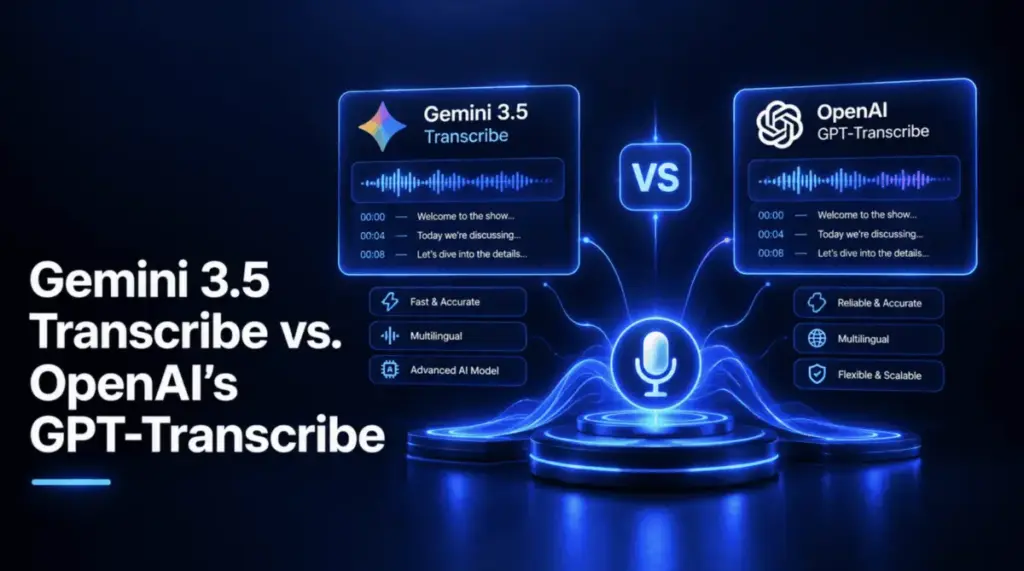
The artificial intelligence landscape has witnessed a rapid acceleration in speech-to-text capabilities as two of the industry’s leading powerhouses roll out competing flagship transcription models within weeks of each other. Google officially shipped Gemini 3.5 Transcribe on August 26, 2026, entering the market just four weeks after OpenAI released its own current transcription model, GPT-Transcribe, on July 28, 2026. This unusually tight release window has provided developers and enterprise buyers with a rare opportunity to evaluate two contemporary systems head-to-head rather than comparing a newly minted model against an aging legacy architecture.
Both companies have structured their commercial offerings identically by splitting their portfolios into two distinct categories: one model optimized for real-time streaming applications and another engineered for processing pre-recorded audio files. This alignment in product strategy allows for a remarkably direct evaluation of performance, utility, and cost. As artificial intelligence integration becomes a standard requirement across customer service platforms, media production pipelines, and corporate tooling, the battle over transcription accuracy, speed, and advanced features like speaker attribution has intensified significantly.
Google’s rollout of Gemini 3.5 Transcribe serves as a direct successor to Chirp 3, the company’s previous audio transcription model. In positioning the new release, Google has heavily emphasized operational speed, highlighting a notable 70 percent improvement in time-to-final-transcription metrics over its predecessor, alongside substantial gains in raw accuracy. To accommodate different deployment needs, Google has made the model available through two separate identifiers rather than a single general-purpose endpoint. The gemini-3.5-transcribe-live model handles continuous, sub-second latency streaming through the Live API, while the gemini-3.5-transcribe endpoint processes pre-recorded audio files, meeting recordings, and call logs via the Interactions API.
Independent evaluations, such as those conducted by Artificial Analysis and cited directly in Google’s launch documentation, illustrate the performance profile of the new architecture. The system achieves a 4.0 percent word error rate for streaming use cases and a remarkably low 2.6 percent word error rate for non-streaming file processing. On the FLEURS multilingual benchmark, Google reports a 5.50 percent word error rate for streaming and 5.04 percent for non-streaming, representing a more rigorous testing environment that underscores the model’s performance across diverse linguistic datasets.
Beyond raw transcription accuracy, the pre-recorded version of Gemini 3.5 Transcribe incorporates several native capabilities that previously required ancillary models or complex processing pipelines. Most notably, it features built-in multi-speaker attribution—reliably identifying up to three distinct speakers out of the box, with support for additional speakers listed as experimental—and word-level timestamps generated natively without a separate model dependency. The ecosystem supports over 85 languages, recognizes custom vocabulary parameters, and enables complex workflows where follow-up tasks, such as automated image generation or deep file analysis, can be delegated to other Gemini models via function calling.
OpenAI’s GPT-Transcribe
OpenAI has similarly restructured its approach to speech recognition following the legacy era of Whisper and the subsequent introduction of gpt-4o-transcribe in March 2025, which marked the company’s initial shift away from older Whisper architectures toward the GPT-4o framework. GPT-Transcribe, launched in late July 2026, represents the next evolutionary step in that lineage. OpenAI now formally recommends the new model ahead of older iterations like whisper-1, gpt-4o-transcribe, and gpt-4o-mini-transcribe for handling recorded speech in its original language. Like its Google counterpart, the architecture includes a dedicated streaming sibling designated as gpt-live-transcribe to facilitate continuous, low-latency sessions.
Performance metrics provided by OpenAI indicate substantial improvements over legacy technology. In benchmark tests conducted against Common Voice across 22 languages, GPT-Transcribe roughly halved the word error rate of the original whisper-1 model, bringing error rates down from 40.37 percent to 19.27 percent, all while reducing operating costs by 25 percent per minute compared to its immediate predecessor. Commercial pricing for the service is established at $0.0045 per minute for file transcription, while the streaming variant is billed at $0.017 per minute of session audio.
The system accepts targeted keyword hints and multiple language parameters to assist with domain-specific terminology and code-switching scenarios, while also providing automated detection reports regarding the languages identified within the audio stream. However, a functional gap remains within the current OpenAI ecosystem: the foundational GPT-Transcribe model does not natively perform speaker diarization or generate word-level timestamps. Utilizing those specific capabilities still necessitates routing audio through separate models, such as gpt-4o-transcribe-diarize or the older whisper-1 architecture for timestamps.
Practical Applications and Technical Implementations
Evaluating how these models function in real-world scenarios highlights the distinct design philosophies of both companies. Consider a multi-speaker corporate meeting where native diarization is essential for producing an intelligible record rather than an undifferentiated block of text. Using Gemini 3.5 Transcribe, developers can submit raw audio bytes alongside a straightforward prompt requesting speaker labels and timestamps directly through the Google GenAI SDK. Because the gemini-3.5-transcribe endpoint is architected specifically to return speaker-attributed and timestamped output natively, the resulting transcript distinguishes between participants like Speaker 1, Speaker 2, and Speaker 3 without requiring secondary processing steps, yielding structured data ready for downstream enterprise analytics.
Conversely, scenarios requiring rapid, continuous output—such as real-time event captioning where latency supersedes the need for speaker separation—demonstrate the strengths of OpenAI’s streaming infrastructure. By establishing a persistent WebSocket connection to OpenAI’s real-time transcription endpoints rather than uploading discrete audio files, applications can continuously append audio chunks to an ongoing buffer. The gpt-live-transcribe model then returns incremental text chunks and partial transcription updates as delta events while the speaker is actively talking. This streaming behavior allows live caption displays to remain synchronized with audio delivery without waiting for session completion.
Comparative Industry Landscape
A direct comparison of the two platforms reveals fundamentally different approaches to feature integration. Gemini 3.5 Transcribe offers native multi-speaker diarization for up to three reliable speakers and built-in word-level timestamps across more than 85 languages, running on pre-recorded error rates as low as 2.6 percent. OpenAI’s GPT-Transcribe focuses on cost efficiency and expansive language hinting across 22 benchmarked languages, achieving significant error-rate reductions compared to Whisper while maintaining a file transcription price point of $0.0045 per minute and a streaming rate of $0.017 per minute, though requiring auxiliary models for diarization and timestamps.
Ultimately, the choice between Google and OpenAI for speech transcription depends heavily on the specific architectural requirements of the deployment. Gemini 3.5 Transcribe presents a compelling option for meetings, customer call logs, and multi-speaker environments where native attribution and timestamps streamline development by eliminating the need for secondary model calls. Meanwhile, OpenAI’s GPT-Transcribe occupies a strong position for single-speaker transcription workflows, cost-sensitive processing pipelines, and real-time captioning scenarios where rapid, low-latency streaming takes precedence over advanced speaker identification.
Shittu Olumide is a software engineer and technical writer passionate about leveraging cutting-edge technologies to craft compelling narratives, with a keen eye for detail and a knack for simplifying complex concepts.