









Open three different job boards today and search for roles in artificial intelligence. You are almost guaranteed to encounter a confusing landscape of overlapping titles. One technology company advertises an opening for an AI Engineer. Another company down the street lists an Applied AI Engineer. A third searches for an LLM Engineer. Despite the varying nomenclature, a glance at the listed responsibilities often reveals near-identical requirements: proficiency in Python, familiarity with a language model API, a mention of retrieval mechanisms, and a concluding line emphasizing production reliability.
A closer look at the fine print, however, reveals shifting specifics. One job posting demands deep experience with LangChain and framework orchestration. Another asks for hands-on fine-tuning capabilities using LoRA. A third simply wants someone capable of making API calls and writing clean evaluation code. The same title can hide three entirely different professional realities.
This ambiguity carries significant consequences for job seekers. Career decisions frequently follow the prominent title at the top of a posting rather than the underlying description. A professional chasing AI Engineer roles simply because the title dominates growth charts might land in a day-to-day routine that looks nothing like their expectations. Similarly, someone assuming that a Machine Learning Engineer title implies training custom models from scratch all day risks an unexpected professional pivot.
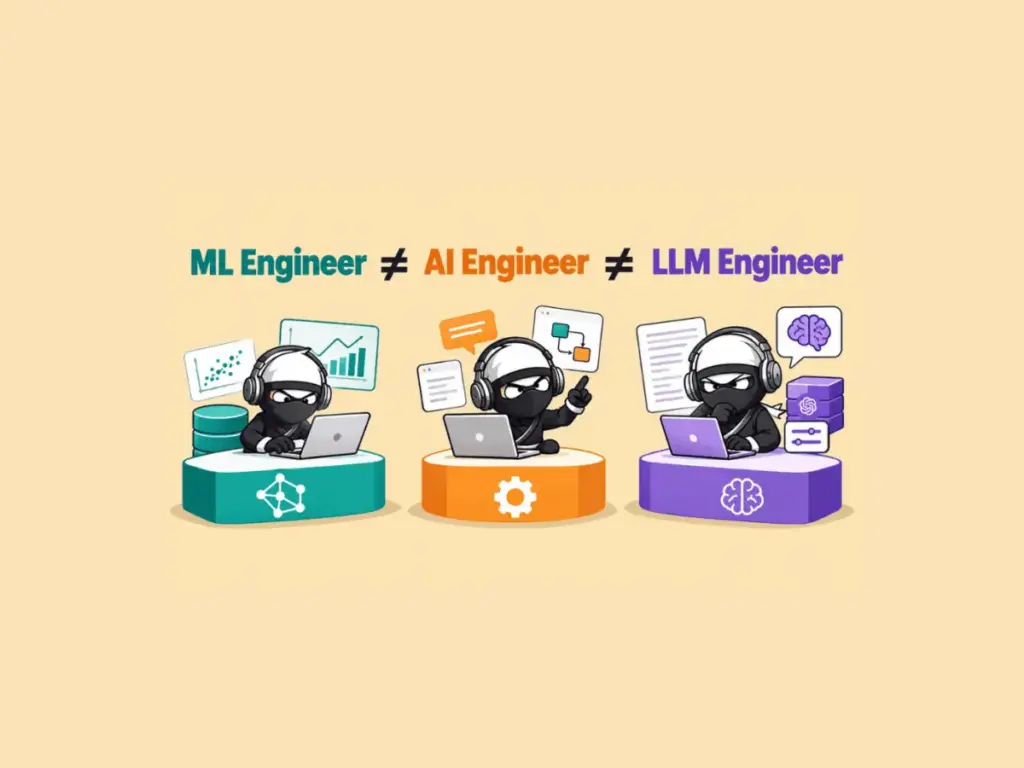
Industry observations and candidate feedback highlight a distinct reality: the true differentiator among these roles lies in the specific outputs professionals are asked to build, own, and maintain six months down the line. Examining the distinct deliverables of each position helps clarify what a machine learning engineer ships compared to an AI Engineer or an LLM Engineer.
The Three Roles, Defined by What They Build
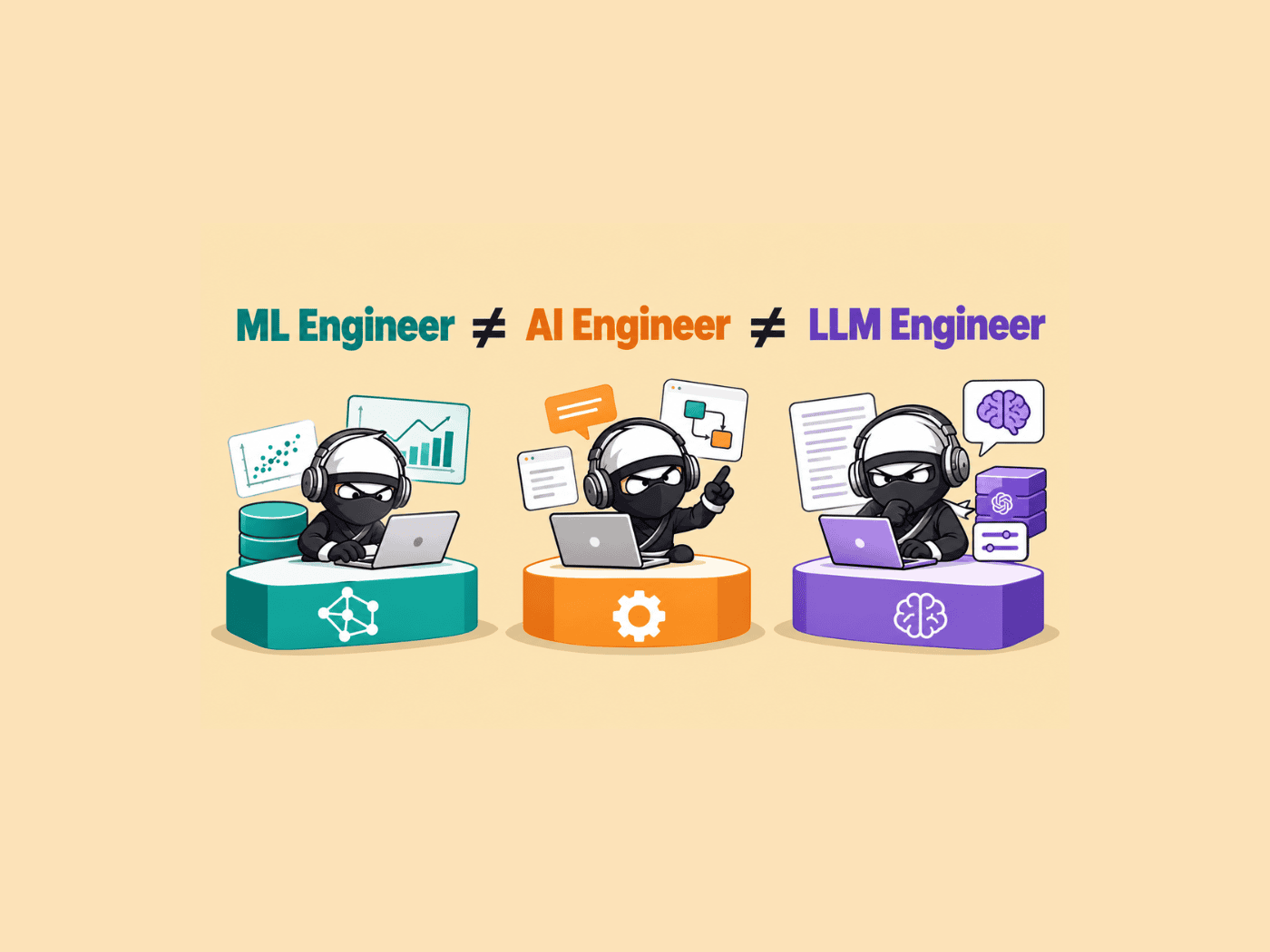
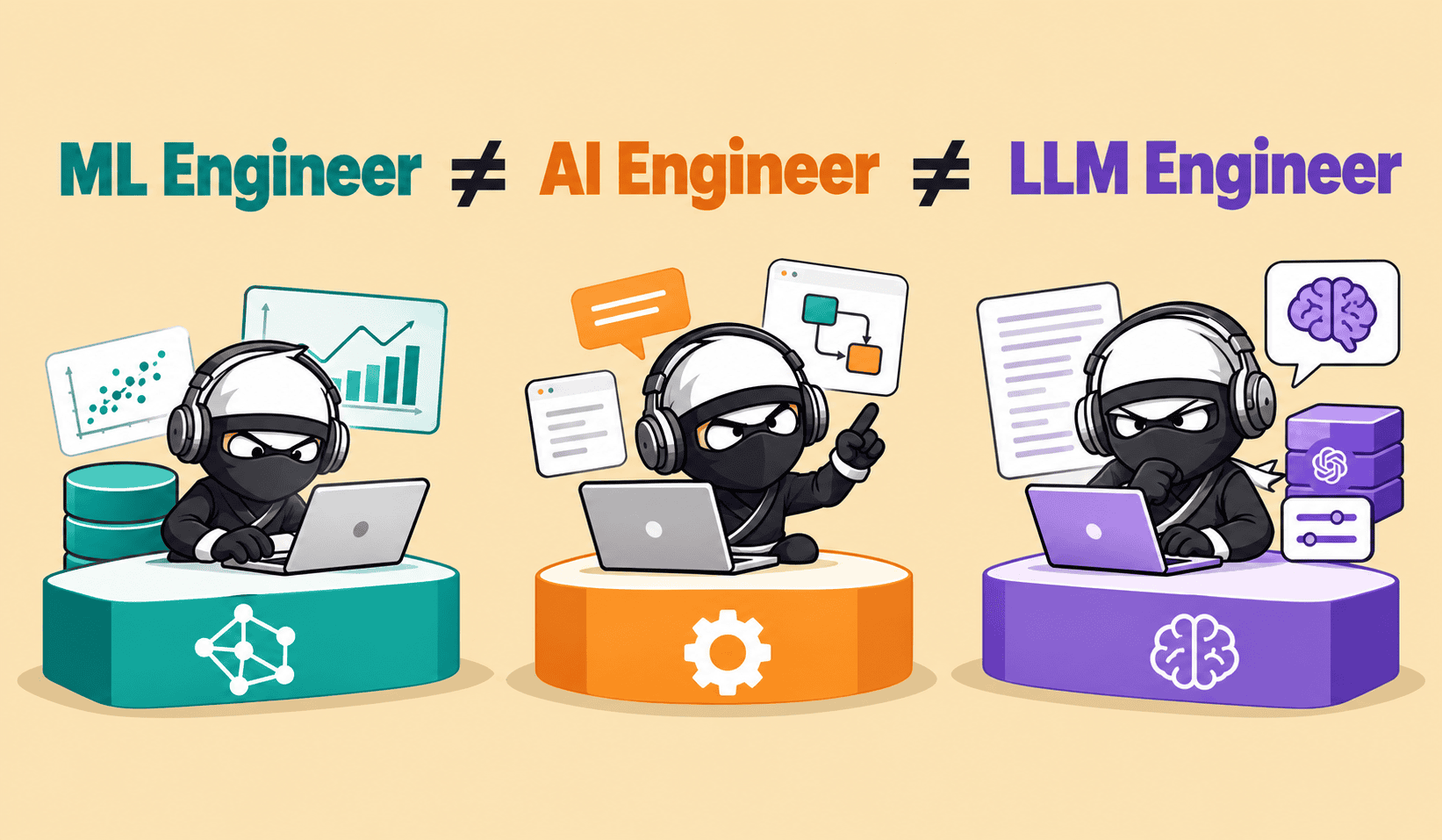
Traditionally, a machine learning engineer builds and trains a predictive model directly from data. While a data scientist typically explores raw data and prototypes an approach, the machine learning engineer takes that validated model and transforms it into a robust system capable of running reliably in production at scale, processing fresh data it has never previously encountered.
An AI Engineer operates from a different starting point, typically stepping in after a foundational model already exists. In most cases, this involves a large model pretrained by a third party and accessed via an API. The primary responsibility of the AI Engineer is to connect that existing model to a functional product, such as a customer support assistant, an internal enterprise search capability, or an automated agent designed to execute multi-step workflows.
An LLM Engineer represents a more specialized branch of the broader AI Engineer category. Rather than addressing artificial intelligence across a wide spectrum—which might include computer vision or recommendation systems—the LLM Engineer focuses narrowly on large language models. The distinguishing factor in their mandate is fine-tuning: adjusting the internal weights of a pretrained model to optimize its performance for a specific, narrow use case.
Understanding the daily work behind these definitions requires examining how each professional spends their operational hours.
For a machine learning engineer, the core engineering loop remains remarkably consistent across industries. The process involves collecting and cleaning data, selecting an appropriate algorithm, training the model, validating its performance against statistical metrics like root mean square error or confusion matrices, deploying the system, and subsequently monitoring and retraining it as incoming data evolves.
The standard toolkit for these professionals includes Python, PyTorch, TensorFlow, scikit-learn, and enterprise feature stores such as Amazon SageMaker or Databricks. The tangible output is usually a targeted system: a personalized recommendation engine, a fraud detection mechanism, a demand forecasting model, or a real-time risk score attached to financial transactions.
A significant portion of a machine learning engineer’s time is spent on data engineering rather than algorithmic tweaking. Poor data quality, leaked labels, or poorly designed feature windows will inevitably cause a model to fail long before the choice of algorithm becomes the determining factor. This reality places the role much closer to applied data science and traditional software engineering than to theoretical academic research.
By contrast, an AI Engineer’s day divides across a different set of priorities. A large portion of time goes toward prompt design, retrieval-augmented generation pipelines, and integrating with language model APIs. Smaller blocks of time are dedicated to evaluating performance, monitoring for hallucinations or sudden quality drops, handling standard backend duties like database management and API maintenance, and prototyping new features for cross-functional teams.

The tools of choice lean heavily toward Python or TypeScript, orchestration frameworks like LangChain, LangGraph, or LlamaIndex, and vector databases such as Pinecone or Qdrant. A common misconception among newcomers is the expectation that they will be training novel models from scratch. In practice, many discover that the role involves troubleshooting data pipelines and refining prompts rather than designing neural architectures from the ground up. The work truly begins after a model is already trained and validated, culminating when the system reliably serves real users beyond an initial prototype.
An LLM Engineer absorbs most of the responsibilities typical of an AI Engineer, with the addition of fine-tuning. Utilizing methodologies such as Low-Rank Adaptation, or LoRA, and its quantized variant QLoRA, these engineers adjust the weights of pretrained models using domain-specific datasets. This step becomes necessary when general-purpose models fail to achieve acceptable accuracy on specialized, narrow tasks.
Experienced LLM Engineers often spend significant effort ruling out fine-tuning before attempting it. Alternative strategies—such as improving retrieval mechanisms, expanding prompt context, or testing a different base model—frequently solve a performance issue at a lower financial cost and without introducing ongoing maintenance liabilities. Fine-tuning is typically reserved as a last resort after simpler interventions have been exhausted.
Why the Titles Don’t Match the Work
This pervasive confusion across job descriptions stems from rapid industry evolution. Machine learning engineering emerged as a distinct discipline once the deployment of predictive models matured into a specialized software engineering task.

The subsequent explosion of generative AI gave rise to an entirely new category—the AI Engineer—which barely existed prior to 2022. Because the technology sector has not yet standardized its terminology, identical job descriptions appear across hiring portals under a half dozen different titles, including GenAI Engineer, Applied AI Engineer, Prompt Engineer, and RAG Engineer.
This lack of standardization directly impacts compensation. Two distinct corporate postings featuring nearly identical technical requirements can command substantially different salary bands simply due to the chosen job title rather than the actual duties required of the employee.
Organizational scale further dictates how responsibilities map to titles. At an early-stage startup, a single individual might handle all three domains regardless of the official job training the underlying model, constructing the retrieval pipeline, and shipping the user-facing feature. Conversely, larger enterprises frequently fragment these duties across specialized teams. A mature organization might divide the work into five or more distinct categories, spanning applied AI product engineering, model quality machine learning engineering, AI research, AI infrastructure, and forward-deployed engineering teams tasked with implementing AI systems within specific client environments.
For job seekers navigating this landscape, the practical takeaway is to scrutinize the specific bullet points within a posting rather than relying on the headline. Evaluating what an incoming hire will build within their first ninety days and what they will own thereafter provides a far more accurate picture of the role than any job title.

How To Prepare, No Matter Which Title You’re Chasing
Regardless of the specific title that ultimately appears on an offer letter, the foundational evaluation criteria across these roles remain consistent. Interview processes lean heavily on core competencies including SQL, data shaping, and the ability to systematically reason through a technical problem prior to writing code.
Technical interviews at major technology firms typically feature coding challenges centered around recommendation systems, time-series forecasting, and text processing, alongside theoretical discussions regarding model evaluation and cross-functional communication. Success in these evaluations depends heavily on correctly framing the problem, avoiding data leakage, and selecting appropriate analytical signals rather than merely memorizing algorithms.
The inconsistencies across AI hiring titles are likely to persist as the technology continues to mature. A machine learning engineer continues to train and deploy predictive models, an AI Engineer builds application logic around models trained elsewhere, and an LLM Engineer applies those same integration principles with a specialized focus on fine-tuning and operating large language models.
Despite these distinct specializations, interview preparation remains remarkably uniform. A strong foundation in database querying, clear problem framing, and the ability to articulate technical tradeoffs hold equal weight across machine learning, AI, and LLM engineering evaluations. As long as corporate recruiters continue to rename roles faster than they update their interview rubrics, applicants will find that the most reliable job description lies not in the title at the top of the page, but in the detailed list of systems they are expected to build, own, and maintain in the years ahead.