The community is hard at work on something new.
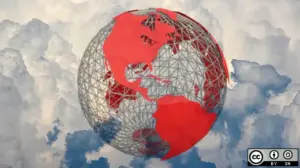
Visitors to Opensource.com may have noticed a distinct quietness settling over the platform lately. That temporary lull is due to an exciting new project currently in the works behind the scenes. While specific operational details and launch features remain under wraps for the moment, there is already a great deal to discuss regarding the direction of the platform and the fundamental nature of the community that sustains it. What better way to begin framing this upcoming transition than by looking at the broader digital ecosystem—starting with the very fabric of the internet itself?
The Internet, and Top-Level Domains
To understand where the community is heading, it helps to examine where the digital world originated. Most internet users recognize that the internet is, at its core, a network. By definition, a network is simply a group of interconnected connections. In fact, the word "internet" is a well-known portmanteau combining "interconnected" and "network."
Historically speaking, the internet began as a network of interconnected networks. In its earliest iterations, it primarily consisted of two primary domains: the military network and the academic network. These specialized spheres allowed researchers and defense personnel to share data securely across vast distances. However, once the internet began to gain widespread popularity outside of those two tightly controlled groups, the limitations of this simple arrangement became obvious. It quickly became apparent that different designations were desperately needed to differentiate entities on the web. A mechanism was required to easily distinguish, for instance, a commercial enterprise from a charitable organization, a university from a governmental department, or a personal page from a public institution.
These vital designations ultimately came to be known as top-level domains, commonly abbreviated as TLDs. Today, internet users can choose from a remarkably vast and diverse array of TLD extensions, ranging from industry-specific suffixes to geographic identifiers. However, for a long period during the web’s formative years, there were only a handful of these extensions available to the public.

Those original TLDs have retained their prominence and remain remarkably popular to this day. Most everyday internet users instinctively understand that when they navigate to a web address ending in .com, they are visiting a commercial site meant for business operations and consumer sales. Conversely, when a browser directs them to a .org address, they are typically visiting the website of a non-profit organization, a public advocacy group, or a community-driven initiative. These suffixes act as immediate shorthand, signaling the underlying intent and organizational structure of the entity behind the screen.
Open Source Is a Network
Just as the internet relies on a vast architecture of interconnected systems, open source can represent many different things depending on the context in which it is applied. Open source software and philosophy can be commercial, serving enterprise markets and driving billion-dollar industries. At the same time, it can be entirely non-profit, sustained by donations and grants. It can be deeply academic, advancing computer science and scholarly research, or it can be cultural, shaping how creators share art, literature, and media.
No matter what specific form open source takes in any given instance, it always operates fundamentally as a network. Sometimes, that network consists of computers communicating via protocols and code repositories, but most importantly, it is always a network of people.
Human connection remains the heartbeat of the open source movement. Whether participants are gathering in large convention centers for a major international conference, catching up over drinks at a local pub after hours, or collaborating asynchronously in an online chat room, open source is first and foremost a community of people working toward shared goals.
For the past twelve years, the website Opensource.com has enjoyed the backing and support of a commercial entity. That institutional support has played a significant role in helping the platform grow, archive countless stories, and foster discussions about collaborative technology over more than a decade. However, the individuals—that means you and me—who truly make up the beating heart of the Opensource.com community are not commercial entities. We are people, bound together by shared values of transparency, collaboration, and the free exchange of ideas.

Now, as the platform prepares to take its next logical step, change is on the horizon. In one month, Opensource.com is going to resolve that bug, ushering in a fresh chapter for the community and its digital home. Stay tuned for further developments as the launch approaches.
Opensource.com regularly publishes stories about creating, adopting, and sharing open source solutions across the globe. Readers and community members can follow the latest updates and announcements on Twitter via @opensourceway.
This work is made available under the terms of the Creative Commons Attribution-Share Alike 4.0 International License, permitting the sharing and adaptation of the material provided proper attribution is maintained.