If you spend your days working with data science, statistics, or machine learning, the odds are high that you have already integrated at least one artificial intelligence assistant into your daily workflow. Whether you have turned to these models to explain an obscure p-value, draft a complex regression script, or assist in cleaning a frustratingly messy dataset, conversational AI has rapidly become a ubiquitous presence in the analytical workspace.
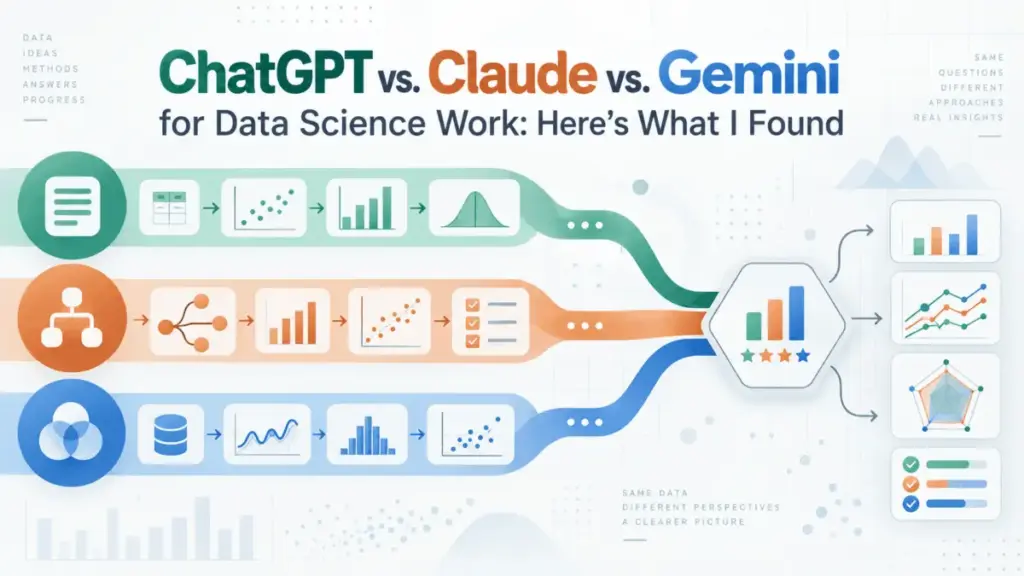
Among the myriad options available to modern professionals, OpenAI’s ChatGPT, Anthropic’s Claude, and Google’s Gemini have emerged as the three primary platforms that data scientists most frequently utilize. AI and data science educator Vinod Chugani recently put the current paid versions of all three models to the test across a battery of standard analytical tasks. Evaluating them on statistical test selection, conceptual explanations, Python code generation, exploratory data analysis, and long-form document review, his assessment highlights both the considerable strengths and the lingering limitations of each platform.
It is worth noting that the landscape of artificial intelligence development shifts rapidly. Because all three platforms update their underlying models with remarkable frequency, these findings serve as a contemporary snapshot of performance rather than a permanent, immutable hierarchy. Nevertheless, the distinct operational philosophies of ChatGPT, Claude, and Gemini offer valuable insights for professionals looking to optimize their computational workflows.
How Each Tool Approaches Data Science Workflows
While all three leading models are fully capable of generating functional Python and R code, elucidating intricate statistical concepts, and guiding users through multi-step analytical workflows, the mechanics of how they accomplish these tasks—and how reliably they execute them—vary significantly.
ChatGPT operates primarily as a broad generalist, offering a flexible and adaptable conversational experience. Its most prominent advantage for data science practitioners is its integrated data analysis environment. This sandboxed setup enables users to upload CSV or Excel files directly into the chat interface, whereupon the model writes and executes Python code behind the scenes. Analysts can effortlessly transition from raw data ingestion to summary statistics and visualizations without ever opening an external notebook environment. Furthermore, users can dynamically redirect their analysis on the fly, instructing the model mid-stream to remove specific outliers and recalculate the metrics.
Claude, by contrast, has built a reputation for producing exceptionally detailed conceptual explanations while adhering strictly to complex instructions over extended conversational threads. Anthropic has equipped Claude with built-in code execution and file creation capabilities, allowing it to run Python scripts on uploaded datasets and render charts directly within the chat interface. When provided with a highly detailed prompt or a stringent set of analytical constraints, Claude tends to maintain fidelity to those parameters more consistently than its competitors.
Gemini derives much of its unique utility from its deep integration within the broader Google ecosystem. For data scientists whose assets reside in Google Sheets or Google Drive, Gemini offers seamless, low-friction access to these resources. The platform supports notably expansive context windows and includes native Python execution capabilities. Additionally, for research-intensive tasks that require synthesizing information across multiple disparate sources, Gemini’s robust web search integration provides a distinct tactical advantage.
Statistical Reasoning and Conceptual Explanation
The divergence in performance among the three assistants becomes most pronounced when evaluating their capacity for statistical reasoning and pedagogical clarity. When posed with a conceptual question—such as determining the appropriate conditions for deploying a Welch’s t-test instead of a standard independent samples t-test—all three models successfully generate mathematically correct answers. The fundamental variance lies in how they communicate those concepts.
In comparative testing, Claude consistently delivers the most structured statistical reasoning, methodically walking through foundational assumptions, underlying conditions, and logical implications without making speculative analytical leaps. This observation aligns with broader academic inquiries into AI-assisted statistics. A peer-reviewed study published in 2025 evaluated six different AI assistants across twenty distinct statistical test selection scenarios, finding that all tested models achieved perfect accuracy in choosing the correct tests. However, human evaluators rated Claude highest for overall clarity, while Gemini received top marks for its pedagogical value. It is worth keeping in mind that this specific study evaluated free-tier versions of the models during a single testing window, and several of the observed differences between individual platforms were not statistically significant.
ChatGPT approaches problem-solving with a strong emphasis on practical context. It frequently connects abstract statistical principles to real-world scenarios typically encountered in business environments or academic research, which can prove invaluable when an analyst is trying to map a theoretical test to a messy, proprietary dataset.
Gemini frames its explanations in ways that naturally facilitate teaching and learning, often cross-referencing related concepts to help practitioners understand how one analytical technique connects to a broader methodological ecosystem.
For straightforward inquiries, any of the three models will adequately fulfill an analyst’s needs. However, a noticeable gap emerges when confronting multi-step reasoning tasks, such as deciding between competing modeling approaches for a dataset defined by complex properties. In these scenarios, Claude and Gemini provide much more methodical, step-by-step walkthroughs, whereas ChatGPT occasionally compresses the analytical path, skipping intermediary steps to arrive at a conclusion more rapidly.
Code Generation and Exploratory Data Analysis
With all three platforms now featuring built-in code execution environments, the debate among data professionals is less about whether a particular tool can run code and more about the overall user workflow and the maintainability of the generated output.
ChatGPT’s data analysis environment remains the most mature iteration of sandbox-based computing. An analyst uploads a dataset, describes the objective in natural language, writes the Python script, executes it, and reviews the resulting visualizations. For rapid exploratory data analysis, this streamlined loop is exceptionally efficient. The primary constraints are that the model operates exclusively on uploaded static files rather than live database connections, and file sizes are subject to strict platform limitations.
Claude excels in generating exceptionally clean code for complex, multi-file undertakings. When a project demands the construction of an entire data pipeline, a modular preprocessing class, or the refactoring of a convoluted analysis script, Claude typically delivers better-organized, highly readable output.
Gemini handles routine code generation competently, performing particularly well when the requested scripts need to interact with Google Cloud infrastructure or BigQuery databases.
Despite these capabilities, data professionals must exercise caution. Across all three platforms, generated code should be rigorously verified before being deployed on critical production data. AI assistants are prone to introducing subtle statistical errors, such as misapplying a method’s underlying assumptions or selecting inappropriate default parameters for specialized libraries.
Managing Large Datasets and Context Windows
Context window capacity is a critical consideration for data scientists managing large datasets, extensive Jupyter notebooks, or voluminous technical documentation. While exact token limits fluctuate depending on the specific model tier and current platform updates, the general operational characteristics of each tool remain distinct.
Gemini consistently offers some of the largest context windows available. Users can ingest an entire technical report or a massive notebook in a single prompt and query its contents directly, though output reliability can occasionally drift when operating at the absolute maximum of the context limit.
Claude also provides robust support for extensive context windows, maintaining high reliability and coherence across lengthy documents. For analysts tasked with dissecting a sprawling research paper or navigating a comprehensive codebase, Claude handles the informational load with notable consistency.
ChatGPT features a comparatively smaller context window, though it is more than sufficient for the vast majority of day-to-day data tasks. To compensate for this, ChatGPT utilizes persistent memory features that remember user preferences across distinct conversations. For instance, if an analyst habitually relies on Python and the pandas library, ChatGPT automatically internalizes those conventions for future sessions.
Honest Limitations and Pitfalls
No conversational AI assistant serves as a viable substitute for a rigorous foundational understanding of statistics and research methodology. Each of these models is fully capable of producing confident, authoritative-sounding output that contains fundamental methodological errors.
All three platforms can easily overlook crucial statistical assumptions that materially alter the validity of an analysis, including violations of independence, unequal variances, influential outliers, improper model specification, or skewed residual distributions. ChatGPT is occasionally prone to pushing forward with an analysis without flagging these potential pitfalls, while Claude can sometimes bury the core answer beneath layers of caveats and methodological warnings.
Gemini occasionally generates outdated syntax or references deprecated functions, particularly when working with less prominent Python libraries. While its conceptual explanations remain reliable, the underlying code frequently requires manual adjustments to run cleanly.
Furthermore, all three models remain susceptible to statistical hallucinations—generating entirely fabricated numbers, non-existent academic citations, or fictitious study results. This phenomenon poses a significant risk when relying on the tools for factual claims rather than code assistance.
Data privacy and security represent another vital consideration. Professionals handling proprietary, confidential, or regulated datasets must carefully review the data retention policies of each platform before uploading sensitive files. Web interfaces, developer APIs, and enterprise tiers handle data governance differently, and default settings rarely align with strict compliance mandates.
Matching the Tool to the Analytical Task
Ultimately, the most effective approach for data scientists is to align their choice of AI assistant with the specific demands of the task at hand.
For rapid exploratory data analysis on a standalone dataset, ChatGPT’s established data environment provides a polished, frictionless path from raw file to visual results. When the objective requires deep conceptual understanding or navigating a complex statistical decision, Claude offers structured, methodical reasoning. For research workflows tied to current web data or requiring native integration with the Google Workspace ecosystem, Gemini proves to be a natural fit. For authoring clean, production-ready code or modular analysis scripts, Claude consistently delivers well-organized results, while ChatGPT remains the most versatile general-purpose daily driver for mixed tasks.
Because each platform brings distinct strengths to the analytical table, many data professionals routinely utilize multiple systems, selecting the appropriate tool based on the specific requirements of the project. Regardless of which assistant is deployed, experts emphasize that rigorous human verification remains indispensable—particularly when the resulting analysis will drive high-stakes real-world decisions.