Something extraordinary is happening across the artificial intelligence development community, signaling what many industry observers believe is the beginning of a profound shift in the global software industry. Developers are no longer limiting their experimentation with generative artificial intelligence to simple coding projects, personal dashboards, or basic web applications. Instead, they are actively attempting to recreate entire, complex commercial software suites, setting their sights on industry titans like Adobe Creative Cloud and Microsoft Office.
What makes this emerging movement particularly fascinating is the execution. Many of these ambitious undertakings are not coming from massive corporate engineering teams with deep pockets and years of institutional knowledge; they are being built by individual developers leveraging the power of advanced AI coding agents. Two distinct projects have captured the attention of the tech world: an AI-powered reverse-engineering toolkit known as Reverse Engineer Anything, or REA, and a growing ecosystem of creative and office applications called ArtCraft.
For decades, the software market has wrestled with a stubborn barrier known to economists and product managers as switching costs. Free alternatives to commercial software have existed for a long time. Applications like GIMP have long competed with Adobe Photoshop, Inkscape has offered vector graphics editing as an alternative to Illustrator, and LibreOffice has provided viable free options for word processing, spreadsheets, and presentations.
Yet, these alternatives have consistently struggled to capture mass market share because of user friction. Most alternative applications feature their own unique interfaces, distinct keyboard shortcuts, and unfamiliar workflows. A professional who has spent a decade mastering the intricacies of Adobe Photoshop often finds that switching to GIMP feels less like transitioning to a new tool and more like learning an entirely foreign operating system.
The new generation of AI-built software clones is attempting to bypass this psychological and operational barrier through a completely different approach. Rather than reinventing the user experience or designing novel interfaces, developers are trying to meticulously recreate familiar layouts, menu structures, shortcut systems, and core functionalities. The underlying concept is as simple as it is disruptive: imagine opening a free alternative to an expensive professional program and immediately knowing where every tool, panel, and command is located. There would be no need for extensive tutorials, no disruption to established muscle memory, and, crucially, no requirement for an expensive monthly subscription.
While this remains the ambitious promise of the movement, the reality of early-stage software development means that the actual quality, reliability, and compatibility of these early clones still vary considerably. Nevertheless, the velocity at which these projects are emerging has caught the attention of software developers and industry analysts alike.
REA Is Making Reverse Engineering More Accessible
At the core of this wave of experimentation are foundational tools designed to demystify proprietary software architecture. One of the most prominent catalysts behind this movement is Reverse Engineer Anything, commonly abbreviated as REA. This AI-powered reverse-engineering toolkit has generated an extraordinary level of interest within the open-source community, rapidly accumulating more than 130,000 stars on GitHub in a remarkably short span of time.
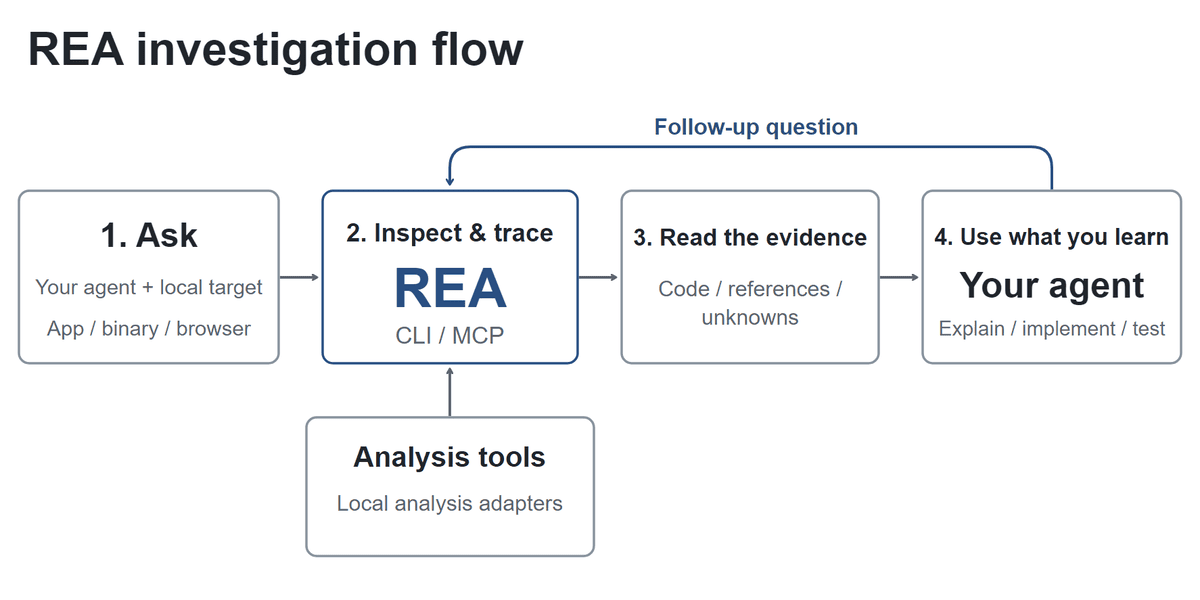
Traditionally, the practice of reverse engineering required highly specialized technical knowledge, deep familiarity with low-level programming, complicated debugging tools, and countless hours of tedious manual labor. REA attempts to democratize and accelerate this process by bridging the gap between modern AI coding agents—such as Claude Code, Codex, and Cursor—and established binary analysis tools like Ghidra, Hopper, and IDA Pro.
The workflow envisioned by the creators of REA is straightforward in its premise. A developer provides the binary file of a target application to the system, allowing an AI coding agent to analyze its underlying functions, dependencies, software architecture, and internal behavioral patterns without needing direct access to the original source code. Once the AI parses and explains these internal mechanics, developers can use those findings as a blueprint to reconstruct specific features or build independent work-alike alternatives.
Early experimenters within the open-source community have already begun testing the limits of this methodology. Documented use cases for REA include successfully reconstructing the complex clipboard functionality of Notion, recreating precise sound calculation routines from classic video games like DX-Ball, and recovering intricate mathematical algorithms from older PC-98 software systems.
The implications of applying these techniques to broader commercial software ecosystems are vast. While REA cannot magically generate a flawless, production-ready clone of a proprietary application with a single click, it drastically lowers the barrier to understanding how complex software is constructed. By making the architecture of existing programs legible to AI agents, REA empowers independent developers to recreate useful features and contribute modular alternatives to the open-source ecosystem.
ArtCraft Is Recreating Adobe and Microsoft Software Ecosystems
Beyond foundational toolkits like REA, individual developers are rolling up their sleeves and building actual application suites using modern AI assistants and systems programming languages like Rust. Among them, developer Brandon Thomas has drawn widespread attention for creating an ambitious collection of applications heavily inspired by the Adobe Creative Cloud ecosystem, built using tools like Claude.
The scope of this experimental ecosystem includes projects such as PhotoCraft, designed for Photoshop-style raster image editing, VectorCraft, aimed at replicating Illustrator-style vector graphics workflows, and FilmCraft, targeting Premiere-style video editing capabilities. When these projects were first introduced, the stated goal of achieving complete functional parity with Adobe’s flagship software within a single month was met with considerable skepticism from veteran software engineers.
Yet, the momentum behind these projects has continued to expand beyond creative suites into productivity software. The broader ArtCraft ecosystem has begun incorporating projects modeled after Microsoft Office applications, pushing the boundaries of what a single developer can conceptualize and prototype using generative AI assistance.
For many observers, the most striking aspect of this trend is not necessarily that these early clones rival established market leaders in every technical metric, but rather that a single individual can even attempt to construct multiple complex application suites in such a compressed timeframe.
What Are People Saying About This?
The rapid rise of AI-generated software clones has sparked vigorous debate across developer forums, social media platforms, and industry circles, generating a complex mix of excitement and skepticism.
Many software engineers and technology enthusiasts express genuine astonishment at how quickly the paradigm has shifted. The realization that individual creators can leverage AI agents to scaffold, prototype, and build complex applications that mimic enterprise-grade software has inspired a new wave of open-source participation. Content creators, designers, and everyday users are similarly intrigued by the prospect of accessing low-cost or free alternatives that do not force them to abandon familiar workflows or spend months retraining on entirely new user interfaces.
At the same time, veteran developers and enterprise software professionals urge caution, questioning whether these rapid, AI-assisted applications can truly match the rock-solid reliability, optimized performance, deep compatibility, and security standards of mature software platforms like Adobe Photoshop or Microsoft Excel. Early adopters and testers have frequently pointed out persistent bugs, missing edge-case features, and performance bottlenecks inherent in code generated largely by AI agents.
Despite these technical hurdles, the overarching enthusiasm is difficult to dismiss. The mere existence of these projects is prompting broader conversations among consumers about the sustainability and necessity of continuous software subscription models, especially when AI-driven alternatives begin to offer functional parity for a fraction of the cost or entirely for free.
Final Thoughts on the Future of Software Development
The most remarkable dimension of this entire movement is its sheer velocity. Projects like REA captured the imagination of the global developer community within days of their public release, accumulating staggering numbers of endorsements on collaborative coding platforms. This rapid adoption highlights a widespread appetite for tools that lower the barrier to software creation and analysis.
What began as isolated experiments with AI coding assistants has rapidly matured into a broader movement where independent developers and small teams are attempting to build sophisticated software that historically demanded years of coordinated corporate development and millions of dollars in capital investment.
This trend points toward a potential evolution in how software is owned and distributed. Rather than remaining locked into rigid subscription models managed by centralized corporate entities, users may increasingly find themselves with open, customizable alternatives that they can run, modify, and truly own. While these early software clones still face substantial challenges regarding reliability, cross-platform compatibility, and intellectual property considerations, they represent a clear warning shot across the bow of legacy software giants.
The true disruption facing established industry leaders may not come from traditional, radically different competitors, but rather from familiar-looking software that delivers the core functionality users rely on every day, removing the economic justification for perpetual subscriptions. As AI coding capabilities continue to advance, the software development landscape stands on the precipice of a profound transformation, with developers eager to see what will be built next.