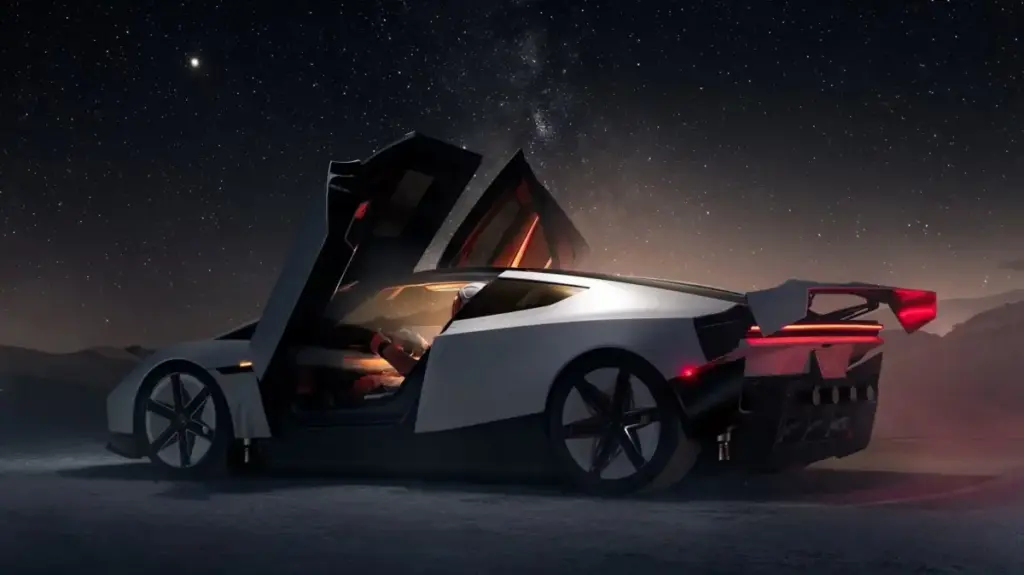
Tesla made a dramatic return to the spotlight this Thursday, staging a spectacle that seemed designed to remind the world of the company’s flair for the theatrical. At an October 15 event, the electric vehicle giant showcased its long-delayed, redesigned Roadster, punctuating the announcement with a stunt that felt ripped from a science-fiction blockbuster. With the help of a suction-equipped rig, the sports car navigated a C-shaped ramp until it was positioned completely upside down, before executing a controlled descent assisted by rocket boosters.
Beyond the pyrotechnics, Tesla provided concrete details on the vehicle’s future. The company is now targeting a 2028 production window—a timeline that CEO Elon Musk insisted is "for real." Furthermore, prospective buyers can now reserve the "Thrust" trim level, which features cold-gas thrusters, for a hefty deposit of $250,000. For those who have followed the saga of the second-generation Roadster, the announcement carried a distinct sense of déjà vu. This is far from the first time the company has unveiled the vehicle, and the lack of acknowledgment regarding its previous "re-announcements" has left many industry observers wondering whether this is another paper launch for a vehicle that has become an emblem of Tesla’s most notorious production hurdles.
To understand the weight of this announcement, one must look back to the original Roadster, which remains a milestone in the annals of electric vehicle history. Released in 2008, the first-generation model was the brainchild of Martin Eberhard, one of Tesla’s original founders. It was this specific project that piqued Elon Musk’s interest in the company back in 2004, leading to his initial investment. Musk went on to oversee the development of the car, which was famously built into the chassis of a Lotus Elise. At the time, the ability of a battery-powered vehicle to achieve 244 miles on a single charge was considered a revolutionary achievement, setting the stage for Tesla’s eventual dominance in the EV market.
The road to the current version of the Roadster has been significantly more complicated. The redesigned model was first unveiled in November 2017, with Musk promising a "hardcore smackdown to gasoline cars." That event, which also featured the debut of the Tesla Semi, set an initial production target for 2020. In February 2018, the narrative grew even more ambitious when Musk announced a "SpaceX" package, claiming the car would be equipped with roughly 10 small, seamlessly integrated rocket thrusters to enhance acceleration, cornering, and braking.
However, the 2020 target proved to be the first of many missed milestones. As Tesla continued to collect deposits ranging from $50,000 to $250,000, the production window slipped. During a July 2020 earnings call, Musk suggested production would begin within 12 to 18 months, citing the complexities of the global public health crisis as a contributing factor. During a subsequent appearance on the Joe Rogan Experience podcast, Musk revealed that his internal priorities had shifted, noting that he wanted to focus on the development of the Cybertruck first. While the Cybertruck eventually reached production after its own extensive delays, the Roadster remained conspicuously absent from the assembly line.
By early 2021, the promised delivery date had shifted to 2022, only to be pushed back to 2023 by the end of that year. Subsequent updates throughout 2023 and 2024 brought further delays, leaving reservation holders in a state of limbo. These years were tumultuous for the company and its CEO. Musk underwent a highly public transformation, moving from a self-styled environmentalist to a central figure in far-right political circles. This trajectory culminated in his leadership of the Department of Government Efficiency (DOGE) under President Donald Trump, a role that involved sweeping efforts to reduce the size and scope of the federal government.
The political polarization surrounding Musk during this period had tangible effects on the Tesla brand. A study published in The Lancet in July 2025 projected that the government spending cuts championed by Musk could have catastrophic long-term health consequences, leading to an estimated 14 million deaths by 2030. Although Musk vociferously disputed these findings, the reputational damage to Tesla was significant, fueling global protests against the company. By the time Musk stepped down from his government role in May 2025, the company was grappling with tanking sales, and reports of personal controversies—ranging from alleged substance abuse to family disputes—further clouded the corporate outlook. The Roadster, once a symbol of innovation, seemed to have fallen to the bottom of the billionaire’s priority list.
By April of this year, when Tesla once again recommitted to the Roadster’s launch, skepticism had hardened into cynicism. For many, the vehicle had become the subject of pop-cultural jokes, a perennial vaporware project that seemed destined to never reach the road. Prominent figures, including long-time Tesla supporters and tech personalities, began to speak out about their frustration. YouTuber Marques Brownlee, who has conducted multiple high-profile interviews with Musk, voiced his exasperation on the Waveform podcast in September 2025. "Tesla has been sitting with my 50 grand for eight years and hasn’t done anything with it," he noted, echoing the sentiments of many early depositors. Among the other high-profile individuals who had their capital tied up in the project was OpenAI CEO Sam Altman, who has also been a vocal critic of the delays.
The recent October event was undeniably impressive, showcasing a level of engineering ambition that few other companies could attempt. Yet, the industry remains wary. A launch event without a concrete delivery date is, by definition, an exercise in marketing rather than a milestone in manufacturing. As Tesla looks toward 2028, the company faces a dual challenge: it must overcome the logistical and production hurdles that have plagued the Roadster for nearly a decade, and it must repair its damaged relationship with a consumer base that has become increasingly weary of promises.
Ultimately, Tesla must convince its potential customers that a reservation for the Roadster is a sound investment rather than a leap of faith. The history of the company is replete with "hardcore" promises that often clash with the cold realities of automotive manufacturing. Whether the 2028 target represents a genuine shift in strategy or simply the latest chapter in a long-running saga of delays remains to be seen. For now, the Roadster remains a tantalizing glimpse of what might be, suspended in the same state of perpetual anticipation that has defined its existence since its first unveiling in 2017. As the company moves forward, the question remains: will the rocket-boosted sports car finally reach the boulevard, or will it remain a dream deferred, forever driving on the metaphorical highway of broken promises?