









The question of whether organizations should deploy open source or proprietary large language models carries a significantly different weight than it did eighteen months ago. As the capability gap between open-weight alternatives and closed commercial models continues to narrow, decision-makers face a shifting landscape where raw benchmark scores no longer dictate the outcome. Instead, cost dynamics increasingly favor open models at scale, while proprietary application programming interfaces maintain an advantage for low-volume workloads and rapid prototyping. For data scientists and machine learning engineers operating in production environments, practical constraints such as data privacy, fine-tuning requirements, infrastructure capacity, and regulatory compliance now outweigh theoretical performance metrics.
Industry specialists argue that neither category represents a universal solution. Both open-weight and proprietary models enjoy widespread deployment across enterprise production systems, each serving distinct operational needs. Rather than following online commentary or chasing the latest leaderboard rankings, engineering teams are adopting structured decision frameworks grounded in specific organizational requirements. These operational assessments typically center on data sensitivity, usage volume, customization demands, and existing infrastructure capabilities. Working through these core factors allows technical leaders to resolve the open-versus-proprietary debate for the vast majority of real-world use cases.
Understanding the Current Model Families
To navigate the 2026 ecosystem, organizations must first understand the composition of both model categories. In the context of large language models, the term "open source" generally refers to open-weight availability. While model weights are made publicly accessible, the underlying training data, proprietary code, and training methodologies are frequently withheld. Furthermore, licensing terms vary significantly across providers, with some distributions failing to meet the formal definition established by the Open Source Initiative.
The open-weight landscape is anchored by several influential model families. Meta’s Llama 4 series continues to shape enterprise adoption, highlighted by variants such as Llama 4 Scout, which features a ten-million-token context window that facilitates advanced long-document analysis. Similarly, DeepSeek has emerged as a major provider, with its V3 and reasoning-focused R1 models performing competitively against frontier systems on complex logical, mathematical, and coding tasks. Alibaba’s Qwen 3.5 series has also climbed to the top of open-weight leaderboards, offering robust multilingual capabilities and mixture-of-architecture variants that rival proprietary counterparts under commercial Apache 2.0 licensing. European providers like Mistral AI deliver efficient models that align with stringent regional data governance frameworks, including GDPR compliance requirements.
Conversely, proprietary models are accessed exclusively through managed application programming interfaces, leaving infrastructure maintenance, updates, and scaling entirely in the hands of the provider. Leading proprietary offerings include OpenAI’s GPT-5 series, Anthropic’s Claude models, and Google’s Gemini systems. Each proprietary ecosystem offers distinct advantages, such as Claude’s extensive context window for document evaluation, GPT-5’s deep integration with developer tooling and structured output formats, and Gemini’s native compatibility with Google Cloud and Vertex AI infrastructure.
Pricing structures for proprietary application programming interfaces have experienced a dramatic downward trend, dropping roughly eighty percent since early 2023 due to intense market competition and infrastructural efficiencies. While mid-tier proprietary models commonly run between modest rates per million input tokens, frontier models still command a notable price premium over equivalent open-weight models accessed via hosted inference providers.
The Performance Reality and Operational Gaps
Evaluating the performance reality reveals that open-weight models have closed seventy to ninety percent of the capability gap with frontier proprietary systems across standard benchmarks. On targeted tasks such as code generation, structured data extraction, and information retrieval, leading open-weight solutions frequently match or exceed their closed competitors. Persistent gaps remain primarily in complex multi-step reasoning, instruction-following consistency at scale, and performance within low-resource linguistic environments.
For approximately eighty percent of standard data science workloads—including text classification, summarization, retrieval-augmented generation, and basic code assistance—open-weight models deliver results that are functionally indistinguishable from proprietary application programming interfaces. For the remaining twenty percent, which involves complex agentic workflows or high-stakes output reliability, proprietary frontier models retain a measurable advantage. Consequently, engineering teams are encouraged to evaluate models against production-specific tasks rather than relying on generalized public benchmarks.
The Four-Question Decision Framework
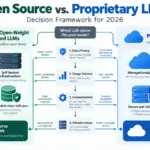
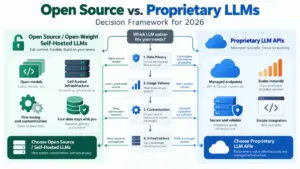
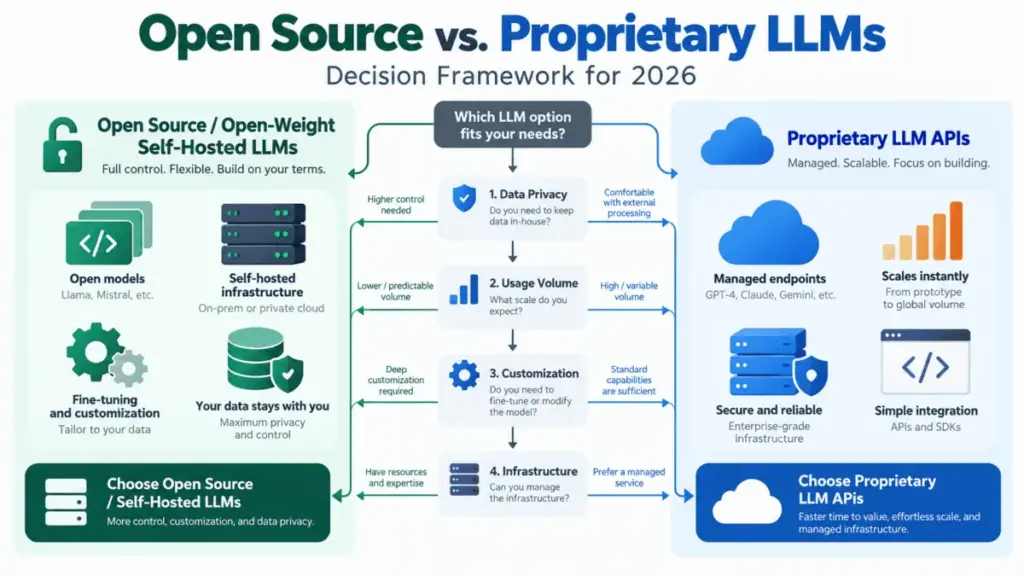
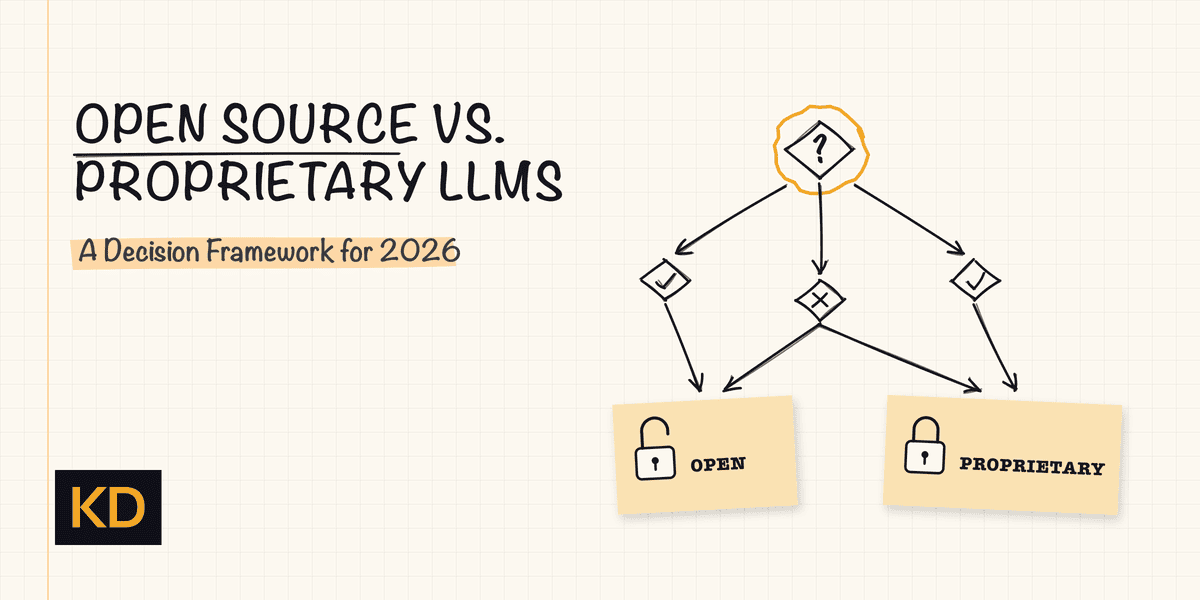
Determining the appropriate model architecture relies on four foundational questions regarding data, volume, customization, and infrastructure.
Data sensitivity frequently settles the debate before cost or capability are considered. Use cases involving sensitive information—such as medical records governed by healthcare regulations, personal financial data, confidential corporate research under nondisclosure agreements, or government intelligence—often require complete data isolation. When regulatory frameworks prohibit data from leaving a secure corporate environment, open-weight self-hosting or private cloud deployment becomes a strict requirement rather than an optional optimization.
When data can safely traverse third-party networks, usage volume dictates the economic viability of each approach. At low volumes under one million tokens per month, proprietary application programming interfaces remain cost-effective by avoiding the engineering overhead and hardware provisioning costs associated with running custom serving stacks. At medium volumes ranging between one and ten million tokens, hosted open-weight inference providers offer a balanced middle ground, delivering open-weight pricing advantages without infrastructure management burdens. At high scales exceeding ten million tokens per month, self-hosted open-weight models deployed on dedicated graphics processing infrastructure achieve substantial cost reductions compared to continuous application programming interface consumption.
Customization needs also divide the two paradigms. When applications demand domain-specific adaptation for specialized clinical, financial, or legal terminology, open-weight models provide structural advantages through flexible fine-tuning. Organizations can train models on proprietary datasets, iterate freely, and retain permanent ownership of the resulting weights without recurring usage fees. While some proprietary providers offer fine-tuning services, the resulting models remain bound to their respective ecosystems, restricting ownership and raising potential compliance complications.
Finally, internal infrastructure capacity determines whether self-hosting is feasible. Operating production-grade open-weight models requires specialized serving tools, hardware provisioning expertise, security hardening, and continuous monitoring. For teams lacking dedicated machine learning operations personnel, the total cost of ownership for self-hosting can surpass external application programming interface expenses, reinforcing the utility of managed open-model hosting services.
Practical Considerations and Enterprise Adoption
Beyond core architectural choices, organizations must navigate additional operational factors, including vendor lock-in risks, ongoing price compression, and licensing variations. Building overly dependent integrations around a single proprietary platform can create prohibitive switching costs, prompting architectural strategies that maintain model-agnostic prompt designs and pluggable inference layers. Furthermore, software licenses associated with open weights require careful legal review prior to commercial deployment, as terms differ significantly between permissive licenses and restrictive community agreements.
Ultimately, many enterprises are turning toward hybrid operational strategies. Organizations frequently leverage proprietary application programming interfaces for early-stage prototyping and rapid iteration, while routing high-volume or privacy-sensitive workloads to optimized open-weight models. By aligning model selection with precise operational constraints rather than fleeting industry trends, data science teams can achieve sustainable, cost-effective artificial intelligence deployments in production environments.