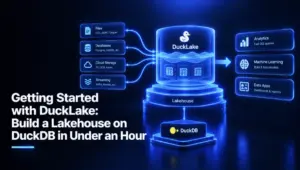







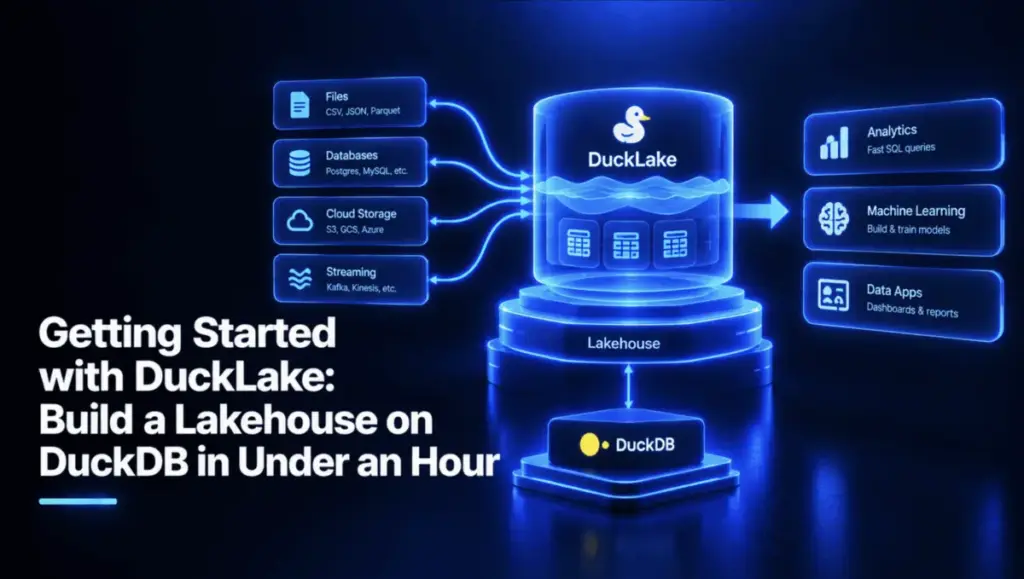
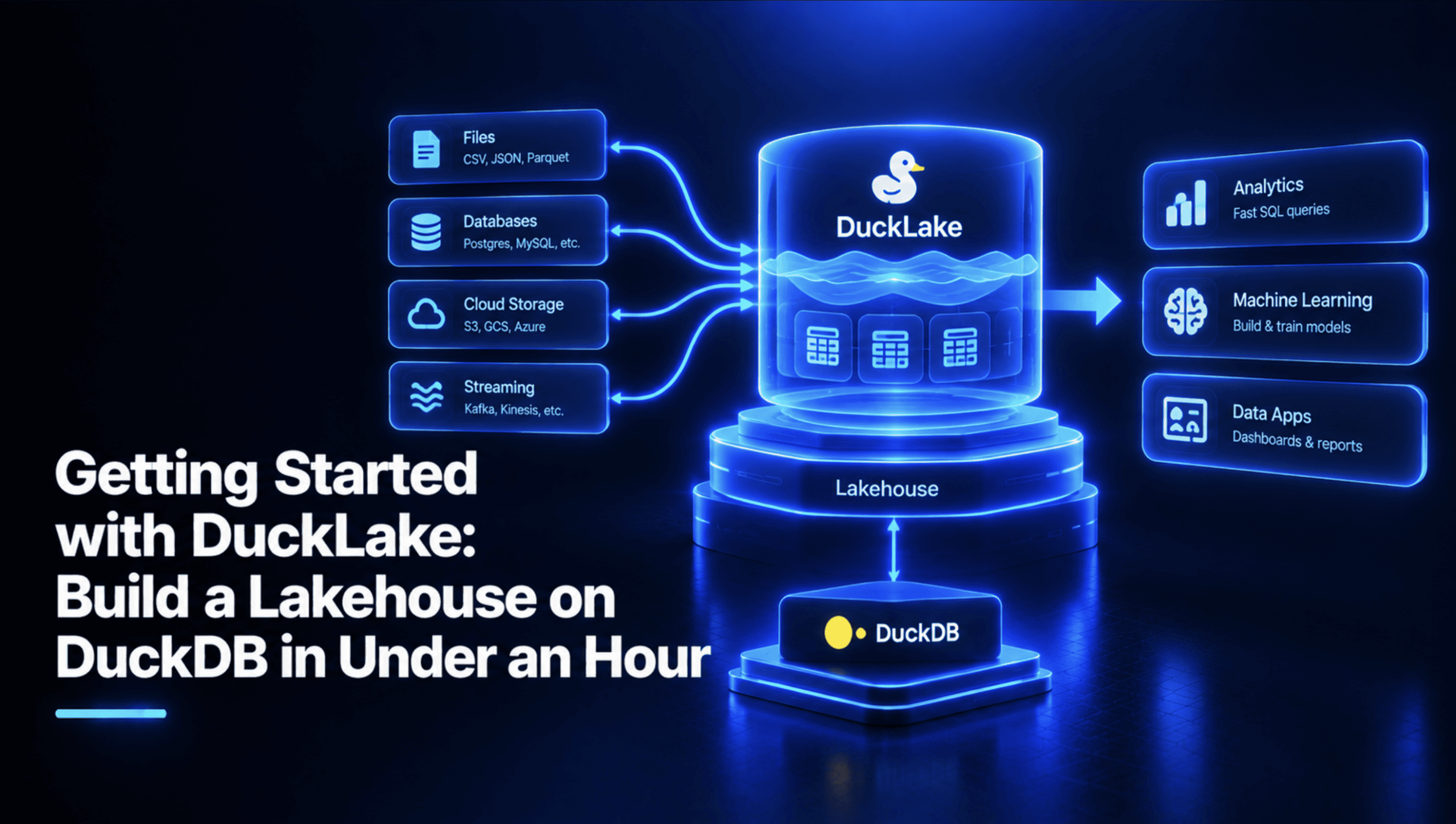
The development team behind DuckDB has officially introduced DuckLake, an open lakehouse table format designed to streamline data architecture by separating table metadata from storage. Released in April 2026 alongside version 1.0 with a stable specification and a guarantee of backward compatibility, DuckLake allows engineers and data practitioners to build a fully functional lakehouse directly on a local laptop or scale it out to a multi-user server environment. By decoupling the storage layer from the metadata catalog, DuckLake provides a lightweight alternative
to traditional lakehouse formats by leveraging standard SQL databases for tracking table schemas, snapshots, and file statistics, while keeping the underlying data stored securely in Apache Parquet files.
The core architecture of DuckLake relies on a two-tier design. The actual data resides in Parquet files located within a designated folder or object storage bucket, whereas all operational metadata—such as active table lists, schemas, historical snapshots, and file-level metrics—is managed by a catalog database. Unlike other prominent open-source lakehouse formats like Apache Iceberg or Delta Lake, which often track this information across a complex web of metadata files, DuckLake delegates catalog responsibilities to any standard SQL database capable of supporting ACID transactions and primary key constraints. This design choice means that identifying and retrieving the correct data files for any given query can be accomplished through a straightforward SQL operation.
To accommodate different operational scales and performance requirements, the DuckLake documentation outlines specific catalog recommendations based on deployment patterns. For a single client or local development, DuckDB itself serves as the catalog database. For environments requiring multiple local clients, SQLite provides a reliable option, while PostgreSQL is recommended for full multi-user production lakehouses. Similar to other modern lakehouse formats, DuckLake does not enforce constraints such as indexes, primary keys, foreign keys, or unique and check constraints directly within the format specification, prioritizing write flexibility and performance instead.
Adopting DuckLake requires DuckDB version 1.5.2 or newer, alongside a standard Python environment to execute database operations and manage data loads. Upon initial initialization, the system automatically fetches the necessary DuckLake extension, enabling users to transition from raw files to a structured lakehouse environment with minimal configuration. Within this framework, creating a lakehouse begins with ingesting raw Parquet files—such as simulated multi-month transactional records containing order IDs, dates, regional classifications, fulfillment statuses, and monetary amounts. Once ingested into the lake via a standard table creation query, the system generates a snapshot that records the structural state of the data at that precise moment.
As data workflows evolve, DuckLake handles updates, schema modifications, and data appends by generating sequential snapshots rather than destructively overwriting existing files. When users append new periods of data, such as subsequent months of transactional records, or execute update statements to modify the status of existing entries, the underlying mechanics treat updates as a combination of deletions and insertions. Old rows are effectively masked by delete files, while updated versions are written as new data. Furthermore, schema evolutions—including the addition of new columns or the renaming of existing fields—are executed as metadata operations, meaning historical Parquet files remain intact while the catalog dynamically maps them to the updated table structure.
One of the defining capabilities of this architecture is built-in time travel, which allows analysts to query historical states of the data simply by referencing past snapshot versions or timestamps. Because every write operation, schema adjustment, and maintenance routine leaves a distinct audit trail in the catalog, users can seamlessly inspect historical data distributions or recover from inadvertent data deletions by restoring previous states from the historical record. This historical tracking eliminates the need for separate backup procedures for minor operational errors, providing a reproducible timeline of database states.
Maintenance operations are similarly integrated into the workflow to manage storage efficiency over time. Because frequent writes and updates generate numerous small adjacent files, DuckLake provides native routines to merge neighboring files that share a common schema version into larger, more optimized storage blocks. However, because time travel functionality relies on historical data files, the system intentionally preserves old data files until administrators explicitly expire older snapshots and execute cleanup procedures. To optimize local storage without sacrificing history, data inlining features handle tiny writes directly within the catalog before flushing them out to Parquet storage during routine maintenance cycles.
As the ecosystem matures, the roadmap for future iterations points toward advanced collaboration and performance features. Discussions surrounding potential future releases include git-like branching models and incremental materialized views, which could further bridge the gap between traditional software development workflows and analytical data engineering. Meanwhile, the broader ecosystem surrounding DuckDB continues to evolve, with institutional developments positioning the technology for broader integration across cloud and remote storage infrastructures. For data practitioners, DuckLake offers a streamlined pathway to establish robust lakehouse patterns using familiar SQL syntax and lightweight infrastructure, providing a scalable bridge from local experimentation to distributed enterprise deployments.