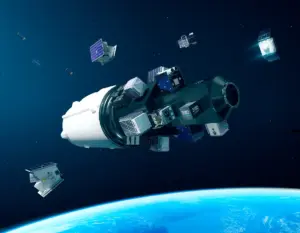










Nigrán, Spain — In a historic milestone for Spain’s rapidly growing aerospace sector, space logistics pioneer UARX Space has successfully achieved the deployment of OSSIE-D, a state-of-the-art Orbital Transfer Vehicle (OTV) designed, engineered, and manufactured entirely on Spanish soil. Launched into low Earth orbit aboard a SpaceX Falcon 9 rocket, the spacecraft represents a watershed moment for European in-space transportation, showcasing the country’s deepening capabilities in complex orbital operations and spacecraft manufacturing.
The mission achieved a notable world first by seamlessly combining an advanced orbital transfer vehicle with a proprietary separation system developed by the exact same company. OSSIE-D was successfully released into space using SAU&RON 24, UARX Space’s custom-built separation mechanism. This technological synergy highlights UARX Space’s fully integrated approach to space logistics, spanning both the design and construction of the vehicle itself and the critical deployment technology required to place it safely and precisely into its intended orbit.
This achievement marks a significant leap forward for Spain’s national space strategy, demonstrating that the country’s aerospace ecosystem possesses the sophisticated engineering and manufacturing competencies required to design, integrate, and execute complex missions on the global stage. By mastering both the transport vehicle and the deployment architecture, UARX Space has positioned itself as a competitive player in the rapidly expanding commercial in-space transportation market.

A Collaborative Triumph Across the European Space Sector
While UARX Space led the overarching architecture and development of the OTV and its deployment systems, the OSSIE-D mission is equally a testament to the power of targeted industrial collaboration within the broader European space community. To fulfill the mission’s stringent energy demands, UARX Space partnered with DHV Technology, another prominent Spanish aerospace firm specializing in advanced space power systems.
DHV Technology was tasked with designing, qualifying, and manufacturing the complete electrical power subsystem for the OSSIE-D vehicle. This comprehensive scope included the spacecraft’s advanced solar arrays, the Power Conditioning and Distribution Unit (PCDU), main battery modules, the Solar Array Drive Assembly (SADA), and several essential supporting subsystems designed to guarantee uninterrupted power throughout the mission lifecycle.
Dr. Andrés Villa, Chief Technology Officer and Co-Founder of UARX Space, emphasized the strategic importance of this partnership during a statement following the successful launch.
"OSSIE-D represents a milestone for the Spanish aerospace industry and shows how collaboration between companies with complementary capabilities can turn ambitious missions into reality," said Dr. Villa. "DHV Technology has been a key partner, with its expertise, highly reliable solutions, and team commitment making a significant contribution to the mission’s energy capabilities. This partnership also highlights the potential of the Spanish space sector to innovate and compete at both European and global level."
Nominal Operations Confirm Engineering Excellence

Following its separation from the SpaceX Falcon 9 launch vehicle, DHV Technology’s electrical power subsystem immediately began operating nominally in orbit. Initial telemetry data downlinked to mission controllers confirmed that every facet of the power architecture was performing exactly as anticipated.
The successful activation began with the immediate generation of solar power by the deployed arrays, followed by the seamless control and distribution of electricity managed by the PCDU, and safe energy storage within the primary battery modules. This flawless orbital activation represents a major engineering triumph for DHV Technology’s technical teams and serves as a critical bedrock for the overall success of the OSSIE-D mission.
Dr. Vicente Díaz, Managing Director and Co-Founder of DHV Technology, expressed immense pride in the performance of his engineering team and the strength of the cross-company partnership.
"Seeing the full electrical power subsystem fully developed by DHV for OSSIE-D operating as expected in orbit is an important milestone for our team and for our collaboration with UARX Space," said Dr. Díaz. "This achievement reflects the close cooperation between both engineering teams and the work invested throughout the design, manufacturing, testing, and integration phases. We are proud to contribute to this mission and look forward to OSSIE-D continuing to deliver positive results for UARX Space and all the partners involved."
Testing Next-Generation Technologies in Real Space Conditions
Beyond fulfilling its primary role as the lifeblood of the OTV, DHV Technology is utilizing the OSSIE-D mission as an active orbital testbed to evaluate several innovative technological concepts. By deploying advanced hardware directly into the harsh environment of space, the company aims to significantly accelerate the technological maturity and readiness level of its upcoming product lines.
The data and operational insights gathered during the OSSIE-D mission will validate novel electrical interconnection methods, highly efficient solar panel deployment mechanisms, advanced hinge systems, and next-generation photovoltaic technologies. This dual-purpose mission architecture ensures that the value of OSSIE-D extends far beyond its immediate commercial and operational objectives, creating a lasting technological legacy that will inform and improve future space endeavors.
The close synergy between UARX Space and DHV Technology underscores an evolving industry trend wherein specialized engineering firms must work in lockstep to tackle increasingly sophisticated space missions. While UARX Space continues to pioneer advancements in orbital transfer logistics and deployment mechanisms, DHV Technology’s robust power solutions provide the vital energy backbone required to sustain these complex operations while simultaneously pushing the boundaries of material and electrical science in orbit.
Ultimately, the successful deployment and ongoing operation of OSSIE-D signal a transformative period for the Spanish space industry. By uniting an independently developed OTV, a proprietary separation system, and a comprehensive homegrown electrical power subsystem, the mission provides concrete proof of Spain’s growing capacity to conceptualize, build, and execute highly complex technological projects that meet the rigorous standards of the modern global space economy.