









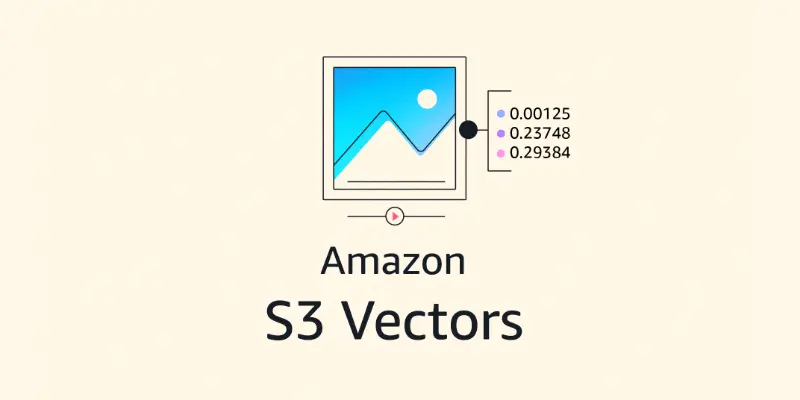
Amazon has officially announced a significant enhancement to its Amazon S3 Vectors service with the introduction of metadata pre-filtering. This new capability is designed to drastically improve the recall performance of filtered queries by ensuring that metadata constraints are evaluated before the execution of similarity searches. By allowing developers to refine their search scope—such as filtering by tenant, document category, operational status, or timestamps—before the vector search engine scans the index, the update ensures that results are more relevant and comprehensive. This release also introduces support for prefix matching via the $startsWith operator, offering greater flexibility for hierarchical data, URLs, and file paths.
The update, which is available now across all commercial AWS Regions and AWS China Regions, comes at no additional cost and requires no re-ingestion of data. Existing applications can leverage these improvements immediately, marking a pivotal shift in how S3 Vectors handles complex, multi-tenant, and large-scale semantic search workloads.
The Problem with Traditional Filtering
In the current landscape of AI-driven applications, including Retrieval-Augmented Generation (RAG) pipelines and sophisticated agentic systems, the ability to search within a specific scope is paramount. Most modern applications do not perform a blanket search across an entire database. Instead, they operate within a defined boundary—such as a specific user’s documents, a particular account’s history, or a specialized category of data. In standard indexing models, these boundaries are often enforced through post-filtering, where the vector similarity search is performed first, and the results are then filtered down to match the user’s criteria.
This traditional "CLASSIC" approach often leads to reduced recall. When the vector engine searches the entire index for the most similar items, it may inadvertently discard highly relevant items that fall outside the top-k results during the initial vector pass, only to have them filtered out later by the metadata constraints. By the time the filter is applied, the "pool" of potential matches has been significantly depleted.
The new pre-filtering approach, referred to as the "ENHANCED" index mode, fundamentally changes this flow. By resolving the metadata filter before the similarity search, S3 Vectors focuses the search entirely on the subset of data that is relevant to the user. This ensures that the similarity search identifies the absolute best matches within the required scope, rather than selecting the best matches from the entire dataset and filtering them after the fact. This simple shift in logic can result in up to five times more relevant matches for highly selective filters compared to previous methods.
Technical Implementation and Flexibility
Amazon has designed this feature to be seamlessly integrated into existing S3 Vectors workflows. Each vector in an index can now carry up to 2 KB of filterable, application-defined metadata. This metadata can be used to store critical attributes such as tenant_id, category, created_date, or boolean flags indicating the status of a document.
One of the most notable aspects of this update is the simplicity of the query structure. The system utilizes a compact JSON syntax that allows developers to combine various conditions using logical operators such as $and, $or, and $gt (greater than). Furthermore, the introduction of the $startsWith operator provides a powerful mechanism for managing hierarchical data. For example, a document management system that encodes file paths or URL structures directly into a document ID can now easily scope a search to a specific folder or subtree.
The transition to this enhanced model is handled through an update to the index mode. For users with existing infrastructure, calling the UpdateIndexMode function transforms the index from CLASSIC to ENHANCED without the need for re-ingesting data. This "in-place" update ensures that developers can modernize their applications without incurring the downtime or overhead typically associated with migrating large-scale vector indexes. Once updated, the system immediately begins applying the pre-filtering logic to all incoming queries, ensuring that existing applications gain an instant boost in retrieval accuracy.
Operational Efficiency and Real-World Impact
To understand the impact of this change, consider the scenario of a large-scale support knowledge base containing eight million tickets. In a traditional system, an agent searching for a specific customer’s history might find that the results are dominated by unrelated tickets from the broader database, with the relevant customer-specific entries pushed out of the top results. If that customer accounts for only 400 of the eight million records, the previous "CLASSIC" search might have failed to surface the most relevant past occurrences.
With pre-filtering, the query first isolates the 400 tickets belonging to that specific customer_id. The similarity search is then conducted exclusively within that refined subset. The result is a significantly higher rate of recall, as the agent is presented with the most semantically relevant items that actually pertain to the specific customer in question.
This level of precision is essential for modern RAG applications. As these systems move from prototypes to production, the expectation for data isolation—particularly in multi-tenant environments—becomes a strict requirement. The ability to guarantee that a user only sees results from their own data, while maintaining high semantic search quality, is a critical hurdle that this update effectively clears.
Deployment and Future-Proofing
For organizations looking to scale this approach across their entire infrastructure, Amazon has provided a straightforward pathway. Once a team has validated the performance of pre-filtering on a test index, they can configure the default index mode for their entire vector bucket. This ensures that all newly created indexes will automatically adopt the ENHANCED mode, preventing the need for subsequent configuration updates.
The administrative overhead is intentionally kept to a minimum. Developers can list their existing indexes, verify their current modes, and apply the update to any remaining CLASSIC indexes using the UpdateIndexMode API. This gives engineering teams granular control over their transition, allowing for a phased rollout that minimizes risk while maximizing the utility of their existing vector assets.
The new feature is currently available globally, including in the AWS China Regions, and follows standard S3 Vectors pricing models. By keeping the pricing structure consistent with existing storage, PUT requests, and query operations, AWS has ensured that the performance gains offered by pre-filtering are accessible to all users without the complexity of new cost tiers.
As semantic search and generative AI continue to evolve, the underlying infrastructure must support both depth and precision. With the introduction of metadata pre-filtering, Amazon S3 Vectors has provided a robust solution for developers who need to bridge the gap between high-dimensional vector similarity and the rigid requirements of structured metadata filtering. Whether narrowing down a vast product catalog, scoping a legal document search, or securing multi-tenant AI agents, the enhanced filtering capability offers a streamlined, efficient, and highly effective way to improve search outcomes across the board. The update is available for immediate use through the standard AWS command-line interfaces and SDKs, providing developers with the tools to refine their search logic and deliver better, more accurate results to their end users.