Artificial intelligence is fundamentally reshaping how defense, intelligence, and commercial organizations collect, process, and exploit satellite imagery. As the global volume of Earth observation data grows exponentially day by day, advanced computing has transitioned from a supplementary tool into an absolute necessity. Intelligence agencies and commercial operators alike rely on machine learning to rapidly identify critical patterns, detect subtle anomalies on the ground, and deliver actionable intelligence at operational speed.
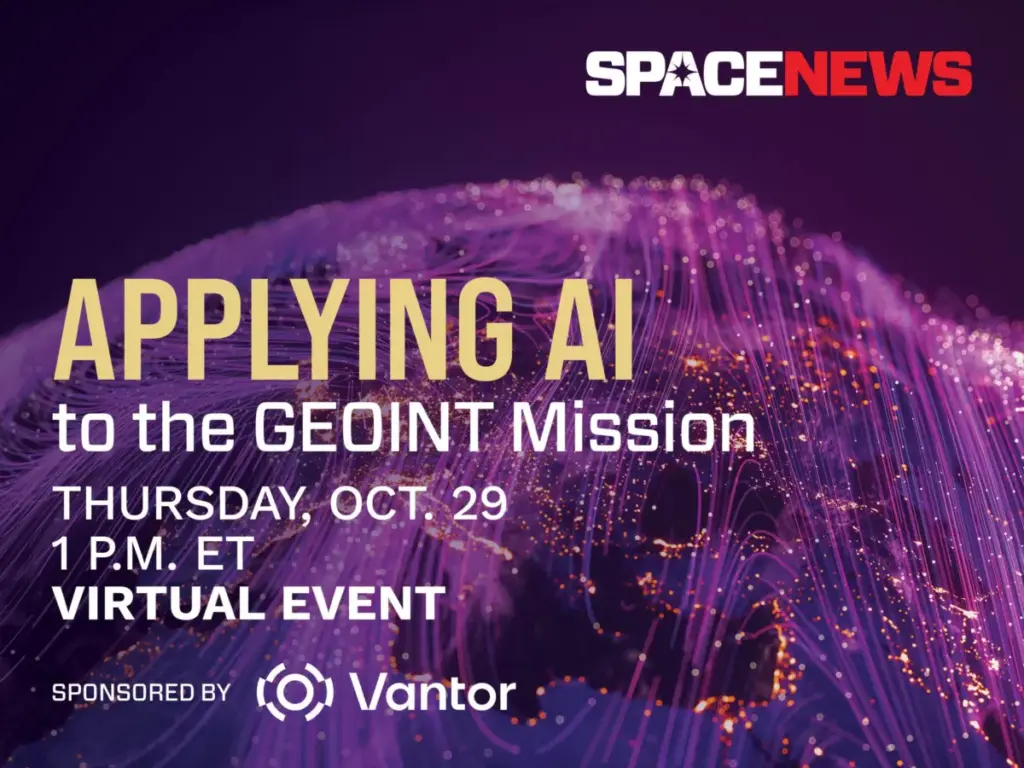
To explore this critical evolution in modern defense and reconnaissance, SpaceNews and Vantor are teaming up to host a comprehensive virtual event on Thursday, October 29. Titled "Applying AI to the GEOINT Mission," the 45-minute briefing will examine how machine learning technologies are actively transforming geospatial intelligence across multiple sectors.
The virtual event is scheduled to take place from 1 to 1:45 p.m. Eastern Time via Zoom. Industry professionals, defense analysts, and technology developers interested in attending can secure their access through the official registration process provided by SpaceNews, with a recording of the session made publicly available shortly after the broadcast concludes.
Transforming the Geospatial Intelligence Mission
The upcoming discussion comes at a time of profound technological transition within the intelligence community. Traditional methods of manual imagery analysis, where human analysts painstakingly review hours of video or thousands of static photographs, can no longer keep pace with the massive influx of data streaming down from modern satellite constellations.

During the October 29 event, participating speakers and industry experts will dive deep into the specific technological breakthroughs driving this shift. Key discussion topics will include recent advancements in automated target recognition, advanced change detection algorithms, multimodal data fusion, and the integration of large language models into intelligence workflows.
However, the conversation will not focus solely on technological capabilities. The panel is also expected to tackle some of the most pressing challenges facing the adoption of machine learning in high-stakes environments. Among these hurdles are the complex task of rigorously validating AI outputs to prevent errors, the ongoing challenge of maintaining and building analyst trust in automated systems, and the operational balance between algorithmic efficiency and human judgment.
Organizers note that the session will carefully evaluate where artificial intelligence delivers its absolute greatest operational value, where human expertise remains entirely indispensable, and how intelligence organizations can successfully adapt to an era defined by persistent, data-driven surveillance.
The Role of Modern Spatial Intelligence
The virtual event is sponsored by Vantor, a company focused on forging the new frontier of spatial intelligence to unlock a more autonomous and interoperable world. Vantor’s work centers on providing decision-makers and frontline operators with the power to build a unified intelligence picture, granting them the clarity required to navigate rapidly unfolding events and anticipate future developments.

Vantor achieves this by fusing data from its proprietary constellation—which includes some of the most capable imaging satellites currently operating in orbit—with real-time sensor feeds gathered from space, air, and ground assets. This comprehensive data integration is designed to create an AI-ready digital twin of the Earth.
The company’s spatial intelligence platform is engineered to automate every single phase of the intelligence cycle, spanning from initial tasking to data collection and final production. By streamlining these steps, the platform updates and analyzes its foundational earth model at the pace of modern global change. These products are ultimately designed to drive deeper, mission-critical insights and seamlessly connect the next generation of autonomous systems across the defense, intelligence, and commercial landscapes.
As global demand for rapid, accurate geospatial intelligence intensifies, events like the upcoming SpaceNews and Vantor collaboration provide a vital forum for stakeholders to discuss the future of intelligence operations. Registration for the October 29 virtual event is currently open, offering participants a front-row seat to the conversation shaping the next era of Earth observation and defense technology.