











When tech reviewers talk about high-end home climate control, brands like Dyson immediately come to mind for their futuristic, bladeless designs and hefty price tags. However, Japanese home appliance manufacturer Balmuda has long carved out its own niche by focusing on understated quality, minimalist aesthetics, and meticulous engineering. Recently, home technology reviewers have turned their attention to the Balmuda NatureWind Studio, a standing fan that commands a steep $429 price point, positioning it squarely in the luxury tier of household cooling devices.
After spending weeks testing the standing fan following a comprehensive round of evaluations for traditional tower fans, reviewers have found that the Balmuda NatureWind Studio is a surprisingly worthwhile investment for consumers who prioritize design and natural airflow over smart connectivity and multi-functional gimmicks. While the market is flooded with affordable plastic alternatives and feature-heavy smart fans, the Balmuda offering takes a deliberately paired-down approach to beat the heat during the next summer heat wave.

Balmuda’s Unconventionally Conventional Design

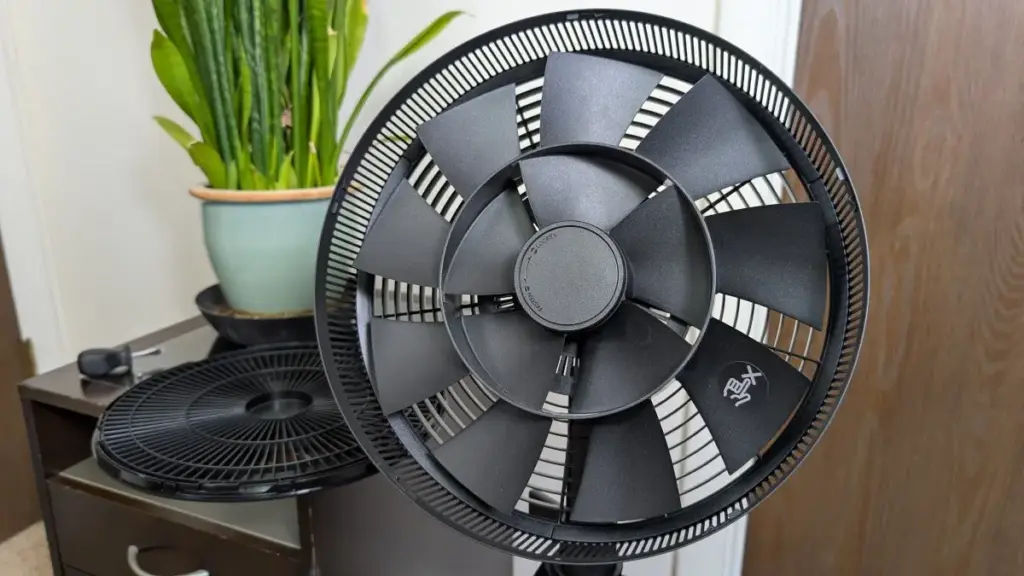
Standing at roughly 3 feet tall, the Balmuda NatureWind Studio is notably shorter than many standard office tower fans on the market. Its construction relies heavily on a mix of premium metal components and selected high-grade plastics, giving the hardware a sturdy, well-balanced feel that avoids any impression of flimsiness. Unlike many modern tower fans that arrive fully assembled in massive, awkward boxes, the Balmuda unit requires a modest amount of assembly straight out of the box.
The unboxing and setup process reveals a thoughtful attention to user experience. The setup instructions feature clear, direct language printed in a larger typeface than typically found in consumer electronics manuals, ensuring accessibility for users with vision impairments. Assembly is completely tool-free and intuitive, allowing a user to go from box to fully operational fan in roughly 10 minutes while minimizing packaging waste.

At the core of the fan’s cooling capability is an unconventional dual-blade design. The mechanism features an inner ring comprising five blades paired with an outer ring of nine blades. According to Balmuda, these two distinct sets of blades generate airflow patterns that deliberately interfere with one another. This mechanical interaction breaks up the typical uniform vortex produced by single-blade fans, resulting in an irregular, randomized breeze that closely mimics the feeling of a natural wind outdoors. Evaluators note that this design delivers a superior sensation at every speed compared to the programmed electronic breeze modes found on competing fans, which typically rely on abrupt motor speed fluctuations.
Another standout design element is the power cord. Crafted with a flexible woven fabric outer casing, the cord resists kinking and moves smoothly across surfaces. It also includes a simple hook for managing excess length and can be detached entirely from the unit, simplifying storage and tidiness.
Minimalist Controls and Innovative Oscillation

True to its minimalist philosophy, the Balmuda NatureWind Studio omits several features common on modern appliances, most notably a dedicated remote control. All operations are handled exclusively via a clean set of physical buttons located on top of the motor casing. The user interface provides a standard timer ranging from one to four hours, five distinct speed settings, and an adjustable oscillation mode. To safeguard the motor from continuous wear, the device also includes an unalterable 18-hour auto-off safety feature.
While four of the five speeds are easily accessible via standard button taps, the maximum jet mode requires the user to hold the speed button down. Because this mode generates substantial velocity and output, Balmuda intentionally disables the oscillation function while jet mode is engaged to maintain structural stability.
The standout mechanical feature of the fan is its completely manual, infinitely adjustable oscillation system. Rather than relying on preset angles or digital buttons to dictate the sweep range, users simply turn on the oscillation mode, physically rotate the fan head to one side until an audible beep confirms the boundary, and then turn it to the opposite side until a second beep registers. This allows the user to define a precise custom arc tailored to their exact seating arrangement in a room. The fan head can also be tilted vertically up or down to direct airflow, though this vertical adjustment uses a fixed manual angle rather than automated movement.

Performance and Efficiency in Real-World Testing
When put through standardized airflow and energy efficiency benchmarks, the Balmuda NatureWind Studio earns a respectable 8 out of 10 score, placing it on par with premium offerings from brands like Dreame, Dyson, and OmniBreeze. While the score reflects deductions for the high retail price, the absence of a remote control, and noticeable operational noise at higher speeds, the core performance remains exceptionally strong.
The fan delivers robust airflow paired with impressive energy efficiency. However, testers note that running the unit at its upper limits does generate audible sound levels, a trade-off common among high-velocity air circulators. Despite these minor drawbacks, the efficiency of the dual-blade system ensures that lower and medium speeds deliver ample cooling power while remaining remarkably quiet.

Evaluating the Value Proposition
For consumers with room in their budgets, the Balmuda NatureWind Studio represents a masterclass in minimalist product design. It demonstrates that household appliances can be highly functional and aesthetically pleasing without being weighed down by superfluous features, smartphone apps, or complex digital displays. Furthermore, reviewers have noted that the absence of a remote control rarely proves inconvenient in practice, given how easily the physical top-mounted controls and intuitive manual oscillation can be managed from across a room.
Nevertheless, the high price point means the fan is not intended for budget-conscious shoppers. Consumers seeking economical ways to combat warm weather can find alternatives such as the Vornado Strata Omni, which can cost a fraction of the Balmuda’s price depending on retail promotions. For design-conscious buyers searching for an authentic breeze simulator backed by solid engineering, however, the Balmuda NatureWind Studio offers a compelling, albeit expensive, alternative to traditional cooling towers.