









The global financial landscape is currently defined by a striking disconnect. While the bedrock of the international financial system—the U.S. Treasury market—is experiencing its most significant turbulence in months, the risk-on assets that typically recoil from such instability, namely bitcoin and the S&P 500, remain remarkably serene. This divergence has left market analysts and institutional investors closely monitoring whether the calm in equity and crypto markets is a sign of resilient underlying strength or merely a delayed reaction to a tightening macroeconomic environment.
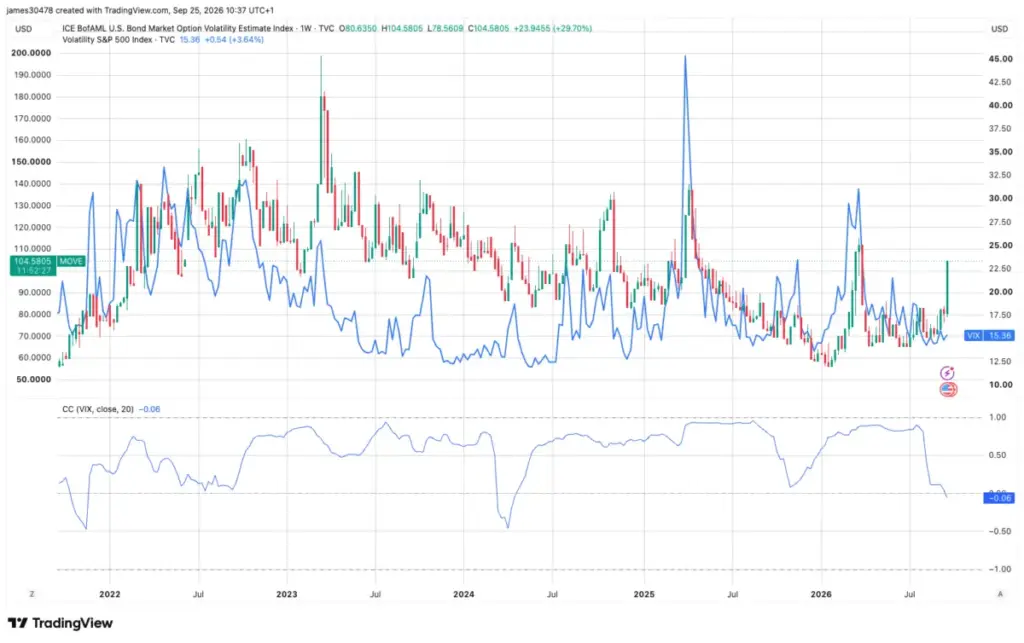
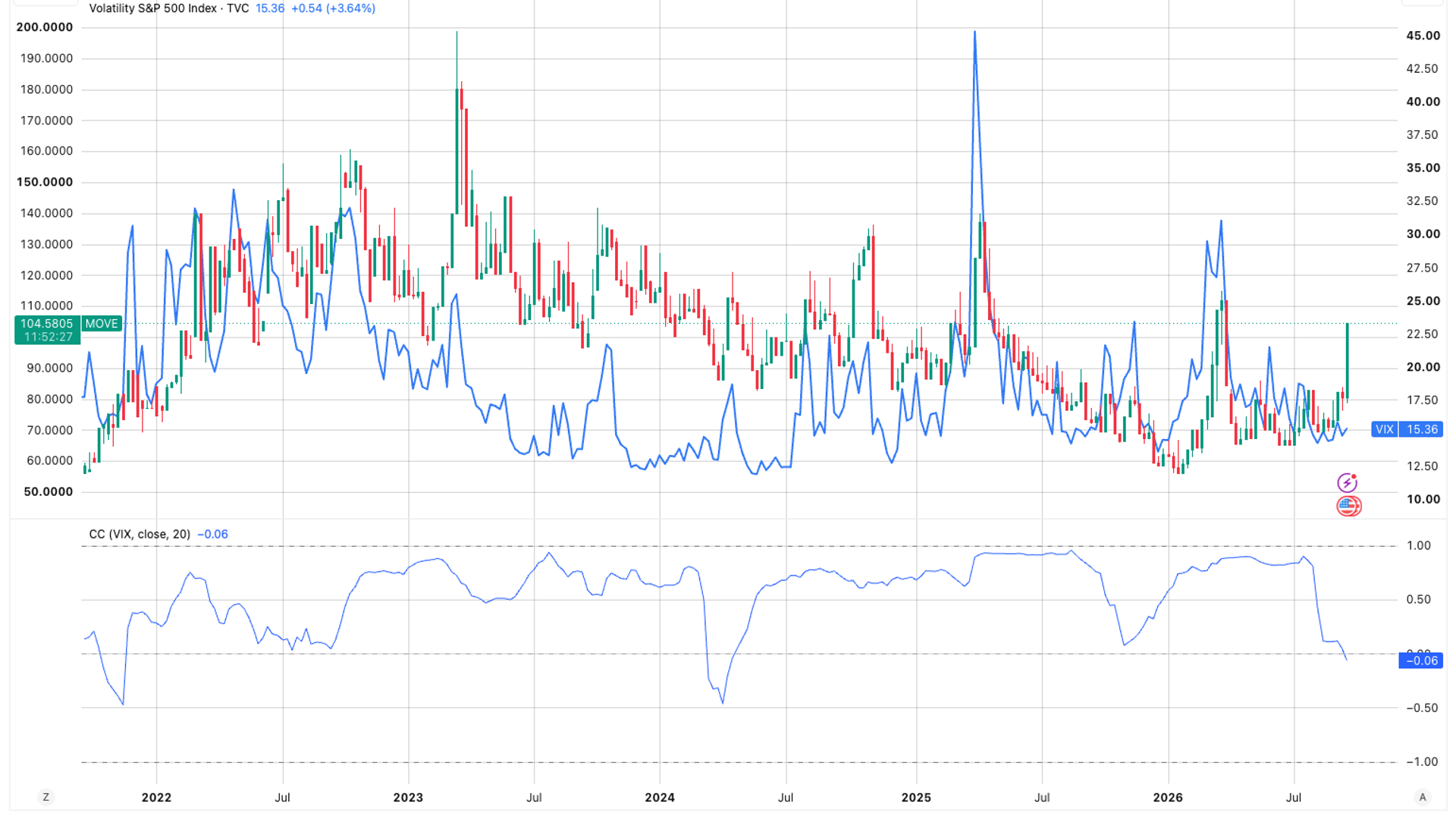
The primary indicator of this stress is the MOVE index, a closely watched gauge of expected volatility in the U.S. Treasury market. As of Thursday, September 25, 2026, the index surged from a relatively stable level of 80 to hit 104. This represents the highest level of bond market anxiety observed since March, a period marked by significant interest rate uncertainty. While the current reading remains below the extreme spike to 199 witnessed earlier in the spring, the rapid upward trajectory over a 48-hour window is notable, signaling that fixed-income traders are scrambling to hedge against heightened interest rate fluctuations.
The Divergence of Risk Assets
In stark contrast to the jittery bond market, the risk-on segments of the financial world have largely shrugged off the news. The Volmex annualized 30-day bitcoin implied volatility index (BVIV), which tracks the sentiment of options traders regarding price swings over the coming month, is currently hovering near its year-to-date lows at approximately 37. This suggests that the crypto market is not pricing in any significant turbulence despite the mounting pressures in the broader macroeconomic sphere.

Similarly, the Cboe Volatility Index (VIX)—often referred to as Wall Street’s "fear gauge"—remains anchored near its yearly low of 14. For equities, this implies that investors in the S&P 500 are largely unconcerned about the potential fallout from rising Treasury yields. This separation between the volatility of debt markets and the volatility of equities and digital assets is highly unusual. Historically, a spike in the MOVE index is viewed as a "canary in the coal mine" for the broader financial system. Because Treasury notes serve as the foundational asset for global credit creation and pricing, elevated volatility there typically signals a tightening of financial conditions, which should, in theory, discourage risk-taking and lead to a repricing of more volatile assets.
Macroeconomic Pressures and Yield Curve Dynamics
The roots of this bond market volatility are not difficult to identify. Global government bond yields have been on a consistent upward march, driven largely by fresh geopolitical instability. The ongoing conflict in the Middle East has sent shockwaves through the energy sector, resulting in significant increases in the price of oil and diesel. This energy price spike has complicated the inflation outlook, forcing investors to reconsider their expectations regarding central bank policy.
If energy prices remain elevated, inflation could prove more persistent than previously anticipated, potentially forcing the Federal Reserve and other major central banks to maintain higher interest rates for a longer duration. This environment is inherently hostile to fixed-income assets, as higher yields decrease the present value of future cash flows. On Thursday, the U.S. 10-year Treasury yield briefly pierced the 5.2% threshold before retreating slightly to 5.163%. This level of yield, combined with the uncertainty surrounding the future path of monetary policy, has clearly spooked bond market participants.
The current situation invites a direct comparison to the market conditions of last March. When the MOVE index was last trading at these elevated levels, the S&P 500 was hovering near the 6,350 mark. In the months since, the index has climbed to 7,704—a robust gain of approximately 21%. Despite this impressive performance, the current pricing of interest rate protection suggests that the "easy money" period of the rally may be facing a new test. Bond traders are now paying a significantly higher premium to protect their portfolios against sudden interest rate swings, effectively signaling that the environment for debt is fundamentally riskier than it was just a few months ago.
Correlation Breakdown
The decoupling of these markets is further illustrated by the shifting correlations between the various volatility indices. Over a 20-day window, the correlation between the Cboe VIX and the MOVE index has slipped to -0.06. While this reading is close to zero, it marks a significant shift, turning negative for the first time since April 2024. More pronounced is the relationship between the BVIV and the MOVE index, which currently stands at -0.37. This is one of the lowest readings in recent years, highlighting a clear inverse movement: as bond market anxiety has surged, the expected volatility for bitcoin has remained anchored at or near its lowest points of the year.
This negative correlation suggests that, at least for the moment, investors are viewing the current bond market turbulence as a contained event rather than a systemic contagion that would necessarily drag down the price of speculative assets. In fact, some market participants appear to be treating the current environment as a buying opportunity, or at the very least, an environment where the traditional inverse relationship between yields and asset prices is failing to hold.
The Resilience of Bitcoin and Stocks
The resilience of bitcoin in the face of these developments is particularly noteworthy. For years, crypto critics have argued that bitcoin would be among the first assets to collapse if liquidity were drained from the system via higher interest rates or bond market volatility. However, recent data suggests that this conventional wisdom is being challenged. As previously reported, rising bond yields have shown little consistent relationship with bitcoin’s long-term returns, suggesting that the asset may be carving out a more independent identity as a hedge or a speculative instrument that is less sensitive to the traditional levers of the Fed’s interest rate policy than once thought.
Whether this calm in the stock and crypto markets is a sign of a "soft landing" confidence or simply a period of complacency remains to be seen. Historically, the bond market tends to be a more accurate forecaster of systemic stress than equity markets, which are often slower to price in the consequences of credit tightening. As the 10-year Treasury yield continues to fluctuate around the 5% mark, the market will be looking for further signals from central banks and incoming inflation data to see if the current volatility in the MOVE index will eventually force a correction in the equity and crypto sectors, or if the current divergence will continue to define the remainder of the year. For now, the disparity remains one of the most compelling narratives in global finance, leaving investors to choose between the caution signaled by the bond market and the optimism displayed by the broader equity and digital asset spaces.