










GitHub has long championed a simple philosophy for the developer community: provide the most effective model for every specific task. Earlier this year, the company took a significant step toward that goal with the launch of "Auto model selection," a feature designed to analyze a developer’s request and automatically pair it with the best-suited AI model. Today, GitHub is evolving that vision with the introduction of Project HydraFusion, a sophisticated research preview that shifts the paradigm from choosing a single model to orchestrating complex, multi-model workflows in real-time.
Project HydraFusion represents a leap forward in "frontier intelligence," utilizing runtime orchestration to build full execution plans for coding tasks. Rather than relying on a static selection process, HydraFusion acts as a dynamic manager. It assesses the complexity of a user’s prompt and determines whether to draft, critique, revise, or escalate the task to more powerful, high-performance models. This internal logic is designed to operate seamlessly behind the scenes; for the developer, the experience remains familiar, as they simply select HydraFusion like any other model. The system then takes responsibility for balancing the intricate trade-offs between performance, operational cost, and latency.
Adaptive Multi-Model Orchestration
At its core, HydraFusion treats workflow selection as an optimization problem. In a traditional development environment, programmers often manually coordinate AI tools—perhaps using a lightweight model for initial scaffolding, a separate model for debugging, or escalating a particularly gnarly logic bug to a frontier-level model. HydraFusion brings this human-centric process into the automated runtime environment.

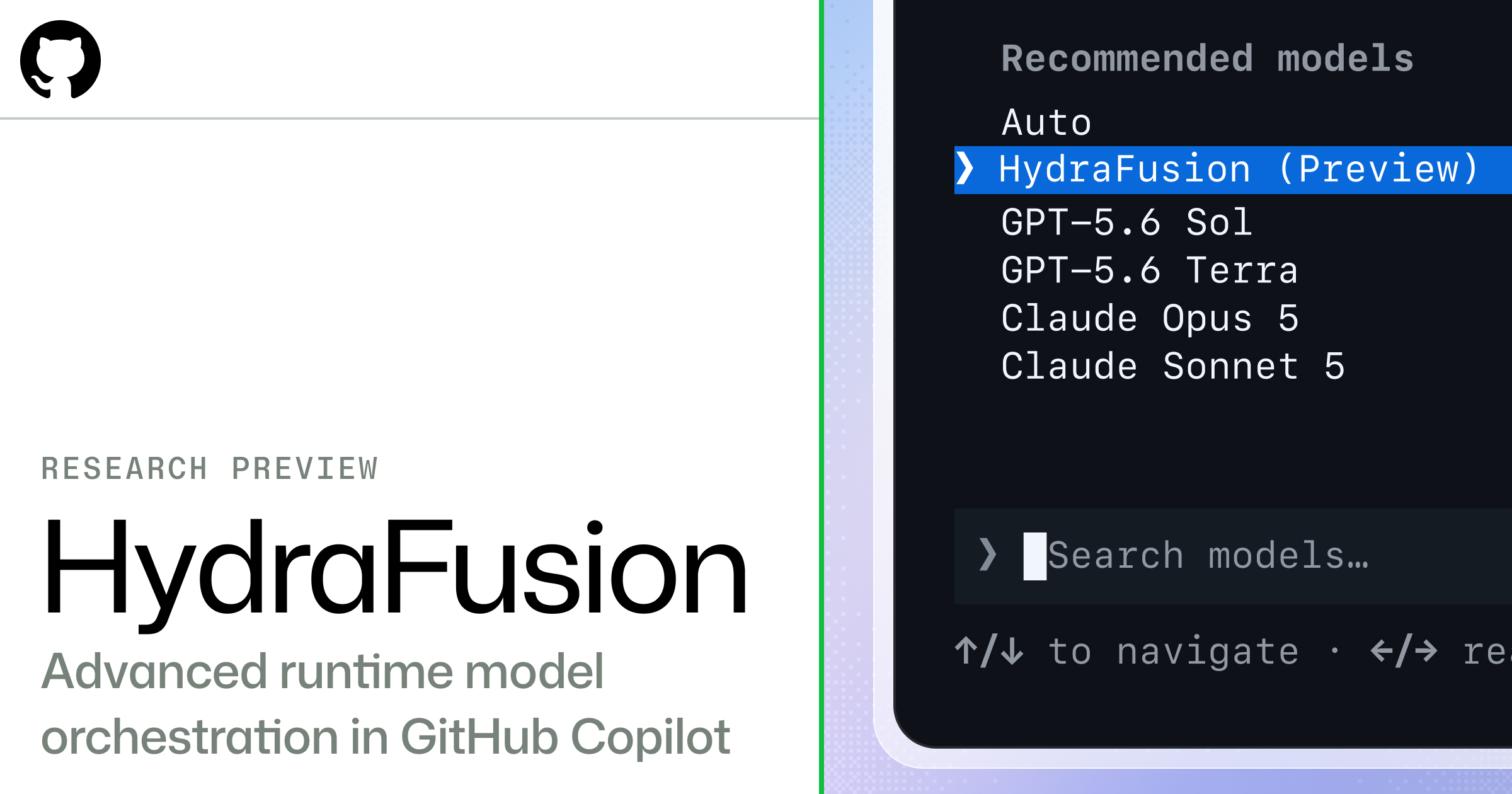
The intelligence behind this orchestration relies on "capability signals." The system evaluates each request based on the specific needs of the task, such as reasoning requirements, code generation, debugging complexity, or the necessity of external tool use. By analyzing these signals, HydraFusion selects the most efficient execution pattern required to meet a high-quality bar.
Currently, HydraFusion operates using three distinct execution patterns. The "Single" pattern is utilized when a task is straightforward enough to be solved directly by one model, preserving speed and minimizing overhead. For tasks requiring higher reliability, the "Cascade" pattern allows an efficient model to take the first attempt at a solution while maintaining a clear, automated path to escalate to a more powerful model if the initial result fails to pass an acceptance gate. Finally, the "Critique" pattern introduces an independent perspective, providing a dedicated review layer for complex tasks where a second, critical look is more valuable than an additional unaided attempt.
This adaptive strategy is designed to evolve alongside the broader AI landscape. As new, more capable models are integrated into the GitHub Copilot ecosystem, HydraFusion can be updated to include these new assets in its "model pool," ensuring that the orchestration logic always leverages the latest advancements in AI research.
Building a Dependable Coding Experience
Transitioning from simple model selection to an automated, multi-model orchestration framework requires rigorous control over execution, repository state, and cost management. To ensure that this complexity does not overwhelm the developer, the engineering team behind HydraFusion has built the project around five core operating principles. These principles focus on maintaining a coherent experience where the developer receives one unified response and a single, permission-aware change set, regardless of how many models were involved in the background.
The system maintains deep internal logs, recording the specific roles assigned to various models, the outcomes of each step, the associated costs, and the latency of each execution leg. This diagnostic data allows researchers to audit the workflows after the fact, ensuring that the system remains transparent and reliable. By managing these variables, HydraFusion provides a production-grade experience that handles the heavy lifting of multi-model coordination without burdening the end user with the underlying architectural complexity.
Benchmarking Results and Performance
To validate the efficacy of this approach, GitHub evaluated fixed HydraFusion policies against three agentic coding benchmarks: TerminalBench 2.1, DeepSWE, and CheckpointBench. These tests were conducted using Claude Opus 5 and GPT-5.6 Sol as comparison baselines, ensuring that HydraFusion was measured against industry-standard, high-performance models.

The evaluation process was comprehensive, accounting for every stage of the workflow, including drafting, critique, revision, and escalation. The results were compelling: on TerminalBench 2.1, which tests agents on complex, multi-step terminal tasks, HydraFusion improved verified task quality by 4.9 percentage points while simultaneously achieving a 67% reduction in estimated workflow costs compared to Claude Opus 5.
On DeepSWE, a benchmark focused on challenging repository-level software engineering tasks—such as navigating large codebases and managing cross-file dependencies—HydraFusion performed within 1.5 percentage points of the baseline, while reducing costs by 36%. Perhaps most notably, on CheckpointBench, an internal suite curated from actual, real-world GitHub Copilot sessions, the system achieved near-parity with the baseline in quality, falling just 0.1 percentage points short, while cutting costs by 65%.
These results suggest that for many real-world development tasks, the "intelligence" of an AI agent is not necessarily found in a single, monolithic model, but in the intelligent orchestration of multiple models working in tandem. Early internal testing from engineers at Microsoft has supported these findings, with some noting that the reasoning and task-solving capabilities of the HydraFusion-orchestrated system are already performing at or above the level of the most capable standalone models.

Refined Development through Iterative Benchmarking
The development of HydraFusion’s routing policies was an exercise in "hill-climbing"—a process of continuous, incremental improvement. Rather than relying on manual threshold tuning, the team utilized beam search to construct the optimal decision policy based on the performance data collected from CheckpointBench and other datasets. Each candidate policy was rigorously measured against a frozen baseline to ensure that any observed improvements in quality or efficiency were genuine and reproducible.
The path to these results was not linear. During the development cycle in August, the team encountered operational failures in their evaluation harness that produced invalid runs. Rather than ignoring these anomalies, the team excluded the faulty data, corrected the underlying issues, and resumed the optimization process. This transparency in the development record underscores the complexity of building agentic systems that must remain both cost-effective and highly reliable.
Accessing the Research Preview
As the project enters its research preview phase, GitHub is focusing on first-turn, single-prompt coding tasks. This initial scope is intended to help the team understand which types of programming challenges derive the most benefit from compound workflows and how this orchestration impacts latency in a production environment.

The company encourages developers to engage with the tool by assigning it substantial, well-scoped tasks through the Copilot autopilot mode. Feedback from this real-world usage—identifying where the system excels, where it struggles, and what features users desire next—will be instrumental in shaping the future of the technology.
Project HydraFusion is, at its heart, an acknowledgement that the next major breakthrough in AI coding agents will not come from just building larger, more expensive models. Instead, it will come from the intelligent, dynamic construction of workflows that treat the AI not as a static black box, but as a flexible partner capable of choosing its own tools and methods. By moving from a "best model" mindset to a "best execution" strategy, GitHub is laying the groundwork for a new era of software engineering, where the complexity of the AI stack is hidden behind a simple, efficient, and highly effective developer interface.