









Managing containerized applications at scale on Amazon Elastic Container Service (Amazon ECS) has long been a task defined by both immense power and significant operational overhead. As platform teams look to maintain agility while ensuring robust security and networking configurations, the complexity of managing ingress traffic for every individual service has often emerged as a bottleneck. For organizations deploying dozens or even hundreds of microservices, the requirement to manually provision and synchronize Application Load Balancers (ALBs), AWS Certificate Manager (ACM) certificates, AWS WAF web ACLs, and complex security group rules has become an increasingly heavy lift. This per-service management model not only hampers deployment velocity but also introduces the latent risk of configuration drift, where subtle inconsistencies across environments lead to security vulnerabilities or performance degradation.
In a move aimed at addressing these architectural challenges, Amazon has officially announced the launch of Amazon ECS Gateway, a new account-level resource designed to fundamentally simplify ingress networking for containerized workloads. By shifting the responsibility of infrastructure management from the developer to an automated, policy-driven layer, ECS Gateway allows teams to move away from manual provisioning. Instead, the service dynamically manages the necessary networking infrastructure on behalf of the user, with all resources created directly within the organization’s AWS account, ensuring that visibility and governance remain intact.
Bridging the Gap Between Platform and Application Teams
The introduction of ECS Gateway is designed to establish a clear and efficient separation of responsibilities between platform engineering teams and application development teams. Historically, the burden of ensuring that an application was "network-ready" fell on the developer or required an extensive collaborative effort between developers and network engineers. With ECS Gateway, this friction is significantly reduced. Platform teams can define the networking standards—such as security postures, load balancer configurations, and WAF rules—at the gateway level. Once these guardrails are established, application teams can simply "connect" their services to the gateway, offloading the heavy lifting of infrastructure orchestration to Amazon ECS.

One of the most notable technical advantages of this new feature is its approach to infrastructure optimization. ECS Gateway utilizes host-based routing via Application Load Balancers, allowing up to 25 individual services to share a single ALB. This consolidation is a substantial improvement for cost management, as it reduces the number of idle or underutilized load balancers in an environment. ECS handles the full lifecycle of this infrastructure; it automatically provisions the initial ALB when the first service connects and intelligently scales the number of load balancers as capacity requirements fluctuate. Conversely, when services are decommissioned or capacity needs shrink, the gateway automatically removes redundant resources. Each service is provided with a unique DNS hostname, ensuring that developers have a ready-to-use, production-grade endpoint the moment the provisioning process concludes.
Implementation and Operational Control
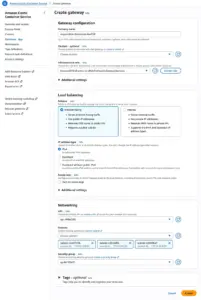
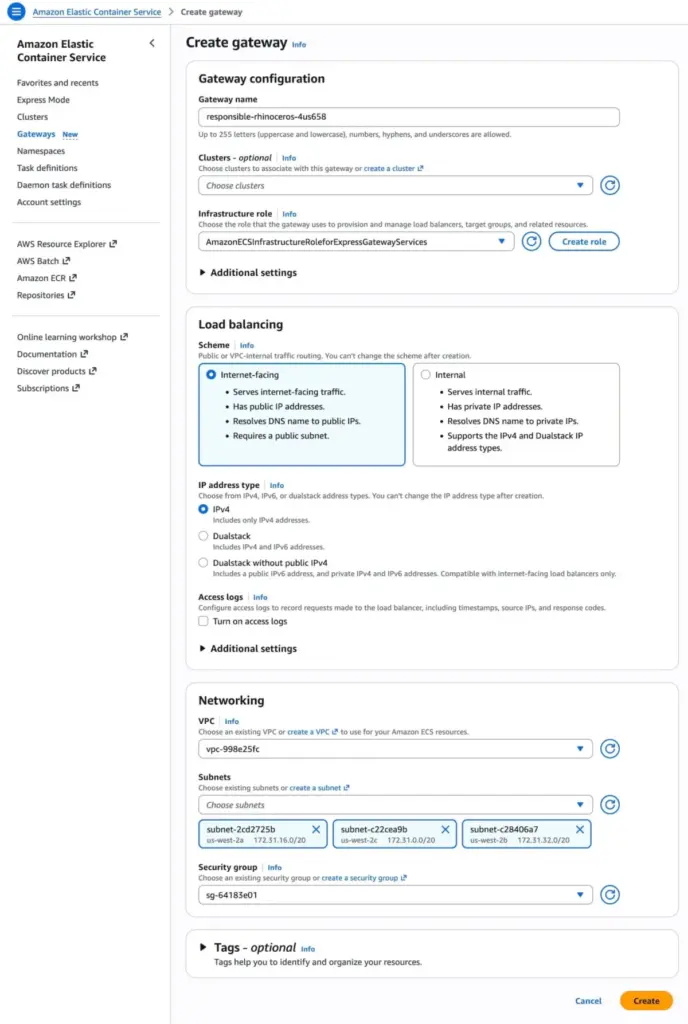
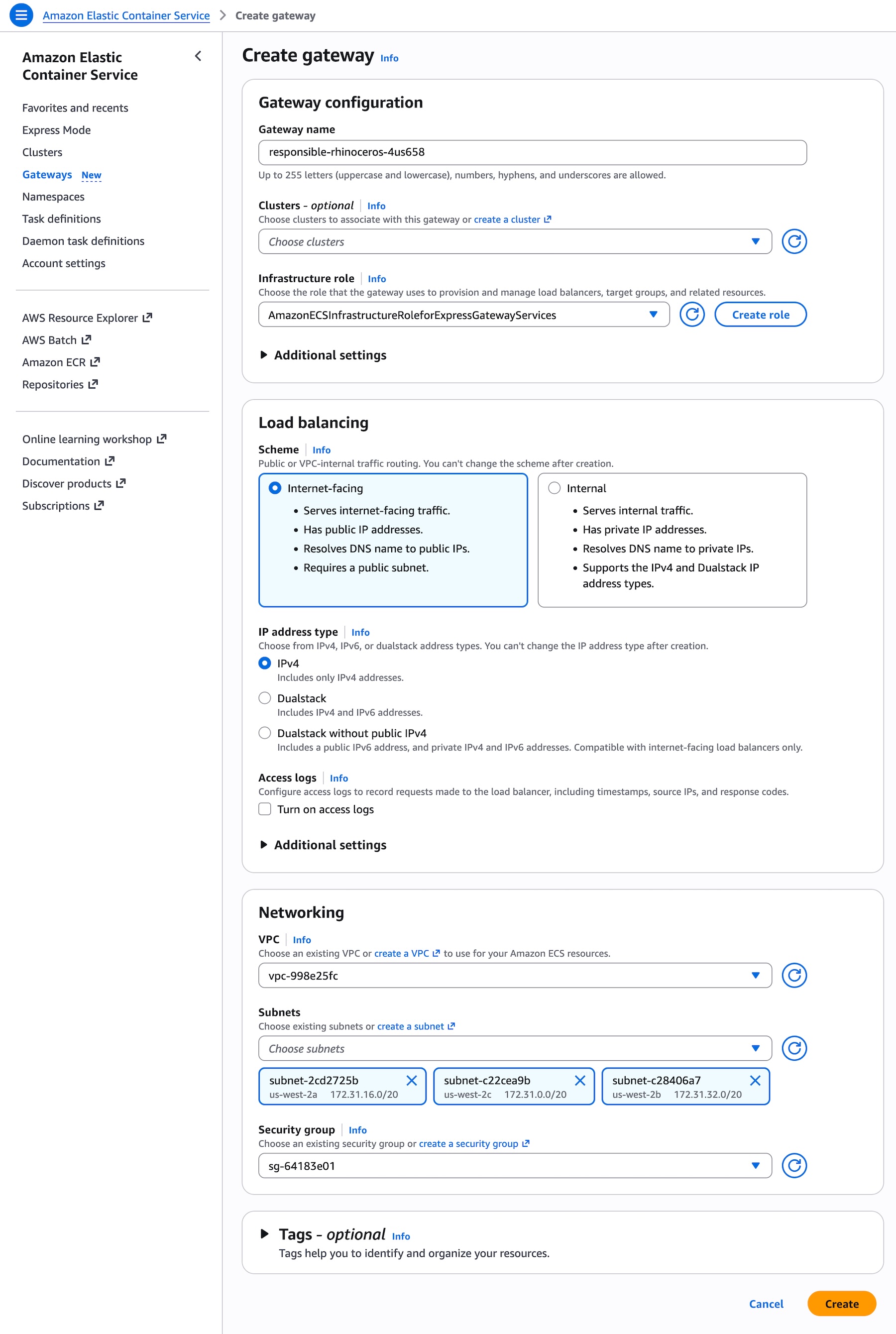
For platform teams looking to implement this new architecture, the process begins within the Amazon ECS console. The setup involves creating a gateway and defining its configuration, a process that hinges on an infrastructure IAM role. This role acts as the bridge, allowing ECS to assume the necessary permissions to provision and manage load balancers, security groups, and certificates within the customer’s account. When configuring a gateway, administrators provide a unique name and select the desired infrastructure role. They also have the flexibility to associate the gateway with specific ECS clusters, either during the initial creation phase or at a later date, providing the granular control necessary for multi-environment deployments.
The gateway configuration is comprehensive, allowing teams to choose between public-facing traffic routing or internal VPC-based traffic. Further settings under the "Additional Settings" menu allow for the definition of listeners, ports, and the maximum number of load balancers the gateway is permitted to scale to, as well as the integration of web ACLs for robust application protection. It is important to note that certain fundamental settings—such as the gateway’s name, the VPC, subnets, IP address type, and the listener protocol—are locked once the gateway is created to maintain architectural consistency.

For those who prefer infrastructure-as-code or command-line workflows, the AWS Command Line Interface (AWS CLI) offers full support for these operations. By invoking the CreateGateway command, users can define their configuration objects with precision. Importantly, the system is designed to be lean; no actual infrastructure is provisioned until a service explicitly connects to the gateway using a gateway connector. This ensures that resources are only consumed when there is an active workload requiring them.
The scalability of this design is particularly noteworthy. A single ECS Gateway can be associated with up to 10,000 clusters, while a single cluster can support up to five distinct gateway associations. This many-to-many relationship provides immense flexibility. For example, a platform team could maintain separate gateways for public and private traffic, or create distinct gateways to segregate traffic across different staging, development, and production environments. By using IAM policies to restrict which teams can deploy services to specific clusters, organizations can enforce strict security boundaries without sacrificing the convenience of the gateway abstraction.
Seamless Integration for Application Teams
For application teams, the adoption of ECS Gateway is intended to be as frictionless as possible. When defining a service—whether through the CreateService or UpdateService API—developers simply add a gateway connector to the service definition. This process is designed to be incremental. If an organization has an existing ECS service that already manages its own load balancer, they do not need to perform a disruptive migration. Instead, they can add a gateway connector to the existing service, allowing both the legacy ingress path and the new ECS Gateway path to coexist. This allows teams to validate the new connection and ensure that traffic is flowing correctly before they finalize the transition and remove the legacy infrastructure.
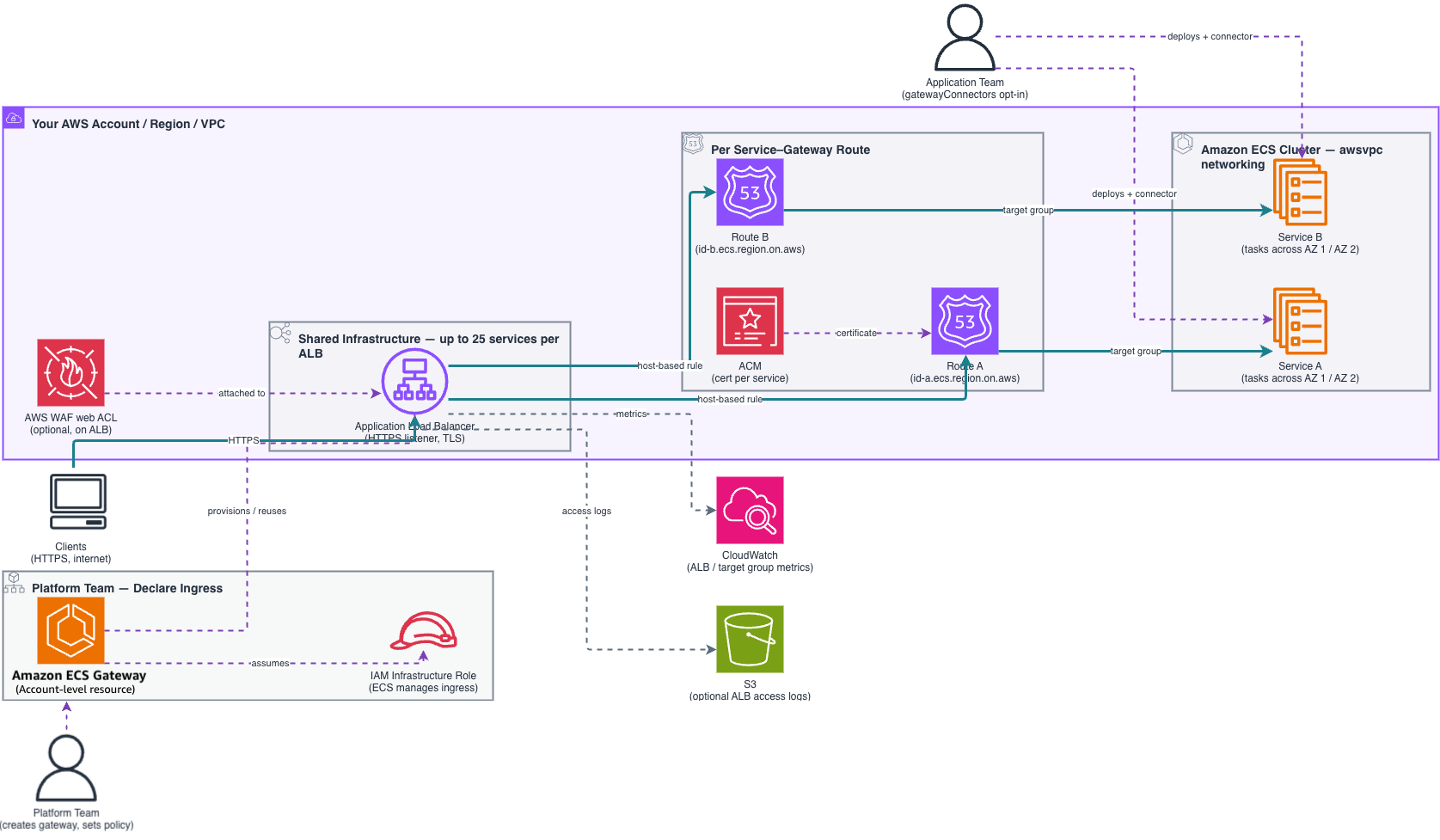
When a deployment is initiated, Amazon ECS evaluates the gateways associated with the target cluster and performs a compatibility check. A connection is only established if the gateway’s access type matches the service’s requirements, and if the gateway is located in the same VPC and covers the same Availability Zones as the service’s subnets. Once these conditions are met, ECS orchestrates the provisioning: an ACM certificate is issued, a unique DNS hostname is registered, a listener rule is created to route traffic to the service’s target group, and security group rules are automatically updated to allow traffic from the ALB. The gateway route transitions to an "ACTIVE" state only when all these elements are confirmed, ensuring that service URLs are ready to accept traffic immediately.
Operational Resilience and Future Availability
The ECS Gateway is engineered to handle common operational hurdles automatically. If a load balancer becomes unhealthy, the system can replace it; if a service is updated, the gateway updates the listener rules dynamically; and if a certificate expires, the system facilitates the necessary lifecycle management. These automated safeguards significantly reduce the "toil" typically associated with managing high-availability web services.
Amazon has confirmed that ECS Gateway is available now in all commercial AWS Regions where Amazon ECS is supported. The pricing model follows standard AWS resource utilization patterns, meaning there is no additional "gateway fee" or premium charge for the service itself. Instead, customers pay only for the underlying infrastructure that is provisioned in their account—such as the active Application Load Balancers, CloudWatch logs and metrics, ACM certificates, and standard data transfer costs. This transparent pricing structure ensures that the operational benefits of the gateway are available to organizations of all sizes without hidden overhead.
As enterprises continue to migrate and modernize their workloads using container technology, the focus is shifting from simply running containers to optimizing the ecosystem that supports them. With the introduction of ECS Gateway, Amazon is addressing the "Day 2" operational challenges of ingress management, providing a scalable, secure, and automated solution that allows developers to focus on building applications rather than managing the intricate web of networking resources required to expose them. For platform teams, this represents a significant step toward a more unified and manageable container infrastructure, capable of scaling to meet the demands of modern cloud-native architectures.