










Ollama, the widely acclaimed platform that has revolutionized how developers and enthusiasts run open-source artificial intelligence models locally, has reached a significant new milestone. The project recently announced the official integration of text-to-speech (TTS) capabilities, marking the first time the platform has moved beyond pure text generation to offer native audio synthesis. This update is currently rolling out for macOS users, with the development team confirming that support for Windows and Linux environments is already in the pipeline and expected to arrive in the near future.
For those who have followed the rapid evolution of local AI, Ollama has become synonymous with accessibility. By providing a streamlined interface to download, manage, and execute complex large language models (LLMs) directly on a user’s own hardware, it removes the necessity for expensive cloud subscriptions or the privacy concerns associated with sending sensitive data to external servers. Since its inception, the project has garnered massive community support, cementing itself as one of the most prominent open-source initiatives on GitHub, boasting nearly 185,000 stars and over 18,600 forks.
Leveraging the Power of Apple Silicon
The integration of speech models on macOS is not merely a feature addition; it is a technical showcase of how Ollama utilizes Apple’s specific hardware architecture. On the Mac, Ollama relies heavily on MLX, the open-source machine learning framework developed by Apple. MLX is designed specifically to take full advantage of the unified memory architecture found in Apple Silicon chips. By allowing the CPU and GPU to share the same memory pool, the framework eliminates the bottlenecks typically associated with data transfer between different processing units.

This architectural synergy allows Ollama to run AI models with remarkable speed and energy efficiency. Because the models reside locally, users can engage with sophisticated AI agents without an internet connection, ensuring that data never leaves the device. While performance remains tethered to the specific hardware specifications—such as the amount of unified memory and the processing power of the M-series chip—the efficiency gains provided by the combination of Ollama and MLX have enabled a smooth, real-time experience that was previously difficult to achieve on consumer-grade hardware.
Introducing Phonon: Real-Time Speech Synthesis
The core of this new functionality is the implementation of Phonon, a family of state-of-the-art text-to-speech models developed by Gradium. The inclusion of Phonon represents a major shift in how Ollama users can interact with their local AI assistants. Rather than generating a text response and then requiring a secondary process to convert that text into audio, the integration allows for real-time streaming. This means that users can listen to the AI’s response as the text is being generated, creating a fluid, conversational experience that mimics natural speech patterns and significantly reduces the friction of waiting for an entire paragraph to materialize before playback can begin.
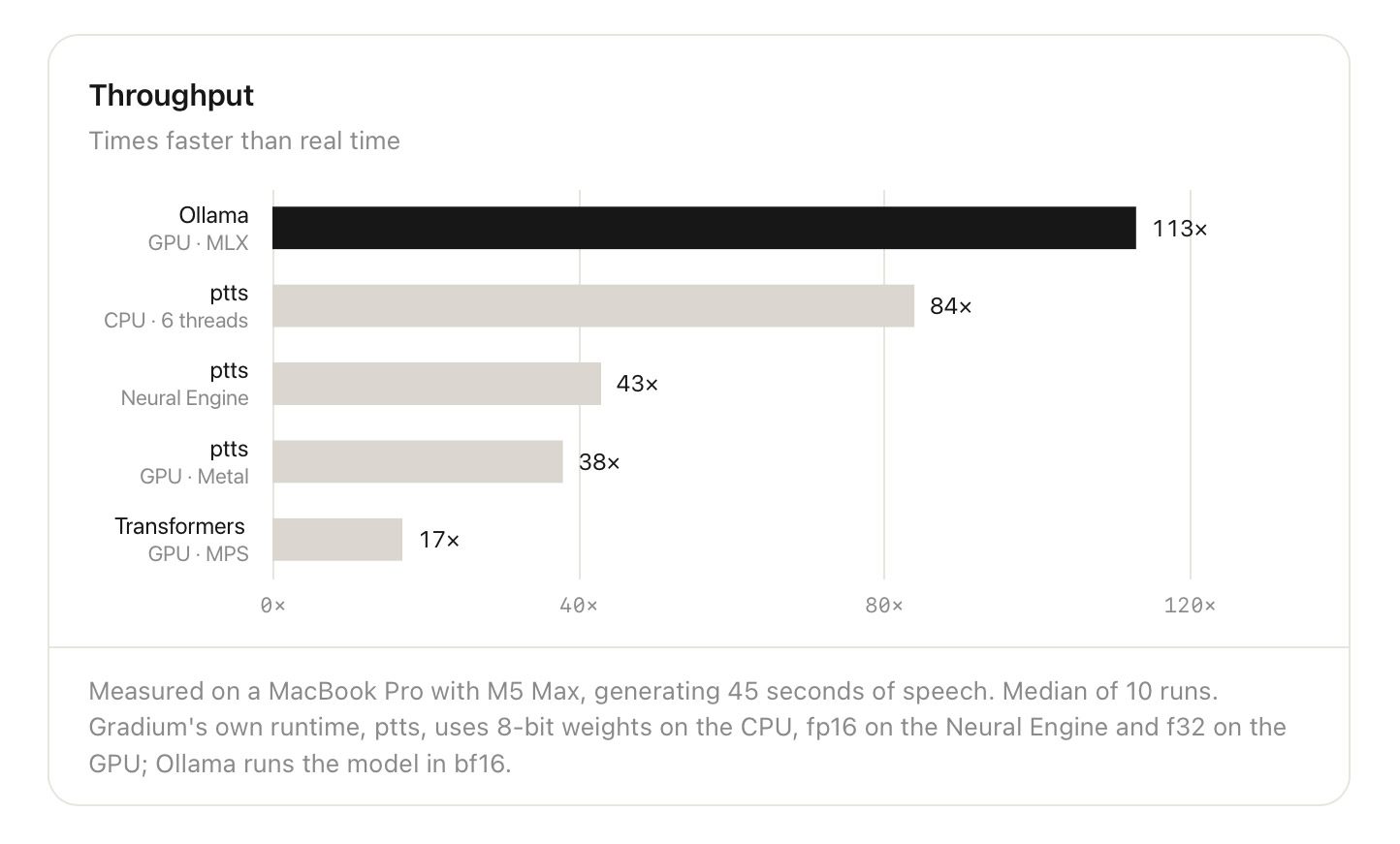
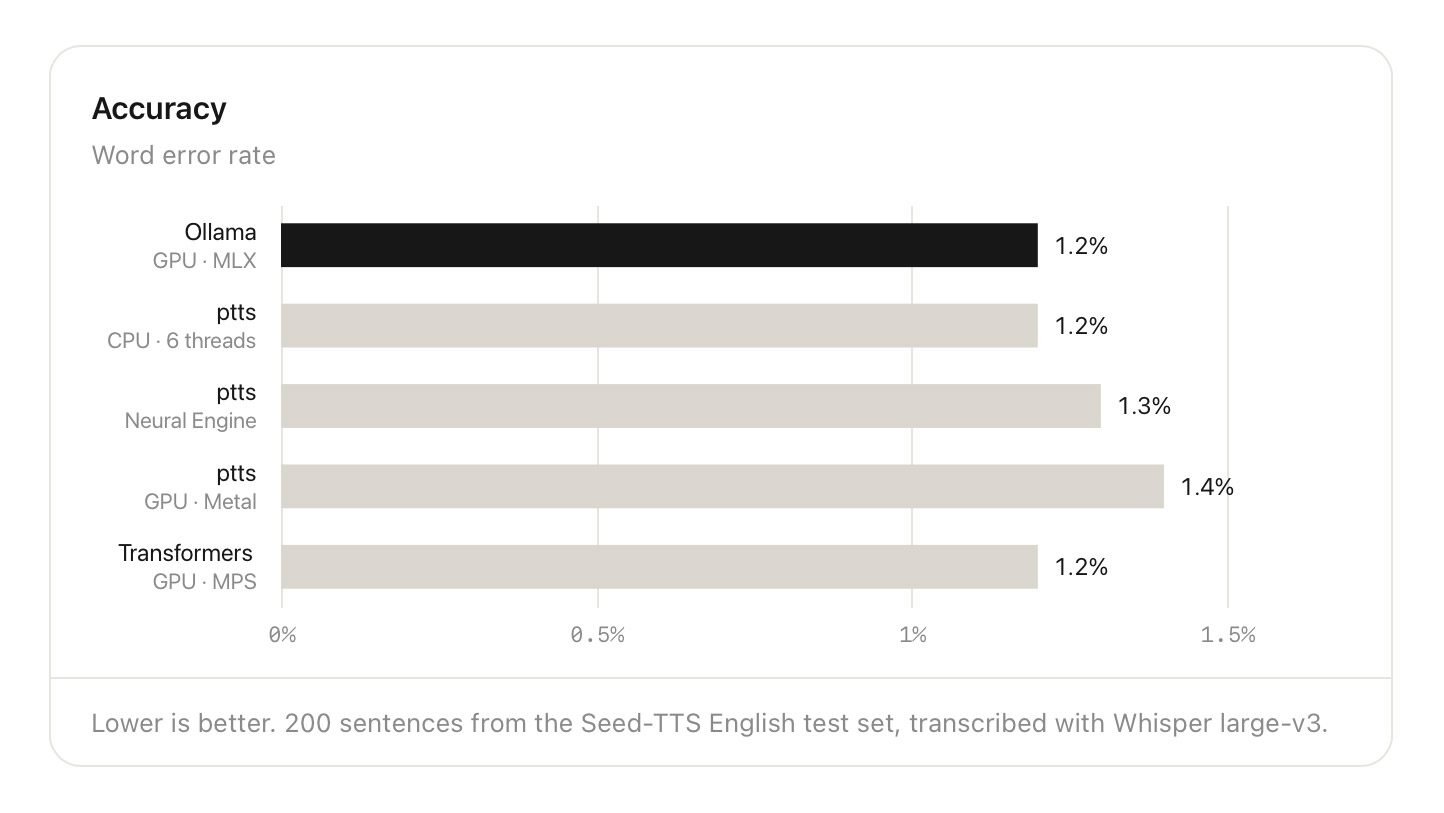
The performance metrics released by the Ollama team underscore the efficiency of this integration. During internal testing on a MacBook Pro equipped with an M5 Max chip, Ollama achieved a 35% improvement in speech generation speed compared to Gradium’s own reference implementation. Perhaps even more impressively, these gains in throughput were achieved without compromising quality; the system maintained a word error rate identical to the reference implementation found in Hugging Face Transformers. This balance of speed and accuracy is critical for real-time applications, where latency can break the sense of immersion during a conversation.
Versatility and Language Support
The Phonon model family is designed with global usability in mind. Upon launch, the platform supports five distinct languages: English, French, German, Spanish, and Portuguese. To cater to different user requirements, the platform offers specific, optimized models for each of these languages, as well as a comprehensive multilingual model capable of handling all five.
Beyond language selection, the system provides a range of voice options. Depending on the model chosen, users can select from different voice profiles and accents, including distinctions between American and British English. This level of customization allows developers and hobbyists to tailor the AI’s "personality" to their specific use cases, whether they are building accessibility tools, voice-interactive assistants, or localized applications.
Getting Started with Ollama’s New Capabilities
The speech models are available immediately for users running Ollama version 0.40.11 or later on Apple Silicon Macs. The process for accessing this new feature is consistent with the project’s established philosophy of simplicity: users can download the Phonon models directly through the existing Ollama command-line interface, mirroring the experience of downloading and running LLMs.
For developers looking to integrate these capabilities into their own software, Ollama has provided extensive documentation and code examples for interacting with the new speech models via the platform’s API. By standardizing the way speech is handled within the Ollama framework, the project is positioning itself to be a comprehensive local hub for multimodal AI. This evolution from a text-only platform to one that can "speak" opens up a wealth of possibilities for local development, from creating offline voice-controlled home automation systems to building private, voice-based research assistants that operate entirely within the secure confines of a user’s local machine.
As Ollama continues to refine its support for speech models, the community expectation is that the upcoming Windows and Linux releases will leverage similar optimization techniques tailored to those operating systems’ respective hardware drivers. With the current trajectory of the project, it is clear that the focus is on maintaining the delicate balance between high-performance computing and user-friendly software design.
For those interested in exploring the technical nuances, listening to audio samples, or reviewing the documentation for implementing these models in custom applications, the Ollama blog provides a detailed overview of the Phonon integration. As the project matures, it remains a key example of how open-source innovation, combined with optimized hardware-level frameworks like MLX, can bring high-end AI capabilities to the desktop, allowing individual users to maintain control over their data while enjoying the cutting edge of speech synthesis technology.