Naming things in design and software engineering is universally acknowledged as one of the hardest challenges in the digital realm. The language people use actively shapes how they think about problems and dictates the nature of cross-functional conversations. This inherent linguistic friction frequently leads to persistent confusion surrounding colors, icons, user interface components, and core product features. Consequently, teams continually struggle to establish clear, scalable naming conventions for design tokens, HTML classes, and code variables.
Choosing the right name requires striking a delicate balance. Names that are overly generic fail to communicate precise intent or context, making the underlying code or component obscure to other team members. Conversely, names that are hyper-specific leave little room for future flexibility, adaptability, and cross-project reuse. Addressing this persistent industry hurdle requires examining how leading organizations, design systems, and open-source contributors approach taxonomy, structure, and nomenclature across the modern web ecosystem.

How To Name Things
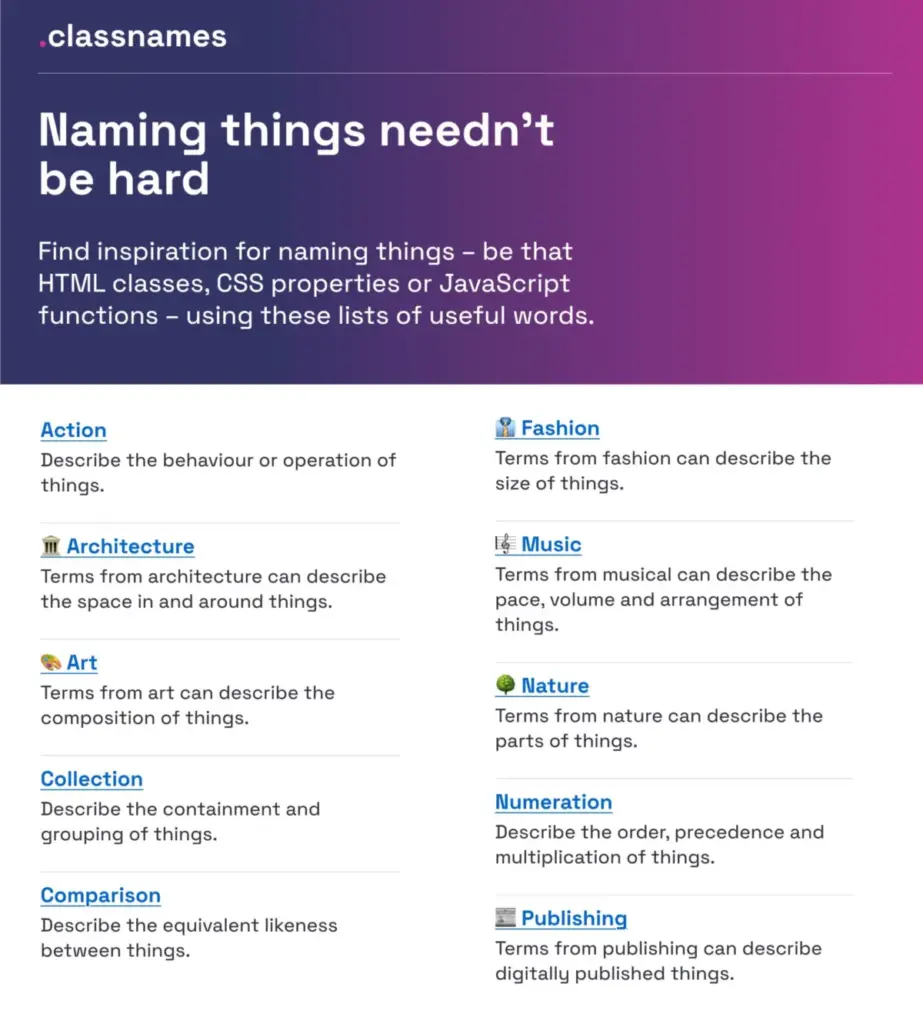
Finding effective inspiration for naming HTML classes, CSS properties, and JavaScript functions often demands looking beyond standard engineering vocabulary. Developers and designers seeking to break away from habitual phrasing can turn to Classnames, a resource curated by Paul Robert Lloyd that offers expansive thematic wordlists designed to provoke creative thinking.
The platform supplies curated collections of terms categorized by behavior, likeness, order, grouping, and association. Crucially, it also introduces specialized thematic lexicons drawn from unexpected domains such as nature, art, theater, music, architecture, fashion, and publishing. By incorporating these varied linguistic frameworks, teams can construct codebases and design systems with a richer, more intuitive vocabulary that avoids repetitive or ambiguous terminology.

How To Name Colors
Establishing a standardized color palette presents a unique challenge, particularly when scaling across multiple brands and product lines. To combat color-naming chaos, David Aerne maintains an expansive repository of color names known as color-names, which currently catalogs over 30,000 unique color designations harvested from diverse reference materials and thousands of community contributions.
Complementing the repository is Color Parrot, a tool that links specific hex codes and visual hues to descriptive names, allowing developers to search, test, and extract color titles seamlessly. This extensive community-driven dataset serves as an invaluable reference guide for maintaining color consistency and documentation across disparate digital environments.

How To Name Layers and Groups
As design files scale in complexity, maintaining structural clarity within design tools like Figma or Sketch becomes paramount. Javier Cuello has consolidated essential naming best practices designed to help teams structure layers, groups, and UI components in a predictable, scalable manner.
According to these guidelines, an effective name possesses a logical structure, remains concise yet meaningful, is universally understood across disciplines, and avoids tying itself directly to temporary visual properties. By establishing strict behavioral do’s and don’ts, design teams can eliminate the cognitive overhead associated with auditing messy artboards, ensuring that handoffs between design and engineering remain frictionless.

How To Name Design Tokens
Building a flexible design token taxonomy capable of scaling across diverse product portfolios represents a massive architectural undertaking. This exact challenge confronted the team at Intuit, the parent organization behind major financial and productivity platforms including Mailchimp, QuickBooks, TurboTax, and Mint. To unify their ecosystem, the company engineered a flexible token system designed to transcend individual brand themes and serve as a foundational infrastructure for a vast array of digital products.
Nate Baldwin detailed this transformation in a comprehensive case study outlining the creation of Intuit’s design token taxonomy. The documentation explores the core pain points of their legacy token architecture, establishes the criteria required for a modern replacement, and outlines the implementation strategy. The resulting insights offer a robust blueprint for organizations seeking to build resilient, multi-brand token structures.

Frequent Names For UI Components
When teams encounter roadblocks while defining interface elements, analyzing existing design systems provides an immediate baseline. To streamline this research, Iain Bean developed the Component Gallery, an exhaustive compendium cataloging real-world interface components from prominent design systems across the web.
The directory covers more than fifty distinct UI components—ranging from standard accordions to complex accessibility patterns like visually hidden text—while documenting the various alternative names each component goes by in different corporate ecosystems. This cross-referencing capability assists product teams in aligning their internal terminology with established industry standards. Additionally, resources like Name That UI function as visual dictionaries to further bridge the gap between abstract concepts and concrete interface implementations.

How To Name New Features
Low user adoption rates for newly launched software capabilities are frequently rooted in poor feature discoverability rather than a lack of underlying utility. True feature adoption requires a deliberate sequence: a user must first discover a feature, understand its value proposition, try it out, learn its mechanics, and eventually integrate it into their established workflows. Erin Gannon addressed these dynamics in a practical guide focused on optimizing feature nomenclature.
Effective feature names must be anchored firmly in user needs and problem spaces. Rather than relying on internal engineering jargon or clever marketing codenames, successful titles signal the direct value or outcome of a capability, reflecting the user’s primary "job-to-be-done." Gannon emphasizes the importance of adopting the user’s authentic language by observing how everyday customers naturally describe their workflows, then applying those exact phrasings to the product interface.

How To Name Variables and Taxonomy Maps
Managing multi-brand and multi-themed design systems requires a sophisticated hierarchy of variables. A prime example of this methodology comes from the Vodafone UK Design System team, whose published Variables Taxonomy Map breaks down the anatomy and categorization of design tokens into a meticulously organized system of collections.
The taxonomy map illustrates the four foundational tiers required to support a modern design system, tracking connections across brands, primitive values, semantic tokens, and page-level implementations. Building upon foundational frameworks established by industry experts like Nathan Curtis, this systemic approach ensures that any team member can immediately determine where a token is utilized and what it represents based entirely on its structured name. Additional Figma kits and resources further expand upon these multi-layered token configuration strategies.

Design Token Naming Guides and Inventories
Structuring design tokens efficiently has also been championed by practitioners like Romina Kavcic, who developed specialized tools such as the Design Token Naming Guide to assist teams in configuring structured nomenclature models encompassing components, categories, states, and roles.
Complementing these guidelines are structured inventories, such as the Design Token Names Inventory spreadsheet, which provides a four-tier bird’s-eye view of an entire token ecosystem. This architecture allows organizations to seamlessly append new rows, themes, and modes without sacrificing data integrity or filterability, ensuring long-term maintainability for large-scale digital products.

Naming Products or Services
Beyond interface elements and code variables, naming an overarching product or service remains a high-stakes enterprise. To assist in this domain, Onym operates as an open-source repository organizing foundational tools, brainstorming frameworks, vetting strategies, historical case studies, and literary resources dedicated to commercial nomenclature.
Wrapping Up
Ultimately, an effective name is defined by clarity, shared understanding, and active adoption across both development teams and end-users. Countless hours are wasted across the technology sector when cross-functional partners speak about identical concepts using disparate internal dialects—translating differently across developer, designer, product manager, and user perspectives. This linguistic fragmentation frequently breeds avoidable frustration and operational friction.

Addressing low feature adoption or interface confusion often begins with a critical review of nomenclature. Cataloging and resolving naming conflicts within a dedicated backlog helps streamline collaboration, bridges disciplinary divides, and ensures that digital products remain cohesive, accessible, and intuitively understood by everyone who interacts with them.