




The process of converting unstructured, messy text into organized, structured data has long been a foundational challenge in data analysis and machine learning. Known as named entity recognition (NER), this crucial capability allows systems to identify, extract, and categorize relevant information from vast oceans of text, powering everything from advanced predictive models to automated search engines. Historically, performing NER meant relying on traditional natural language processing libraries that demanded massive training datasets and grueling fine-tuning processes just to recognize custom entities.
However, the rapid evolution of artificial intelligence has introduced a more streamlined approach. A new paradigm has emerged through the integration of large language model reasoning capabilities into standardized machine learning pipelines, simplifying tasks that once required extensive specialized knowledge. By bridging the gap between traditional machine learning frameworks and modern generative AI, developers can now achieve sophisticated data extraction in just a few simple steps, extending far beyond basic text classification into highly customized domain-specific applications.
Revolutionizing Custom NER with Modern LLM Integration
At the forefront of this shift is Scikit-LLM, an open-source library designed to seamlessly incorporate large language model intelligence into familiar workflows. Traditionally, building a custom NER model required developers to annotate hundreds or thousands of training examples, train specialized token classifiers, and rigorously evaluate them against domain-specific edge cases. This traditional overhead often made custom NER economically or computationally unfeasible for smaller teams or rapid prototyping initiatives.
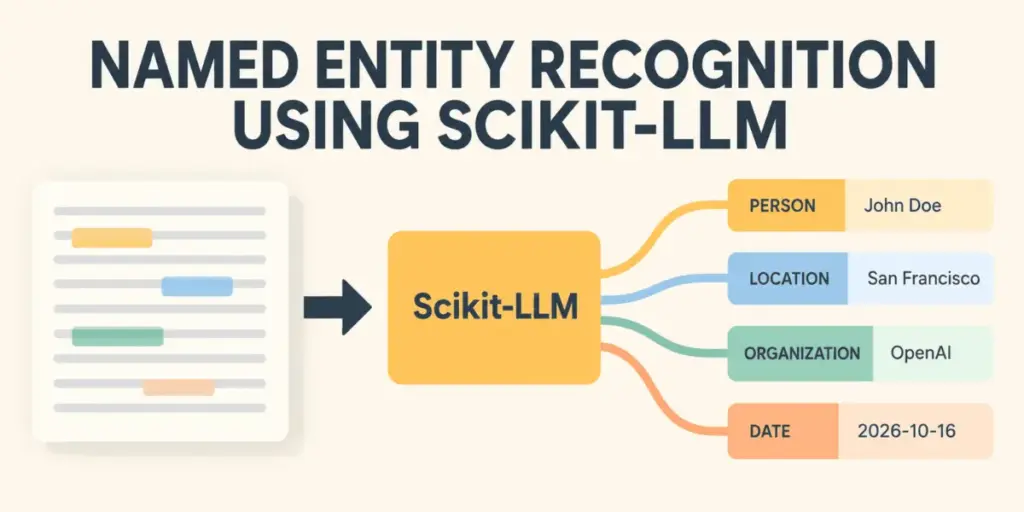
By leveraging the reasoning power of pre-trained models, modern libraries bypass the traditional data-heavy training phase. Instead of teaching a model from scratch through millions of parameter adjustments, developers can define custom entities using clear semantic descriptions. These descriptions act as direct instructions that guide the underlying model through the contextual nuances of the text, enabling accurate extraction even when dealing with complex, multi-word entities or domain-specific terminology across technical, financial, or legal sectors.
Running these advanced workflows has also become increasingly accessible thanks to high-speed, free-tier compatible inference providers like Groq. By utilizing open-source models hosted on optimized infrastructure, practitioners can experiment with and deploy intelligent text processing pipelines without incurring prohibitive compute costs. Setting up such an environment typically involves securing an API key, configuring the underlying client to point toward a high-speed endpoint, and initializing task-specific estimators designed to handle complex tagging procedures natively.
Practical Implementation in the Technology Domain
To understand how this modern approach operates in practice, consider a typical scenario within the fast-paced technology business sector. Traditional NER systems might easily stumble when encountering newly coined product names, niche corporate designations, or leadership changes unless explicitly trained on similar historical data. In contrast, an LLM-powered estimator utilizes an entity dictionary—a collection of key-value pairs where keys denote the categories to extract, such as executives, corporations, products, or cities, and values provide precise textual descriptions outlining what each category represents.
When parsing unstructured sentences describing executive announcements, product rollouts, or architectural unveilings, the model evaluates each token not just by statistical proximity, but through contextual reasoning. For instance, when presented with statements involving corporate leaders announcing software integrations, hardware facilities, or advanced silicon architectures, the underlying framework analyzes the semantic role of each proper noun.
Executing this process through specialized estimators like the GPTExplainableNER class allows the system to process raw strings and return detailed outputs containing the extracted entities alongside the reasoning paths the model took to reach its conclusions. While these raw outputs often include internal reasoning tags and structural metadata, they provide complete transparency into how the model interprets text. This explainability is a significant advantage over black-box traditional models, allowing data scientists to immediately inspect why a particular entity was categorized in a specific way.
Refining and Post-Processing Extracted Data
While raw model outputs offer valuable semantic reasoning, production environments typically require clean, standardized data formats for downstream analytical consumption. Because large language models occasionally wrap their findings in conversational phrasing or complex tagging structures, developers frequently employ lightweight post-processing routines—such as regular expression parsers—to extract the core entity types and values cleanly.
Through systematic parsing, messy raw outputs can be distilled into straightforward dictionaries mapping category labels directly to their corresponding text extractions. In technology-focused text corpora, this cleaned output successfully isolates corporate leaders, major technology enterprises, specialized hardware and software products, and geographical locations with high accuracy.
This level of performance, achieved with minimal configuration and zero manual model training, highlights a major shift in how organizations handle text data. By combining the standardized API design of traditional machine learning tools with the flexible reasoning of modern language models, practitioners can deploy robust data extraction pipelines rapidly, transforming unstructured narratives into actionable intelligence with unprecedented ease.