









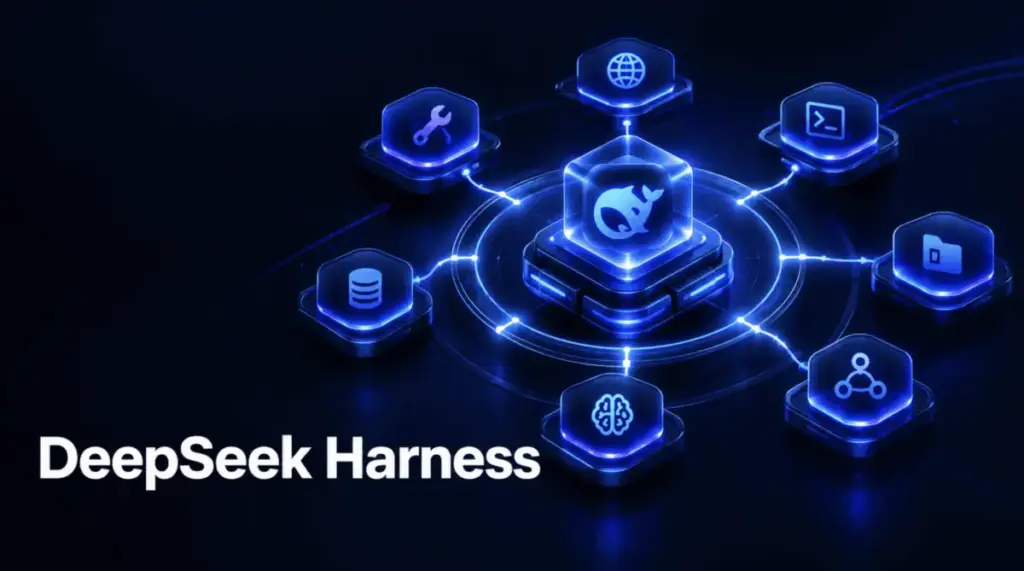
On August 13, 2026, DeepSeek quietly open-sourced an agent runtime called DeepSeek Harness, operating under the command-line interface name dsh, and the reaction from the global software engineering community was anything but quiet. The newly launched repository quickly captured the attention of developers worldwide, picking up roughly 50,000 stars on GitHub in its first twelve hours of public availability. That momentum continued to accelerate dramatically, pushing past 92,000 stars by hour twenty-eight, and ultimately surpassing 186,000 stars alongside more than 20,000 forks within its first ten days. Such rapid adoption represents an extraordinary velocity even within the fast-moving landscape of modern artificial intelligence tooling, prompting researchers and engineers alike to examine what lies beneath the surface of the project to understand what earned it such unprecedented traction.
What’s the Buzz About DeepSeek Harness?
The central claim repeated across DeepSeek’s documentation for the project is a radical structural proposition: literally every layer of an autonomous agent is treated as a modular plugin. This includes the model adapter, the tool registry, the session log, the sandboxing environment, the user interface, and even the core agent execution loop itself. Rather than inventing an entirely untested framework from scratch for this launch, the runtime is built upon Cordis, a mature plugin framework with a solid production track record. Cordis spent four years running in active production inside the Koishi chatbot project before being adopted by DeepSeek for this new initiative, giving the foundation a level of battle-tested reliability that early-stage developer tools rarely possess at launch. Furthermore, the architectural design is thoroughly documented in an academic paper titled A Programming Paradigm for Spatiotemporal Composability, providing a deeper theoretical and academic grounding than most agent tooling releases typically bother to publish.
To understand the scope of the project, it is essential to look at what it represents fundamentally: this is not a ready-to-use coding agent that developers can simply point at an existing software repository to begin modifying files today. Instead, it is the underlying machinery and modular foundation from which a sophisticated coding agent can be assembled.

This strategy aligns closely with DeepSeek’s history of favoring open infrastructure over walled gardens. In January 2025, the release of DeepSeek-R1 made waves globally as the first open, MIT-licensed frontier-class reasoning model originating from outside the traditional Silicon Valley and Western laboratory ecosystem. Trained for a fraction of the financial cost required to produce comparable Western models, DeepSeek-R1 fundamentally reset industry assumptions regarding who gets to ship frontier artificial intelligence capabilities in the open. The launch of DeepSeek Harness reads like that exact same strategic instinct applied one layer higher up the technology stack. Rather than limiting open-source contributions to open weights alone, the organization has delivered open agent infrastructure, published publicly at the exact moment of the initial announcement rather than teased through months of pre-release marketing.
What I Found When I Ran It
Because the project ships as a standard npm package, developers can install and inspect it directly from the command line using standard package execution tools. Running a quick version check reveals version 0.1.5-rc.2, matching the version history recorded on the project’s official GitHub releases page and confirming that the package is an active, current installation rather than a placeholder. Examining the command-line interface help output demonstrates a flexible architecture centered around distinct profiles. Commands allow developers to boot a web-based user profile, run headless single-task operations where the system answers a prompt and exits immediately, or utilize terminal user interface and rescue profiles. Each of these profiles is ultimately just a different stack of mounted plugins operating under the same unified launcher. Furthermore, package management commands treat installing new agent capabilities as an ordinary package installation procedure rather than relying on a separate, proprietary mechanism.
One of the most revealing diagnostics available in the runtime is a specific configuration flag designed to print the entire composed plugin tree for a profile before it boots. When executed against the default web profile, the system outputs a list of 152 separately named, independently swappable plugins. This granular breakdown includes everything from the sidebar and chat window down to the approval prompt, the sub-agent panel, and scheduling interfaces that ship within the codebase but remain disabled by default. Each component operates as its own installable package possessing a distinct identifier. Observing this behavior confirms that the architecture is not merely a marketing slogan, but a genuinely fine-grained plugin system that decouples individual user interface panels and backend handlers that conventional tools typically integrate into a single monolithic frontend.
Testing the headless operational path without a pre-configured model API key further illustrates the thoughtfulness of the engineering. Attempting to execute a simple prompt immediately triggers a clean, highly specific error message indicating precisely which environment variable needs to be established or where the web user interface model configuration page would store the required credentials. This level of error handling reflects a deliberate focus on developer experience, ensuring that failure cases provide actionable guidance rather than dumping raw, uninformative stack traces onto the terminal.
My Take
The genuinely distinctive architectural bet driving DeepSeek Harness is not simply its high plugin count, but the fact that the core agent loop itself is treated as just another swappable plugin. In conventional developer tools, altering how the core reasoning loop functions typically requires editing a compiled binary or navigating rigid internal codebases. Within this runtime, the execution loop resides in an ordinary package that can be swapped out via configuration settings in the exact same manner a user would swap a visual user interface panel. This represents a profound architectural departure from traditional extensible software design, and it explains why engineers specializing in advanced agent infrastructure are paying close attention to the project.
At the same time, these architectural strengths do not mean the runtime is ready for broad, mainstream recommendations just yet. The project explicitly and repeatedly identifies itself as a developer preview, and the surrounding ecosystem is still in the process of forming. Independent community plugin directories have begun cataloging early community contributions, highlighting a vibrant but undeniably young ecosystem of add-ons and extensions.
Who Should Actually Care Right Now
For software engineers who focus on building underlying agent infrastructure, or for developers who frequently need to swap out session stores, logging backends, or sandboxing environments without forking monolithic codebases, DeepSeek Harness is well worth examining today. The underlying architecture is sound, and the software is genuinely functional rather than remaining in the realm of conceptual vaporware. However, for practitioners whose primary objective is finding a daily-driver coding agent to immediately replace existing developer assistants in their everyday workflow, this tooling is not yet positioned for that role, and the project’s maintainers make no effort to pretend otherwise.
Shittu Olumide is a software engineer and technical writer passionate about leveraging cutting-edge technologies to craft compelling narratives, with a keen eye for detail and a knack for simplifying complex concepts.