









Every digital project experiences its zenith on launch day. The final branch of code merges cleanly, the staging environment transitions seamlessly to production, and the site goes live precisely as envisioned by its creators. For a brief, shining moment, the website is perfect. Yet, industry veterans know a sobering truth: it will never be this good again.
This decline is rarely the result of catastrophic failure. The underlying infrastructure rarely collapses overnight, and the links generally continue to resolve. Instead, the decay is quiet and relentless. The broader market shifts, corporate messaging evolves, competitors roll out innovative features, and the carefully crafted digital ecosystem slowly stops reflecting the living, breathing company behind it. A year later, a website can easily feel like a period piece—not strictly broken, but fundamentally behind the times.
Web development and design teams across the globe are intimately familiar with this lifecycle of digital decay, long treating it as an immutable law of nature. However, emerging paradigms in artificial intelligence and automation suggest it does not have to be this way. The modern vision of an autonomous website proposes that a digital property should continuously improve after launch, quietly self-optimizing while the human team focuses on high-level creative and strategic initiatives.
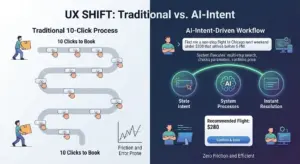
Imagine a scenario where automated agents operate overnight. While the development team sleeps, an agent detects that a recent design-system update failed to propagate correctly to the pricing page and automatically implements a fix. Another agent identifies a batch of high-resolution images shipped uncompressed during a rushed morning deployment and optimizes their delivery formats. A third agent flags an accessibility regression introduced by a newly integrated component, either resolving the issue independently or flagging it for human review. In this ideal vision, stakeholders wake up to a site that is measurably superior to the one they left the evening before, accompanied by a concise log of decisions that genuinely required human judgment.
Yet, as platform developers and engineers begin turning this theoretical promise into tangible software, they consistently run into a fundamental hurdle that has very little to do with raw technology: almost nobody actually wants a website that changes entirely on its own.
Why "Just Make It Autonomous" Is the Wrong Goal
When engineering teams first gain access to highly capable artificial intelligence agents, the most obvious initial impulse is to hand over the entire digital property. The instinctive goal becomes letting autonomous systems write, edit, optimize, and publish content without human intervention, effectively getting out of the way of the technology. It sounds like the natural endpoint of web automation and serves as the primary mental image conjured whenever industry professionals discuss the concept of an autonomous website.
However, software creators are discovering that this is precisely what users reject once the capability is deployed in front of them in a real-world production environment.
This realization emerged firsthand during the development of Fimo, an autonomous website platform created by Pierre Burgy and his team. Setting out with the explicit mission to build fully autonomous websites, the developers assumed that complete independence was the ultimate objective. Instead, they watched as early adopters hesitated. This hesitation stemmed not from a deep-seated distrust of artificial intelligence capabilities, but from the organizational reality that a corporate website possesses no single, monolithic owner.
Different sections and layers of a website belong to different stakeholders within an organization, and each stakeholder demands a vastly different threshold of autonomy. Consequently, the core engineering challenge was never a simple binary choice of whether or not to trust autonomous agents. Rather, the central dilemma revolved around determining precisely where to draw the line, and establishing who holds the authority to draw it.
When approached through this nuanced lens, the sprawling universe of website management splits cleanly into distinct operational categories.
Most Website Maintenance Is a No-Brainer
Analyzing the daily workload required to maintain a modern web property reveals that a massive percentage of the burden consists of rule-bound, repetitive, and entirely mechanical tasks. Ensuring ongoing accessibility compliance as layout pages dynamically evolve, propagating a design-system update once a core design token shifts, catching a broken meta tag, optimizing an overlooked image asset, or repairing a uniform resource locator that rotted when a site structure was reorganized three sprints ago all fall into this category.
None of these chores represent the domains where human talent, creativity, or strategic vision truly live. Professionals are rarely hired for their unique, inspired gift for spotting a missing alternative text attribute on an illustrative graphic. Consequently, this administrative upkeep represents the exact type of labor that teams are actively relieved to offload.
These repetitive duties happen to be the exact domain where artificial intelligence agents excel, precisely because the work is defined by rigid operational rules rather than subjective artistic taste. An autonomous agent quietly maintaining this foundation across an enterprise-grade website without constant human supervision does not threaten anyone’s professional role. Instead, it successfully absorbs the tedious eighty percent of website maintenance that drains team morale.
Recognizing the sheer volume of labor that lives within this administrative category fundamentally alters how the concept of website autonomy is perceived. Teams are not delegating core creative judgment; they are simply handing over routine digital chores.
Some Responsibilities You Would Never Hand Over
At the opposite end of the operational spectrum sits a small, highly protected category of work: tasks that experienced professionals would refuse to delegate at any conceivable price. This domain represents only a fraction of total website operations, yet it forms the primary justification for why creative teams exist in the first place.
An autonomous agent can easily evaluate a newly drafted landing page against an exhaustive checklist of programmed rules. It can verify that color contrast ratios pass regulatory thresholds, confirm that heading tags follow a strict numerical hierarchy, check that design tokens match system variables, and ensure the copy adheres strictly to a corporate style guide.
What an artificial intelligence agent fundamentally cannot do is decide what emotional resonance the page should evoke, or determine whether the asset being shipped is genuinely good in the qualitative, taste-driven sense of the word. That specific brand judgment is precisely what design and marketing professionals are hired to provide, and no amount of computational capability will ever remove that responsibility from a human desk.
This is the exact domain that professionals instinctively protect when they initially resist the wave of automation, and their cautious stance is entirely justified. The critical mistake lies in assuming that an entire website is composed exclusively of this kind of subjective, high-touch work. In reality, very little of a website requires this level of bespoke human oversight. Yet, because that small fraction carries disproportionate importance for brand identity, automating everything indiscriminately feels deeply unsettling.
The Operational Line Depends Entirely on Who You Are
Between the routine chores of baseline maintenance and the untouchable realm of core creative judgment lies a vast middle ground. Commercial software products cannot arbitrarily determine where this boundary should rest for an organization, because the operational line runs through radically different places for different individuals within the exact same company.
Consider a concrete operational change: modifying a website’s default presentation theme to dark mode for all incoming visitors. An autonomous agent possesses the technical capability to execute this adjustment across a global codebase in a matter of seconds. The real debate centers on who holds the authority to decide whether that change should happen at all.
For a brand designer who fiercely guards the organization’s visual identity, the default theme setting is not merely a technical configuration toggle. It represents a definitive statement regarding how the brand intends to present itself to the world upon first impression, and the designer expects to retain absolute control over that aesthetic call. Conversely, for a front-end developer tasked with managing implementation details, updating a default theme is a routine one-line parameter change backed by clear technical rationale—precisely the kind of mundane adjustment they would happily let an autonomous agent apply so they can move on to more complex architectural challenges.
This dynamic illustrates a fundamental truth: the exact same operational task carries drastically different amounts of subjective judgment depending on the stakeholder evaluating it. For one professional, the action represents a strategic brand decision; for another, it is a minor technical chore.
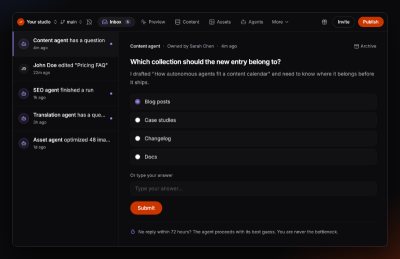
No pre-packaged software setting can ever accommodate both perspectives out of the box, because the definition of the correct action is a direct function of where an individual’s professional value lies, rather than an inherent property of the task itself. This reality necessitates granular, per-task, and per-person control frameworks, moving past rigid global configurations in favor of flexible boundary-setting tools.
Building and Composing the Agents Themselves
Once an organization accepts that the operational boundary is entirely personal, a simple binary toggle between asking for manual approval and granting full delegation ceases to be sufficient. Because the exact location of the line depends heavily on the specific function an agent performs, the true unit of control shifts from a settings menu to the agentic architecture itself.
Rather than choosing from a static menu of rigid platform behaviors, modern platforms allow teams to compose custom agents, explicitly defining the boundaries of what each distinct digital entity is permitted to touch. Organizations can build specialized agents from the ground up or adapt existing templates to align with internal comfort levels. An enterprise might deploy an accessibility compliance agent granted full autonomy to run unattended across production environments, while simultaneously keeping a content-generation agent on a tight leash whenever brand-facing copy is involved.
Furthermore, these agents are not static entities frozen in time. They learn iteratively from the execution of their assigned tasks and from direct feedback provided by human supervisors. Consequently, the operational boundaries established last month do not permanently restrict current workflows. Tasks that initially required rigorous manual sign-off can gradually transition toward automated delegation—not because human teams lowered their standards, but because the autonomous agents steadily earned that trust over time.
Starting Narrow and Widening the Scope as Trust Grows
Embracing website autonomy does not require flipping a digital switch to full independence on day one. In practical deployment scenarios, the process moves in the exact opposite direction, mirroring traditional mentorship models. Teams begin by delegating a remarkably narrow slice of responsibility, closely observing the agent’s performance, and gradually loosening operational constraints as empirical confidence builds.
This oversight is fully transparent. Every agent execution, historical log, and diagnostic trail—including a side-by-side comparison of the state of the codebase before and after an automated intervention—remains accessible for thorough inspection. Trust does not accumulate simply because users become accustomed to the abstract concept of artificial intelligence; it grows because supervisors can visually inspect what occurred, evaluate the accuracy of the intervention, and compare outcomes against expectations. The first time an autonomous agent quietly resolves a subtle layout error that human reviewers would have otherwise missed, subsequent delegation steps become significantly more intuitive.
Establishing clear operational boundaries and fallback mechanisms prevents human supervisors from becoming a restrictive bottleneck for the very processes they have already offloaded. By defining the operational parameters once, teams step aside, ensuring the entire digital infrastructure no longer grinds to a halt waiting for human sign-offs.
The Frozen Site as the Real Operational Risk
When organizations first encounter the concept of fully integrated website automation, their immediate vocal concern centers on the fear that an autonomous agent might unexpectedly alter a public-facing page without explicit supervision. Industry leaders suggest turning that perspective around entirely: the true operational risk facing modern enterprises is a website that never changes at all.
A frozen, stagnant digital property does not inherently stay secure or preserve brand integrity. Instead, it quietly falls behind the demands of the market in a subtle, incremental manner that often goes unnoticed until the outdated web presence no longer matches the actual maturity of the underlying company.
The ultimate objective of introducing website autonomy was never to remove human creators from their digital homes. Rather, the core mission is to systematically eliminate digital decay. By allowing automated systems to shoulder routine maintenance, teams can reclaim their time and apply human judgment to the vital fraction of decisions that genuinely deserve creative oversight, while the remainder of the digital ecosystem maintains itself.