











Recent weeks have brought a wave of industry anxiety, panicked headlines, and widespread confusion regarding massive potential fines, drastic enforcement measures, and sweeping new artificial intelligence regulations across the European Union. However, a closer examination of the official framework reveals a much more targeted and fundamentally practical reality. Rather than introducing an impossible bureaucratic hurdle for every digital creation, the incoming mandates primarily focus on making artificial intelligence transparent and immediately obvious when transparency genuinely matters—most notably when dealing with AI-generated or synthetically manipulated content that could easily be mistaken for human work.
Beginning August 2, 2026, formal AI labelling transitions from a recommended best practice into a strict legal requirement for any enterprise that serves citizens within the European Union. Much like the broad geographic scope of the European Accessibility Act or the General Data Protection Regulation, these transparency obligations are not restricted exclusively to homegrown European corporations. Instead, the mandate applies universally to any organization worldwide with operational reach into the EU, provided that their artificial intelligence outputs are actively utilized, viewed, or consumed by people residing within member states. As product designers, developers, and corporate legal teams scramble to assess their compliance postures, understanding the exact scope of these regulations has become an urgent operational priority.
What Actually Needs Labelling
The core philosophical objective underpinning the EU’s AI labelling framework is straightforward: to help every individual exposed to digital media and synthetic outputs easily recognize, in a clear and distinguishable way, that the content has been artificially generated or substantially manipulated. According to Article 50, Paragraph 4 of the landmark AI Act, mandatory disclosure rules apply to specific categories of synthetic output, covering both the providers who build or supply underlying machine learning systems and the deployers who integrate them into consumer-facing environments.

Under the legislative framework, companies cannot evade their responsibilities under Article 50 simply by licensing an external, off-the-shelf artificial intelligence tool from a third-party vendor. Legal accountability is shared across the supply chain. At the same time, however, the regulation explicitly clarifies that this does not mean every single piece of AI-assisted output across the digital landscape must be explicitly tagged with a warning label.

The vast majority of everyday AI-assisted workplace productivity tasks—such as drafting internal emails, brainstorming rough concepts, or organizing unstructured data—fall entirely outside the scope of these new transparency rules. Most notably, the statutory disclosure obligation does not apply in professional contexts where AI-generated text has been thoroughly reviewed, vetted, and edited by a human editor, with a named individual or legal entity taking formal editorial responsibility for the final published output.
Ambiguity frequently surrounds what constitutes matters of "public interest," a critical boundary defined under the law as touching upon health, safety, the environment, economic stability, financial systems, politics, science, or culture. If commercial product claims or corporate communications generated by artificial intelligence intersect with these sensitive domains, the disclosure rules take immediate effect. Furthermore, legal analysts and specialized corporate law firms strongly recommend labelling realistic AI-generated illustrations, composite images, and synthetic photographs as a standard cautionary measure for advertising, marketing campaigns, and other public-facing commercial materials. Any AI-generated product illustration, poster, or marketing photo that closely resembles a real person, place, physical object, or historical event requires a visible disclosure.

The Fine Line Between Edited and AI-Generated Content
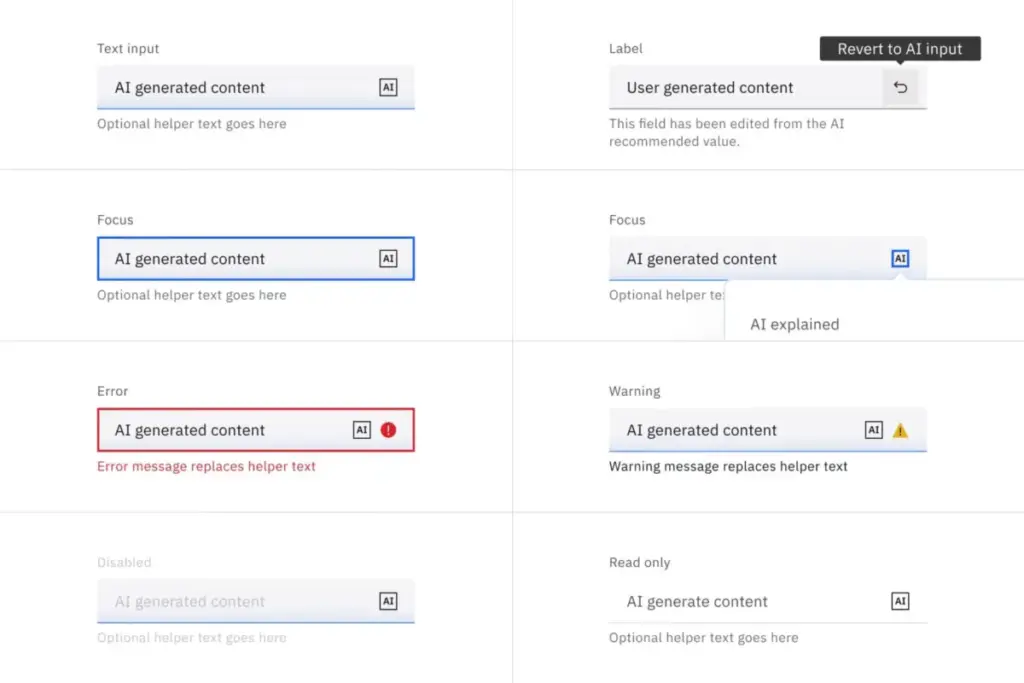
A persistent challenge for product teams and content creators involves determining the precise threshold where human-edited artificial intelligence content ceases to be classified as pure AI content. For instance, when an enterprise software form is automatically pre-filled by an algorithm and a human user subsequently edits the fields, does the resulting dataset retain its artificial intelligence classification? The European Commission’s official guidance on this matter remains somewhat nuanced. Small, routine assistive edits—such as automated spellchecking, basic grammar corrections, structural formatting, image cropping, simple color correction, and machine-driven language translation—do not legally constitute AI generation.
Conversely, complex system operations like automated text summarization, composite imagery synthesis, substantive semantic rewrites, or the programmatic addition and removal of elements from a base photograph are definitively categorized as AI generation. In practice, refining a rough sentence drafted by a human writer is permissible without a label, but generating that sentence from scratch via a prompt requires an explicit public disclosure.

Furthermore, the legal threshold cannot be satisfied by a superficial glance. The argument that a human simply "skimmed the text before publishing" does not qualify as an adequate editorial review. The European Commission is explicit that the human intervention must be substantive, backed by a named individual who assumes clear editorial accountability. The fundamental dividing line rests between intentional manual intervention and automated generation, with the latter always requiring clear disclosure unless deployed entirely within closed business-to-business environments.
Why AI Sparkles Are Probably Not Enough
As an essential component of the newly established Code of Practice, the European Commission has published an official set of EU AI icon assets. This collection introduces a specific, standardized "AI" visual mark designed to provide a clear and distinguishable signal, moving away from the ambiguous "sparkle" or magic wand symbols that many software products currently rely on to indicate smart capabilities.

The ubiquitous sparkle icon is increasingly viewed by regulators as too ambiguous for compliance purposes. Historically, software companies have used sparkles to denote an AI-powered feature embedded within a user interface rather than explicitly signalling that a specific piece of content was autonomously generated by an algorithm. This dual usage creates user confusion, which the new EU guidelines explicitly aim to resolve.
The European Commission’s guidance explicitly states that deploying an arbitrary icon does not establish legal compliance by itself. A barely discernible icon, a text notice buried deep within a website footer, or a label that flashes momentarily on screen fail to meet regulatory standards. Instead, visual signals must be clearly visible, accompanied by plain-language text labels, and fully accessible to assistive technologies utilized by individuals with disabilities. A reliable compliance strategy involves pairing any visual icon with persistent plain text, such as an explicit "AI-generated" tag, which must remain permanently attached to the asset even when the file is downloaded or reshared across digital platforms.

A Global Regulatory Pattern
While European regulations often appear to arrive as an isolated wave of bureaucratic oversight, they form part of a much broader, international regulatory movement. Similar transparency and disclosure frameworks have recently emerged across various global jurisdictions. California has introduced specific restrictions concerning synthetic digital replicas of performers, while federal and state agencies in the United States have steadily tightened rules surrounding artificial intelligence usage in political advertising and commercial disclosures. Similar legislative initiatives are advancing across international markets, pointing toward a cohesive global pattern rather than an isolated coincidence. Organizations shipping artificial intelligence features are well-advised to establish comprehensive internal policies governing precisely which outputs require labelling and which remain exempt.
Ultimately, these regulatory developments are rooted in a straightforward principle shared by lawmakers worldwide: when artificial intelligence content can easily be mistaken by the public for authentic human creation, creators and deployers must say so clearly, obviously, and unambiguously. Far from serving as an insurmountable barrier to innovation, these transparency standards offer a vital mechanism to help consumers differentiate authentic human expression from synthetic media, benefiting both the digital marketplace and the broader public interest.