










Every website is at its absolute best the day it ships. The final code branch merges, the platform goes live exactly as designed, and it is briefly, brilliantly perfect. Yet, industry veterans know a sobering truth: a website will never be this good again. This decline does not happen because something breaks or servers crash. Rather, the market moves, messaging shifts, competitors launch new features, and the carefully crafted digital property slowly stops matching the reality of the company it represents. A year later, it often feels like a period piece—not strictly broken, but quietly and undeniably behind.
Every web development and marketing team knows this slow decay, and almost everyone in the industry has historically treated it as an immutable law of nature. Maintaining a website takes an immense amount of continuous human effort, and because attention is finite, digital properties inevitably drift from their peak state. However, recent developments in artificial intelligence and automation suggest it does not have to be that way. Industry thinkers argue that a website could keep improving after launch instead of slowly drifting away from its prime, quietly optimizing itself in the background while the creators focus on higher-level strategic work.
To picture this future in action is to imagine a seamless digital ecosystem. While the development team sleeps, an autonomous agent detects that the previous week’s design-system change failed to propagate correctly to the pricing page, and automatically rectifies the discrepancy. Another agent flags a set of images that were accidentally shipped uncompressed during a rushed release cycle and instantly optimizes them for performance. A third system catches an accessibility regression introduced by a newly deployed component, either fixing it outright or flagging it for human review. In this scenario, stakeholders wake up to a digital property that is measurably better than the one they left the evening before, accompanied by a concise, manageable list of high-level decisions requiring human intervention.

Yet, the moment platform developers take this promise seriously, they run into a fundamental psychological and organizational hurdle that has very little to do with raw technology: almost nobody actually wants a website that changes entirely on its own.
Why "Just Make It Autonomous" Is the Wrong Goal
The most obvious move for software developers equipped with capable artificial intelligence agents is to hand over the entire website. The logic suggests letting algorithms write, edit, optimize, and publish content while humans step out of the way. It sounds like the natural endpoint of web automation and is typically the first picture people paint when discussing autonomous websites.
However, it is also the exact configuration that almost nobody wants once it is placed in front of them in a real-world environment. Pierre Burgy and his team learned this reality through direct experience while building Fimo, an autonomous website platform. Initially setting out to construct fully autonomous web properties under the assumption that absolute autonomy was the ultimate goal, the team observed how users actually interacted with the software.
Instead of eagerly handing over the keys, users hesitated. This hesitation did not stem from a deep-seated distrust of artificial intelligence capabilities. Rather, it highlighted a fundamental organizational truth: a website has no single, monolithic owner. Different sections, features, and layers belong to different stakeholders across an organization, and each stakeholder demands a vastly different threshold of autonomy. Consequently, the core challenge was never about whether to trust the underlying technology; it was about determining where to draw the boundary of control, and for whom. Once framed in this manner, the broader landscape of website maintenance splits cleanly into distinct categories of human and machine responsibility.
Most Website Maintenance Is a Routine No-Brainer
To understand how autonomy can successfully integrate into web management, it helps to examine the largest pile of tasks required to keep a digital property healthy—a volume of work that is typically much larger than most people expect. The vast majority of what keeps a website functioning correctly is rule-bound, repetitive, and entirely devoid of creative joy. This includes maintaining accessibility compliance as pages evolve, propagating a design-system update across dozens of templates once a core token changes, catching broken meta tags, compressing uncompressed images, or repairing links that rotted when a URL structure shifted three sprints ago.
None of this operational overhead is where professional talent truly thrives. Organizations do not hire brilliant designers or developers for their gift at spotting missing alternative text attributes or validating contrast ratios. In fact, this maintenance layer represents the exact type of labor that technical teams are actively relieved to hand off. Furthermore, it is precisely the kind of work artificial intelligence agents excel at, because success here is defined by rigid rules rather than subjective taste.
An agent that quietly keeps this foundational layer correct across an entire web property, operating unattended in the background, does not pose a threat to anyone’s job security. Instead, it handles the tedious eighty percent of digital maintenance that usually falls through the cracks due to human fatigue and shifting priorities. Acknowledging how much of the maintenance load lives in this category transforms the concept of an autonomous site from an intimidating leap into a practical relief, removing chores rather than human judgment.
Some Core Creative Work Should Never Be Delegated
At the opposite end of the spectrum sits the critical work that teams would refuse to delegate at any price. This category forms a much smaller pile of tasks, but it is precisely the reason creative and strategic teams exist in the first place.
An agent can evaluate a newly drafted web page against every programmatic rule imaginable. It can confirm that color contrast passes regulatory thresholds, heading hierarchies are properly structured, design tokens are accurately applied, and copy strictly adheres to an established style guide. What an artificial intelligence agent fundamentally cannot do is decide what a page should emotionally feel like, or determine whether the asset being shipped is genuinely good in the subjective sense of human taste. That level of nuanced judgment is precisely what digital professionals are hired to provide, and no advancement in computational capability removes that responsibility from a human desk.
This untouchable creative core is the first thing people point to when resisting the broader concept of website automation, and their instinct to protect it is entirely correct. The critical mistake lies in assuming that an entire website is composed exclusively of this kind of high-level creative work. In reality, almost none of it is. Yet, that small fraction of creative judgment matters far more than all the routine maintenance combined, which explains why the idea of automating everything feels fundamentally counterintuitive to many professionals.
Autonomy Depends Heavily on Individual Roles
Between the routine chores and the untouchable creative decisions lies a vast middle ground that no off-the-shelf product can standardize, because the line of acceptable autonomy runs through entirely different places for different people.
Consider a concrete operational change, such as making dark mode the default theme when a visitor lands on a corporate website. An autonomous agent can execute this structural shift in a matter of seconds. The real question is who possesses the authority to decide whether that change should happen at all. For a brand designer who owns the visual identity and emotional resonance of the site, a default theme is not merely a technical setting; it is a definitive statement about how the brand wishes to present itself to the world on first impression, and they want direct control over that call.
Conversely, for a software developer tasked with implementing performance and user experience updates, shifting to a dark mode default is a straightforward one-line configuration backed by clear usability rationale—the exact kind of task they would happily allow an agent to apply so they can move on to more complex engineering challenges. Analyzing this scenario reveals a fascinating dynamic: the hesitation does not stem from one person being excessively cautious and another being reckless. Rather, the exact same task carries entirely different dimensions of judgment depending on the stakeholder. For one professional, it represents a critical brand decision, while for another, it is simply an administrative chore.
Because of this divergence, no universal software default can ever satisfy every department within an organization. Rightness is a direct function of where an individual’s professional value lies, not an intrinsic property of the task itself. This reality necessitates that digital control mechanisms must be structured on a per-task and per-person basis, providing tools detailed enough to let individuals draw their personal boundaries with precision.
Building and Composing Task-Specific Agents
Once an organization accepts that the boundary of autonomy is deeply personal, a simple binary toggle between manual approval and full delegation ceases to be adequate. Because the exact placement of the line depends entirely on what a specific agent is designed to do, the true fundamental unit of control shifts from a global setting to the agent itself.
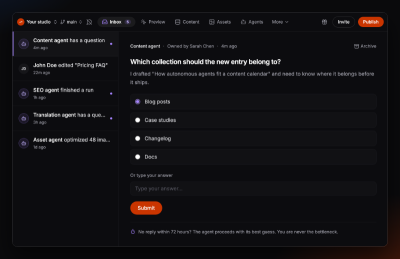
This realization fundamentally shaped platforms like Fimo, steering developers away from fixed menus of rigid behaviors toward a modular composition model. Instead of accepting a pre-packaged suite of automation tools, administrators compose their own agents, explicitly defining what each individual system is permitted to touch. Teams can construct agents from scratch or adapt existing templates to align with their specific comfort zones—deploying an accessibility agent with full autonomy to run unattended while keeping a content agent strictly tethered to human oversight for anything customer-facing or brand-sensitive.
Furthermore, these systems are not static. They learn from their operational history and from direct feedback provided by human supervisors. Consequently, the strict boundaries established last month do not have to remain permanent. Tasks that initially required mandatory human approval can gradually transition to automated delegation over time, not because human standards slipped, but because the underlying agent consistently earned that trust. The line of control ceases to be a static configuration panel and instead evolves dynamically alongside the working relationship between human professionals and artificial intelligence.
Starting Narrow and Widening the Scope of Trust
Adopting website autonomy does not require flipping a switch to full automation on day one. In practice, implementation flows in the opposite direction. Teams typically delegate a narrow set of low-risk responsibilities, monitor how the system performs, and gradually loosen restrictions as competence is proven.
This monitoring process is transparent. An agent’s execution runs, historical logs, system outputs, and direct before-and-after comparisons of every modified file remain fully accessible for human inspection. Trust does not grow simply because a team gets used to the abstract concept of automation; it builds because administrators can empirically review what happened and evaluate the results. The first time an autonomous system quietly resolves a minor regression that human teams would have otherwise missed, subsequent delegations become significantly easier to authorize.
Deadlines prevent human stakeholders from becoming operational bottlenecks on processes they have already formally delegated. If a reviewer fails to weigh in on an agent-proposed optimization within a designated window, the system can proceed safely based on pre-established parameters. Teams configure the governing terms once, permanently removing themselves as the central point of friction that the entire web publication pipeline waits upon.
Confronting the Real Risk of the Frozen Site
The primary anxiety voiced by digital teams exploring automation is the fear that an agent might alter their website without explicit, real-time oversight. However, industry advocates suggest reversing that perspective: the genuine, compounding risk is a digital property that never changes at all.
A frozen, static website does not remain safe or pristine over time. It merely falls behind competitors slowly, in a subtle manner that often goes unnoticed until the outdated digital presence no longer accurately represents the active enterprise behind it. The core purpose of introducing autonomy into web management was never to remove human creators from their websites, but rather to systematically remove the invisible decay that accumulates over months of neglect.
By leveraging automated systems to maintain foundational hygiene, digital teams can preserve their launch-day quality indefinitely while redirecting their finite creative judgment toward the handful of strategic decisions that genuinely deserve human attention. Drawing clear boundaries around professional value, empowering agents to handle everything else, and letting those boundaries expand as trust is established offers a sustainable path forward for modern web operations.