Naming things is universally acknowledged as one of the hardest problems in computer science and digital design, but a fresh wave of resources, repositories, and community-driven taxonomies aims to bring order to the chaos. Across the tech industry, the language we choose shapes not only how we conceptualize interfaces and systems, but also how designers, developers, and product managers communicate with one another. When teams struggle to agree on names for colors, icons, UI components, and features, the result is friction, poor feature adoption, and a fragmented user experience.
The core dilemma often stems from choosing names that are either too generic to convey specific meaning or too hyper-specific to allow for flexibility and reuse. To address this persistent industry challenge, leading practitioners and community members have recently released a series of comprehensive guides, design systems, and open-source directories. These resources provide practical frameworks for naming everything from raw CSS classes and design tokens to complex multi-brand product ecosystems and everyday UI components.

How To Name Things
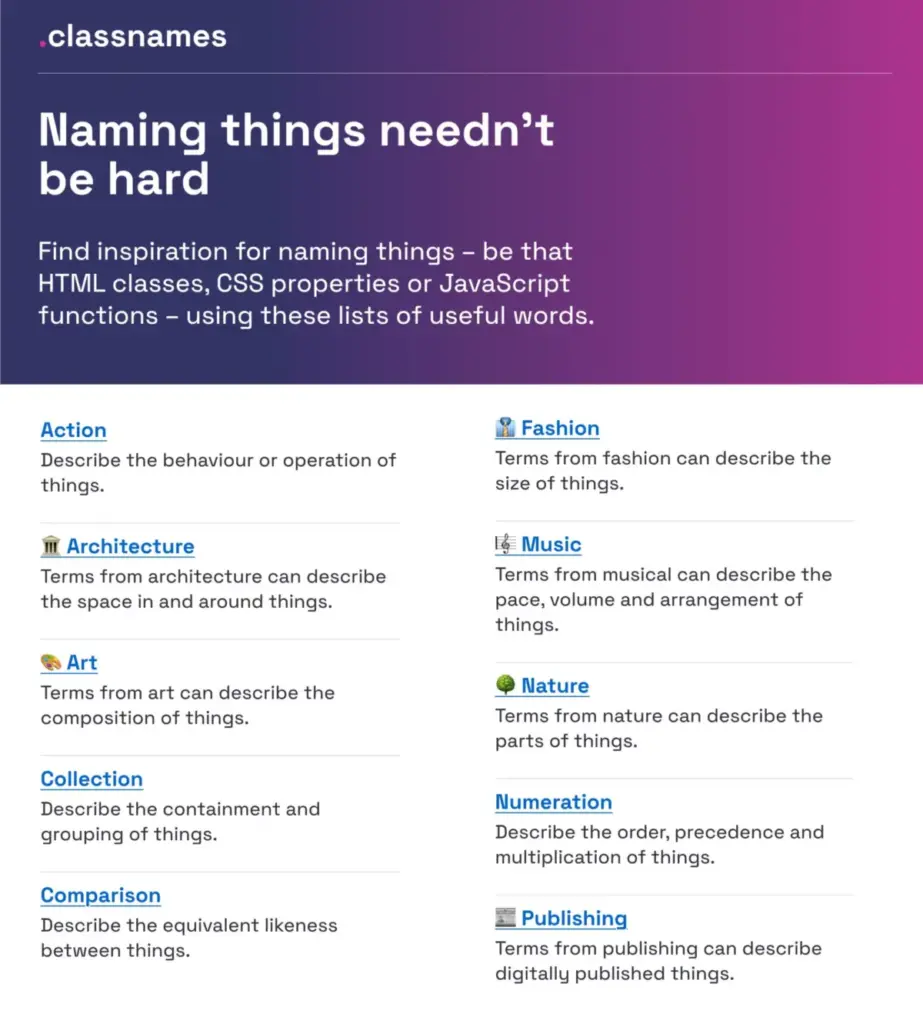
Finding the right vocabulary for code bases, HTML classes, CSS properties, and JavaScript functions often requires breaking out of habitual patterns. To help developers and designers think outside the box, Paul Robert Lloyd maintains "Classnames," a resource packed with ideas and thematically grouped lists of words. Rather than relying on predictable terminology, the site offers terms describing behavior, likeness, order, grouping, and association. It also curates themed collections drawn from unexpected fields such as nature, art, theater, music, architecture, fashion, and publishing, giving creators a richer palette for naming code elements.

How To Name Colors
Choosing the right name for a specific color value has long vexed front-end developers and design system architects. To solve this, David Aerne maintains a massive repository of color names that currently features over 30,000 unique entries sourced from various reference materials and thousands of user contributions. Accompanied by interactive tools such as color pickers and name searches, this repository serves as a vital reference point for teams trying to establish predictable, human-readable color palettes in their projects without resorting to arbitrary hex codes or overly mechanical naming conventions.

How To Name Layers and Groups
In the realm of interface design files, maintaining a clean hierarchy requires disciplined layer and group naming. Javier Cuello has summarized a set of best practices designed to help teams name layers, groups, and components in a consistent and scalable way. According to Cuello, an effective name must possess a logical structure while remaining short, meaningful, universally understood, and detached from transient visual properties. By outlining clear dos and don’ts, these guidelines help designers navigate the nuanced details involved in naming sizes, colors, and structural components within collaborative workspaces.
How To Name Design Tokens
Scaling a design system across multiple enterprise products introduces profound taxonomic challenges. This was the exact hurdle faced by the team at Intuit, the parent company behind major brands such as Mailchimp, QuickBooks, TurboTax, and Mint. To unify these diverse offerings under a cohesive umbrella, the team developed a flexible design token taxonomy capable of extending far beyond any single brand theme.

Nate Baldwin detailed this journey in a comprehensive case study outlining the pain points of their legacy taxonomy, the criteria established for the new system, and the architectural decisions behind its rollout. The insights offer a valuable blueprint for organizations seeking to build robust, scalable token systems that can withstand multi-brand expansion.
Frequent Names For UI Components
When teams find themselves deadlocked over what to call a recurrent interface element, examining established design systems is often the most efficient way forward. To save practitioners from falling down a research rabbit hole, Iain Bean created the Component Gallery, a curated collection of interface components gathered from real-world design systems.

The gallery features examples and alternative naming conventions for more than 50 distinct UI components, ranging from accordions to visually hidden utility elements. This collection is complemented by visual dictionaries like "Name That UI," which help bridge the gap between abstract design patterns and concrete component labels.
How To Name New Features
Beyond internal code and design systems, the names given to user-facing features play a critical role in product success. Poor discoverability is frequently rooted in ambiguous nomenclature, leading to low adoption rates as users struggle to discover, understand, and integrate new tools into their daily workflows.

Erin Gannon has addressed this dynamic in a practical guide focused on feature naming. Gannon argues that successful names must be driven by genuine user needs and problems, signaling the value or outcome of a feature—the job-to-be-done—in the user’s own language. By actively listening to how users describe a feature in qualitative research and incorporating their phrasing, product teams can drastically improve clarity and engagement.
How To Name Variables (Taxonomy Map)
Complex multi-brand and multi-themed environments require sophisticated variable architecture. A prominent example comes from the Vodafone UK Design System team, whose published Variables Taxonomy Map breaks down the anatomy and categorization of design tokens into an organized hierarchy of collections.

Building upon Nathan Curtis’s foundational work on design token naming, the Vodafone map illustrates the four core collections required to support a modern system—spanning brand primitives, semantics, and page-level applications. This structure ensures that any team member can immediately understand where a token is used and what it represents simply by reading its identifier. Additional frameworks, such as Romina Kavcic’s interactive design token naming guide and spreadsheet inventory, provide teams with practical tools to configure their own token structures across components, categories, states, and roles without losing track of their data.
Naming Products or Services
At the highest level of abstraction, naming an entire product or service requires an entirely different set of methodologies. To assist with this creative endeavor, the open-source repository Onym organizes tools, brainstorming frameworks, vetting strategies, sprint guides, and etymological resources. By aggregating expert advice, cautionary tales, and professional agency insights, the platform encourages creators to approach high-stakes naming decisions with structured rigor.

Ultimately, the right name is defined by clarity, mutual understanding, and adoption across both development teams and end users. Countless hours are lost across the technology sector when designers, developers, product managers, and users speak about the same concepts using disparate internal dialects. By addressing these naming conflicts and establishing shared taxonomies, organizations can significantly reduce confusion and foster smoother collaboration across disciplines.