









The lineage of knowledge transfer has historically mirrored human institutions. Long before the invention of writing in ancient Mesopotamia—where laws, history, myths, and songs were passed down orally through storytelling and direct instruction—human society relied heavily on the teacher-student paradigm. History records this dynamic across epochs: Jesus and his twelve disciples, Socrates teaching Plato, and Plato establishing an academy in Athens where he instructed Aristotle for twenty years before Aristotle went on to revolutionize science, logic, and politics.
In the twenty-first century, this profound lineage of knowledge transmission has found a digital equivalent in deep learning artificial intelligence. During the twentieth-century AI winter, when neural networks were widely dismissed as a technological dead end, a lineage of academic mentors and disciples kept the field alive. Geoffrey Hinton, widely regarded as a foundational figure in modern artificial intelligence, ran a laboratory where he mentored pioneers such as Yann LeCun and Ilya Sutskever. LeCun subsequently invented the convolutional neural network, while Sutskever co-founded OpenAI before later establishing Safe Superintelligence Inc.
While human-to-human knowledge transfer remains familiar, the artificial intelligence community has increasingly turned its focus toward machine-to-machine knowledge transfer, a process formally known as model distillation. As modern artificial intelligence systems scale to trillions of parameters, the computational cost, energy consumption, and hardware requirements associated with running these frontier models have skyrocketed. To address these infrastructural bottlenecks, researchers and developers are utilizing distillation techniques to compress massive models into smaller, highly efficient architectures without sacrificing critical performance capabilities.

The Mechanics and Necessity of Model Distillation
Model distillation, frequently referred to as knowledge distillation, is an architectural compression technique designed to transfer the learned behavior of a large, highly accurate neural network to a smaller, computationally efficient model better suited for practical deployment. In this teacher-student dynamic, the smaller student model learns to mimic the outputs and internal representations of the larger teacher model. The ultimate objective is for the student model to approximate the performance of the teacher while operating with significantly fewer parameters.
The necessity of this approach is underscored by the sheer scale of contemporary artificial intelligence. Both closed-source and open-source models are routinely trained on trillions of internal configuration variables, known as parameters, which are learned automatically from vast datasets. Operating these massive networks demands immense funding, specialized hardware, and substantial electrical power. By distilling the accumulated intelligence of these frontier models into smaller counterparts, developers can drastically reduce deployment costs and computational latency.
Exploring Distillation Techniques
The specific distillation technique deployed within a project depends heavily on the nature of the knowledge being transferred. Some methodologies focus exclusively on final predictions, while others capture internal representations, attention maps, reasoning steps, or the comprehensive operational behavior of the teacher model.
Response-based distillation represents the classic teacher-to-student approach, originally introduced by Geoffrey Hinton in foundational research on neural network distillation. This technique relies heavily on the distinction between hard labels and soft labels. Hard labels deal strictly with fixed categorical targets; for instance, when an image of a dog is classified into rigid categories, the model outputs a definitive binary value for the correct class while assigning zero probability to all others.
Conversely, soft labels incorporate probabilistic nuance. When processed through soft labeling, the same image might yield a high probability of belonging to the dog category alongside fractional probabilities of resembling a cat or a horse. In response-based distillation, the student model learns from these probabilistic outputs—often referred to as dark knowledge—enabling the smaller network to capture the nuanced behavior and generalization patterns of the larger teacher. While response-based distillation offers high stability and ease of implementation, particularly in image classification tasks, it operates largely as a black-box approach, ignoring the internal mechanisms through which the teacher arrived at its conclusions.
Feature-based distillation addresses this limitation by transferring the internal feature representations of the larger model rather than focusing solely on final outputs. During training, the student model is compelled to produce hidden layer activations that closely match those of the teacher using metrics such as mean squared error. This ensures that the student is penalized if its internal functional systems diverge from those of the teacher, a technique frequently deployed in convolutional neural networks and vision transformers. However, this method requires the student to continuously access and store internal feature maps during training, leading to elevated memory and power consumption.
Attention distillation shifts the focus toward the regions where a larger model directs its computational attention. In transformer architectures, attention maps indicate which input tokens or regions are deemed most critical for generating accurate predictions. The student model attempts to replicate these attention distributions, effectively learning where to focus when solving complex problems. Despite its effectiveness, attention distillation introduces substantial overhead in training time and computational resources due to the continuous calculation of divergence metrics across massive attention tensors.
Self-distillation offers an alternative path where a model trains itself through knowledge transfer between earlier and later versions or across different internal layers. This approach enhances model performance without necessitating an increase in overall network size or the computational burden of a separate, massive teacher model.
Implementing Knowledge Distillation in Practice
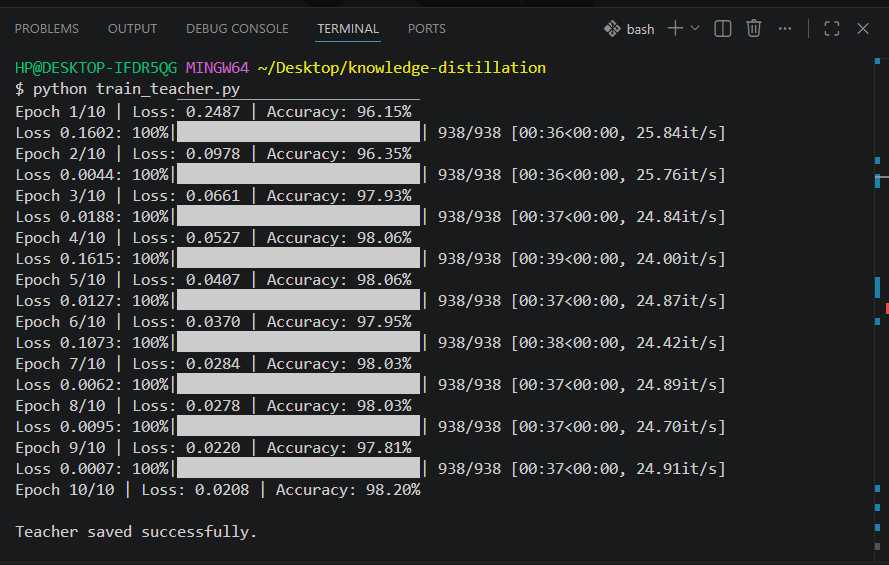
To demonstrate the practical workflow of model distillation, developers frequently turn to frameworks like PyTorch and standard benchmark datasets such as MNIST, which contains thousands of greyscale images of handwritten digits. The standard experimental pipeline involves training a larger teacher network on the dataset, freezing its parameters, and subsequently training a smaller student network using a combination of ground-truth hard labels and soft targets generated by the teacher.
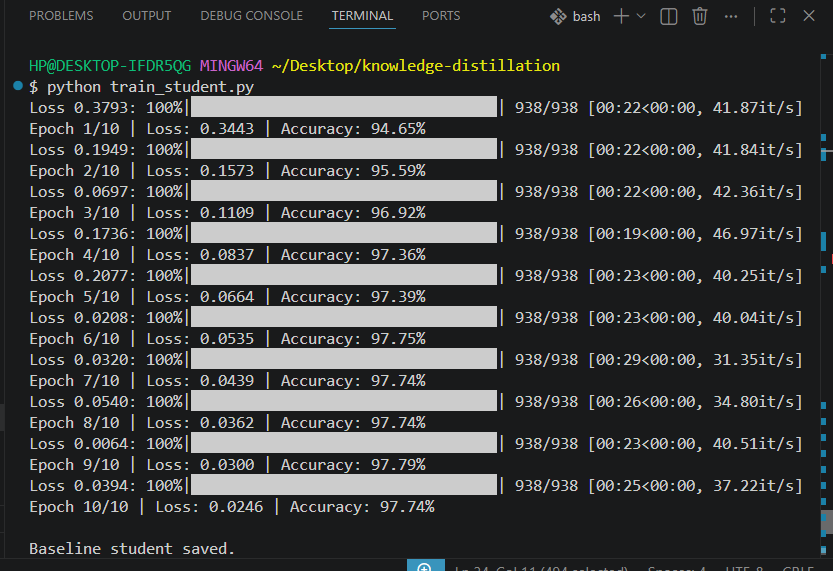
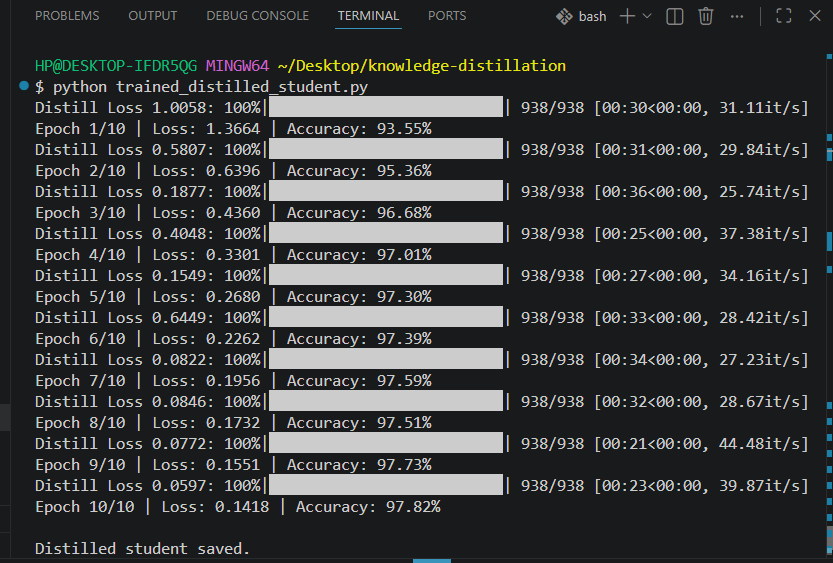
While smaller datasets like MNIST yield modest absolute performance gains compared to massive language models, they illustrate the core mechanics of the distillation workflow. The training process integrates specialized loss functions that balance standard cross-entropy loss against Kullback-Leibler divergence, blending hard and soft target information across training epochs.
Experimental evaluations comparing standalone student networks against distilled student networks consistently demonstrate the value of this approach. While a baseline student model trained independently may achieve high classification accuracy, a distilled student trained under the guidance of a teacher model regularly bridges the performance gap, nearly matching the accuracy metrics of the much larger teacher architecture while maintaining a fraction of its parameter footprint.
Alternative Approaches to Model Reduction
Model distillation is part of a broader ecosystem of optimization techniques aimed at mitigating the computational challenges associated with large neural networks. Quantization achieves efficiency by reducing the bit-width of numerical weights and activations within the network. By converting standard high-precision representations into lower-bit formats, quantization primarily targets memory bandwidth bottlenecks, shrinking file sizes significantly without altering the core network architecture.
Pruning operates on the premise that large neural networks contain redundant, low-impact parameters that contribute little to overall performance. By systematically identifying and removing these weak connections, developers can produce smaller, faster models. Low-rank factorization employs linear algebra to simplify the complex matrix multiplications that dominate deep learning architectures, rewriting intricate operations into streamlined mathematical equivalents.
Ultimately, the choice of optimization technique depends on the specific performance bottleneck a project faces. While quantization effectively addresses memory constraints, pruning and distillation are specifically engineered to reduce computation time and enhance inference efficiency, providing developers with viable pathways for deploying advanced artificial intelligence on consumer-grade hardware, mobile devices, and edge infrastructure.