










There is a persistent gap between what data scientists think employers want and what hiring managers actually write into job descriptions. That gap is widest at the senior level, where requirements have shifted more in the past two years than in the previous five combined. In 2026, senior data scientist postings reflect a field that has moved decisively beyond the traditional era of building models in isolated notebooks. Employers are screening for production-grade technical depth, comfort with artificial intelligence tooling that did not exist two years ago, and a set of business and communication skills that many technically strong candidates still underestimate.
Recent analyses of thousands of active U.S. job postings—including a detailed review of 500 postings from
LinkedIn, Indeed, and Glassdoor, an analysis of over 7,000 postings for AI skill frequency, and comprehensive job market data from Axial Search tracking 12,148 listings—reveal exactly what senior data science roles demand. The findings are specific, and some of them present a stark reality for professionals navigating the current hiring landscape.
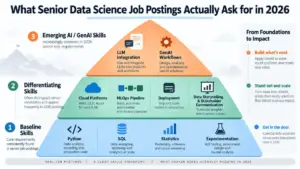
The Baseline Has Risen: What Table Stakes Look Like Now
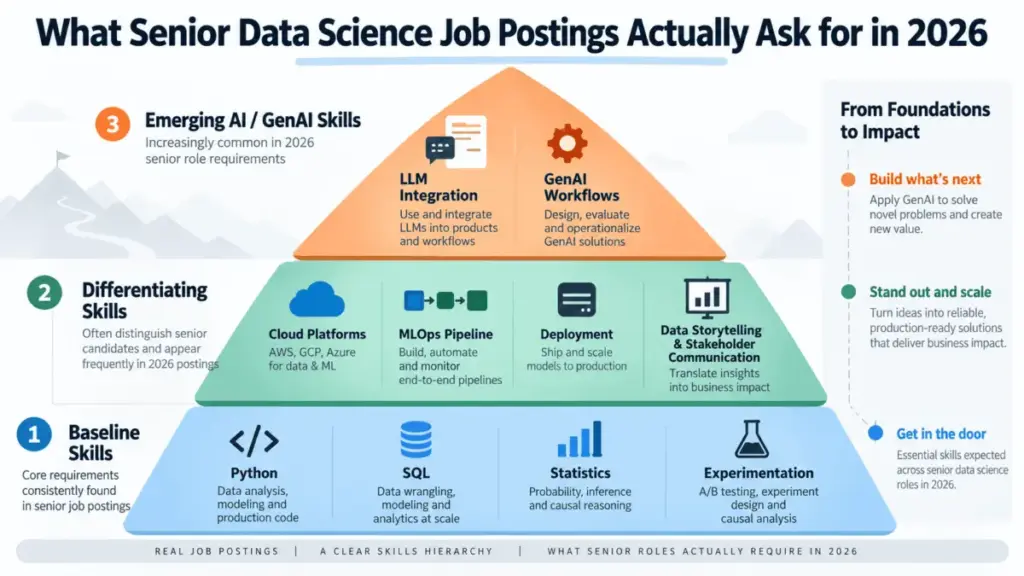
The data makes it clear from the outset that skills once considered advanced have become entry requirements at the senior level. Three core competencies appear in the majority of all data science postings, and none of them are optional. Python continues to dominate as the most frequently required language, appearing in 74% of postings. However, listings have become far more specific about which Python skills they demand. The 2026 market is not looking for basic pandas fluency alone. Senior role descriptions routinely call out scikit-learn for machine learning pipelines, PyTorch or TensorFlow for deep learning, FastAPI or Flask for model deployment, and increasingly, LangChain or LlamaIndex for large language model integrations. If a candidate’s Python skills stop at data manipulation and basic visualization, they sit in the bottom half of the applicant pool for most senior positions.
SQL follows closely behind, appearing in nearly two-thirds of all data science postings, with that number climbing even higher when looking specifically at senior roles. What has changed is the depth expected by hiring organizations. Senior postings increasingly specify advanced capabilities, including window functions like ROW_NUMBER, RANK, and LAG or LEAD, complex common table expressions, nested subqueries, query optimization, execution plan analysis, and familiarity with cloud-native SQL variants such as BigQuery SQL, Snowflake SQL, and Redshift SQL. For senior roles, vanilla SQL is no longer enough.
Furthermore, machine learning appears in 69% of data scientist job postings. At the senior level, the primary emphasis has shifted from building models to owning them across their full lifecycle. Postings now call out MLOps far more consistently than classical algorithm knowledge. Feature engineering and model interpretability tools like SHAP and LIME appear regularly in regulated industries such as finance and healthcare. The clearest signal in the data is that employers want individuals who can deploy and maintain models in production environments, rather than simply training them in experimental notebooks.
What Sets Senior Roles Apart: The Skills That Separate Levels
Beyond the baseline, several skill categories differentiate senior postings from mid-level ones, representing the requirements that most frequently appear at the senior and staff levels. Cloud platform fluency has become structural rather than supplementary. In the analysis of 500 postings, 62% mentioned at least one cloud platform, led by Microsoft Azure, Amazon Web Services, Google Cloud Platform, Snowflake, and Databricks. Senior postings go significantly further than mid-level equivalents by specifying exact cloud services, such as AWS SageMaker for machine learning workflows, AWS S3 and EC2 for storage and compute, Google Vertex AI, Azure ML, and BigQuery for heavy data processing. The underlying message is that a senior data scientist must be able to deploy and scale production systems on their preferred cloud ecosystem.
One notable finding from the market data is that approximately 20% of data science job postings explicitly request a cloud certification, with credentials such as the AWS Certified Machine Learning Specialty, Azure Data Scientist Associate, and Google Professional Data Engineer leading the list. Postings that specify a cloud certification tend to carry noticeably higher salary bands.
Simultaneously, the shift from modeling to production systems has elevated MLOps to a defining technical requirement. Senior postings routinely include tools for model tracking and versioning, workflow orchestration via Apache Airflow, analytics engineering through dbt, containerization using Docker and Kubernetes, and continuous integration and deployment pipelines through GitHub Actions or Jenkins. An analysis of U.S. data science postings found that hands-on technical execution ranks higher than boardroom influence as the defining leadership characteristic employers screen for, meaning senior professionals are expected to build and ship systems personally rather than merely directing others.
Generative AI and large language model skills represent the fastest-growing requirement category. Across 500 postings analyzed, 31% explicitly mentioned generative AI, LLMs, or prompt engineering skills, a figure that was effectively zero just a few years prior. A separate analysis of more than 7,000 postings found that AI skills appear in roughly two out of three postings overall, with about half expecting candidates to have specific AI expertise or a history of working on applied AI projects. These requirements heavily concentrate at the mid and senior levels, confirming that AI fluency is now an expected core competency for experienced practitioners.
Real senior job postings illustrate this pattern directly, with major financial institutions, research organizations, and consulting firms listing full-stack agentic AI skills, hands-on production experience with LLM applications, retrieval-augmented generation, multi-agent systems, and model fine-tuning as mandatory qualifications.
Statistical depth also remains a consistent requirement at the senior level. Postings explicitly call out probability theory, statistical inference, A/B testing and hypothesis testing design, Bayesian statistics, regression analysis, and time series forecasting. The correlation with advanced degrees is strong, as statistics remains the most consistently named foundational skill in roles requiring a master’s degree or a PhD. As automated machine learning tools lower the technical barrier to building basic models, understanding why a model works and when it will fail becomes the critical differentiator.
Data visualization and storytelling appear in more than half of all postings, but at the senior level, the expectation moves beyond basic tool proficiency into executive-level data storytelling. This involves communicating complex model outputs and analytical findings to non-technical decision-makers in ways that directly drive business action. Tableau and Power BI lead the tool breakdown, aligning closely with respective enterprise ecosystems and advanced SQL requirements.
The Credentials Picture: Degrees, Experience, and What Actually Matters
Senior data science roles in the U.S. ask for a median of five years of experience. Progression across seniority levels typically spans two years for junior roles, a median of four years for mid-level positions, five years for senior roles, seven years for principal roles, and a decade or more for director-level positions. The market has noticeably shifted away from entry-level openings, which have become the least common segment, reflecting a selective, senior-weighted hiring environment where mid-level and senior roles remain undersupplied.
Data science continues to be the most credentialed artificial intelligence function in the job market, with 93% of postings requiring a degree. Among those specifying a degree level, roughly 30% require a master’s degree, while a significant portion mention or prefer a PhD, with doctorate-level mentions increasing year-over-year. However, a growing percentage of listings do not specify a degree at all, indicating that demonstrated work is steadily gaining ground relative to traditional credentials. For most industry roles, a master’s degree paired with a strong production portfolio remains the optimal profile, while a PhD adds the most value in research-heavy environments or frontier AI labs. For practitioners without a graduate degree, a portfolio of shipped models, clean repositories, and demonstrated production experience carries more weight than a list of certifications.
Certifications themselves barely register as mandatory requirements in the broader posting data, accounting for a tiny fraction of listings outside of cloud-specific credentials. While cloud certifications appear in roughly 20% of postings and correlate with higher salary bands, hiring managers consistently emphasize that they care far more about portfolio projects than standard certificates.
The Skills That Drive Hiring Decisions
The posting data reveals that communication and cross-functional influence are critical factors mentioned frequently by hiring managers. The ability to communicate insights to non-technical stakeholders and work cross-functionally appears in a substantial portion of all data science listings, with these expectations scaling higher at the senior level. This shift reflects how generative AI has automated basic coding tasks, placing greater value on problem framing, business judgment, and translating technical findings for executive leadership. The ideal senior candidate is someone who builds solutions, explains their mechanics, and connects the output directly to a measurable business outcome.
Active hiring is heavily concentrated outside of major tech platforms, with the vast majority of openings originating in technology and engineering, human resources and staffing, health and life sciences, financial and professional services, retail, and manufacturing. Healthcare has emerged as a particularly fast-growing vertical for data science hiring, while financial services remain a top-paying sector. Mid-size enterprise technology companies, regional banks, hospital systems, and manufacturers undergoing AI adoption are currently generating the largest volume of senior openings.
Ultimately, the senior data science job market rewards a specific combination of statistical depth, production machine learning experience, generative AI literacy, and the communication abilities necessary to connect technical work to organizational value. Practitioners assessing their career positioning benefit most from examining active job descriptions in their target industries to align their development time with the specific tools, cloud platforms, and capabilities currently demanded by the market.