







As the barrier to entry for software development continues to drop—with many developers relying on modern coding assistants and rapid prototyping tools to build basic AI applications—a pressing challenge has emerged for technical teams. While whipping up a proof-of-concept application or a functional wrapper around a large language model has never been easier, engineering a robust AI system capable of handling thousands or millions of concurrent requests without incurring unsustainable costs or crippling latency is an entirely different discipline.
According to machine learning engineers and technical writers, modern artificial intelligence engineering extends far beyond ensuring a model delivers accurate answers or successfully executes assigned tasks. Professionals working in the field must grapple with intricate underlying infrastructure challenges, including inference latency, GPU memory optimization, production deployment hurdles, sophisticated context management, and traffic surges. The complexity multiplies exponentially when developers transition from simple prompt-response interactions to building autonomous AI agents capable of multi-step reasoning and tool execution.
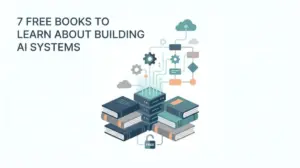
While various commercial courses and bootcamps attempt to address these infrastructure hurdles, deep-dive reading remains one of the most reliable pathways for mastering foundational architecture. To help developers bridge the gap between simple prototypes and production-ready deployments, machine learning experts have compiled a curated library of seven free resources. These open-access books and reference manuals cover everything from classical machine learning systems design and hardware optimization to advanced agent architectures and large-scale model inference.
Machine Learning Systems Design
For practitioners looking to build a strong foundation in end-to-end architecture, "Machine Learning Systems Design" by Chip Huyen serves as a critical entry point. Originally published to address the lifecycle of traditional machine learning, the book conceptualizes ML as an end-to-end engineering problem divided into four primary stages: project setup, data pipeline preparation, modeling—which encompasses selection, training, and debugging—and serving, covering testing, deployment, and ongoing maintenance.
Rather than remaining purely theoretical, each stage is supplemented by practical resources and case studies contributed by engineers at major technology companies. The text also features 27 system design questions designed for practical application. While the landscape has evolved significantly since its initial release, rendering it less focused on the nuances of contemporary large language model infrastructure, the book remains a valuable resource for understanding how disparate machine learning components integrate into a cohesive operational system.
Machine Learning Engineering Open Book
Shifting from high-level system architecture down to the hardware and operational layer, the "Machine Learning Engineering Open Book" by Stas Bekman functions less as a traditional read-through manual and more as a comprehensive reference guide. Rooted in Bekman’s firsthand experience scaling massive model projects such as BLOOM-176B and IDEFICS-80B, the book addresses physical and network-level realities that frequently trip up production teams.
The text covers critical infrastructure topics including GPU hardware configurations, networking topologies, storage management, SLURM orchestration frameworks, distributed training, inference pipelines, and systematic debugging. Designed as a practical companion for engineers encountering severe hardware bottlenecks, the reference repository has garnered significant community traction on GitHub. Distributed under an open license, it provides an accessible lifeline for developers tackling hardware challenges like GPU out-of-memory errors or multi-node training stalls.
AI Agents in Depth: Design Principles and Engineering Practice
As developer interest pivots heavily toward autonomous workflows, the engineering requirements for intelligent agents have grown increasingly sophisticated. In "AI Agents in Depth: Design Principles and Engineering Practice," author Bojie Li breaks down the mechanics of agentic systems, beginning with a fundamental premise: an agent is simply a large language model augmented with dynamic context and actionable tools.
From this foundational definition, the book explores context engineering, advanced memory management, retrieval-augmented generation integration, tool utilization, and complex multi-agent orchestration. It details the underlying engineering trade-offs required to build systems capable of executing long-horizon, error-prone tasks. Furthermore, the repository is accompanied by practical experiments and complements Li’s parallel work, "Understanding AI Infra," providing a comprehensive view of both software-level agent design and the underlying infrastructure.
The Architecture of AI Agents and LLM Systems
Expanding further on modern language model applications, Aleksandr Drobiazkin’s "The Architecture of AI Agents and LLM Systems" offers a contemporary look at the software patterns driving modern generative AI applications. The book explores the internal mechanics of language models alongside practical methodologies for context engineering, retrieval-augmented generation, structured output parsing, dynamic tool calling, and alternative agent structures.
Beyond software patterns, Drobiazkin dives deep into the operational engineering metrics that dictate production success, including automated evaluation frameworks, system observability, security vulnerabilities, inference costs, and latency minimization. By analyzing the engineering trade-offs inherent in various architectural approaches rather than merely demonstrating how to implement a specific third-party framework, the book provides a well-rounded perspective for engineers designing resilient LLM stacks.
Inference Engineering
Addressing the critical intersection of model performance and operational expenditure, Philip Kiely’s "Inference Engineering" tackles the mechanics of deploying large language models efficiently at scale. The text guides readers through the complete inference stack, examining the relationship between underlying GPU architectures, model compression techniques, production serving software, and cloud-native deployments.
Key technical areas covered include continuous batching strategies, quantization methods, memory bandwidth utilization, and latency optimization, equipping engineers to select appropriate hardware profiles and serving engines such as vLLM. The book addresses a common production anomaly: why an LLM pipeline that performs seamlessly during localized testing can degrade rapidly under the weight of hundreds of simultaneous user requests.
LLM Inference Illustrated
For visual learners seeking to demystify the internal processes of text generation, Ted Kyi’s "LLM Inference Illustrated" utilizes detailed diagrams to break down token-by-token generation. The resource illustrates the exact computational steps that occur when a language model produces a response, explaining how modern inference optimization techniques reduce memory footprints and accelerate throughput.
By lifting the hood on what is frequently treated as a black-box API call, the book equips developers with a clearer conceptual model of the hardware and software interactions necessary to serve language models efficiently in production environments.
How to Scale Your Model
Rounding out the technical collection, "How to Scale Your Model," authored by researchers at Google DeepMind including Jacob Austin, offers a rigorous look at distributed training and serving across massive hardware clusters. The book begins with the foundational architecture of Tensor Processing Units, analyzing memory bandwidth, model sharding strategies, distributed training topologies, and large-scale inference optimization.
Using practical examples such as the LLaMA 3 architecture, the text calculates the compute power, memory capacity, and financial investment required to train and deploy frontier-scale models. While the mathematical concepts require a strong technical background, the work serves as an authoritative reference on large-scale infrastructure management.
Industry practitioners emphasize that while modern tooling has democratized the creation of basic AI applications, bridging the gap between a functional prototype and a secure, low-latency, cost-effective production system requires deliberate mastery of systems engineering principles. As the software landscape evolves, understanding the foundational infrastructure powering artificial intelligence remains a vital competency for developers and engineers across the technology sector.