










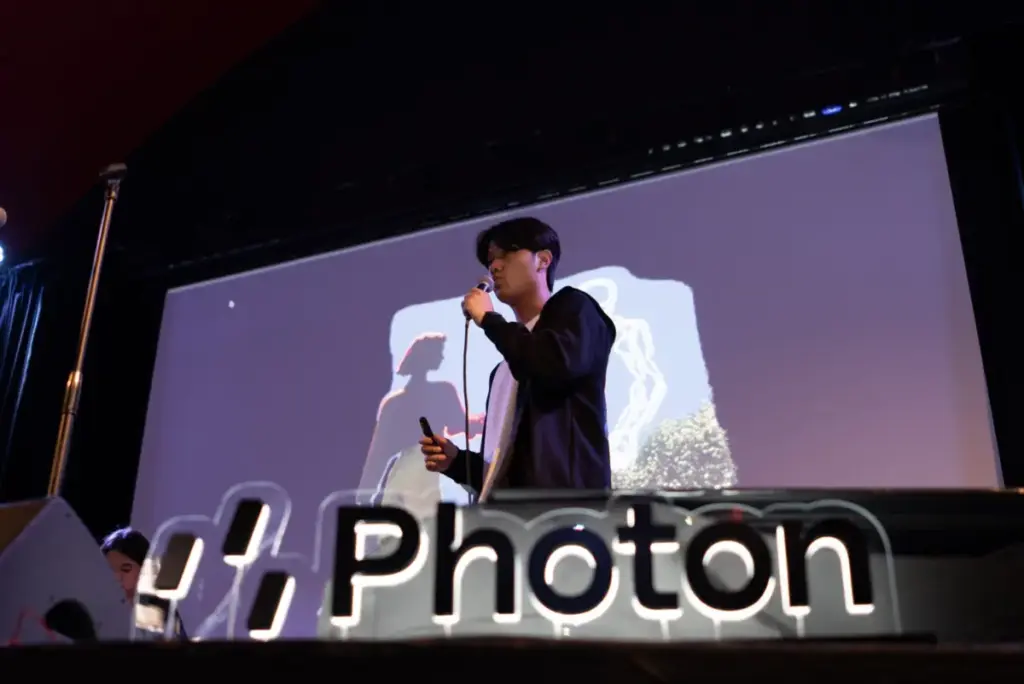
In a bold, if slightly macabre, statement on the future of software, the AI startup Photon recently held a literal funeral for mobile apps. The event, held in a San Francisco church on September 17, featured speeches, a somber atmosphere, and even a physical coffin containing app icons—a symbolic farewell to the era of downloading, installing, and managing disparate mobile applications. While the spectacle was tongue-in-cheek, the message behind it was deadly serious: Photon’s leadership believes that the traditional app-centric model of computing is rapidly approaching its expiration date, set to be replaced by a more fluid, conversational paradigm of AI agents.
This provocative funeral served as both a marketing statement and a developer summit, drawing industry heavyweights from Vercel, Stripe, and OpenAI to discuss the shifting technological landscape. For Photon’s co-founders, Daniel Tian and CTO Ryan Zhu, the event marked a pivotal moment for their startup, which has just announced a successful $4.5 million seed funding round. This infusion of capital arrives at a time of rapid growth for the company, which claims to have onboarded over 40,000 developers and achieved a 10x increase in revenue over the last four months.

The core thesis driving Photon is as simple as it is ambitious: users are suffering from "app fatigue." In an increasingly crowded digital ecosystem, consumers are less likely to download new, standalone applications for every minor task. Instead, the modern user prefers to interact with services through the platforms they already frequent daily—namely, messaging applications like iMessage, WhatsApp, Telegram, and SMS. Photon aims to be the invisible connective tissue that enables developers to build sophisticated AI agents that function seamlessly within these conversational channels.

While consumer-facing AI giants like Meta, with its rapidly adopted "Muse" AI, are testing the boundaries of the consumer AI space, Tian argues that there is a massive, underserved market for infrastructure that helps developers transition their existing software into agent-based experiences. To meet this demand, Photon provides a comprehensive suite of tools, including a unified API, an extensible channel framework, a command-line interface (CLI), and a sophisticated observability suite. These tools are designed to allow developers to build and deploy an agent experience that operates across virtually any communication medium, including iMessage, WhatsApp, Telegram, SMS, RCS, email, and voice.

The origin story of Photon is rooted in the practical frustrations of its founders. As students frequently participating in hackathons, Tian and Zhu spent years building consumer applications, only to hit the same stubborn wall every time: user acquisition. They realized that the barrier to entry for a new, standalone app is prohibitively high. By pivoting to build an agent that operated directly within iMessage, they discovered an immediate, frictionless way to reach users in an environment where they already spent their time.
The initial experiment, which involved a bot capable of mimicking Tian’s conversational style to text his friends, became an overnight success when they open-sourced the underlying technology on GitHub. Thousands of developers flocked to the project, validating the founders’ hunch that the developer community was hungry for a better way to interface with messaging platforms. The traction was so immediate that it changed the trajectory of both founders’ lives: Tian opted to drop out of the University of Pennsylvania’s prestigious M&T program, while Zhu departed high school to focus on the company full-time, eventually spending time as a visiting student at MIT’s Media Lab.

Even today, the open-source version of Photon remains a cornerstone of its operations, accounting for 98% of its total usage. However, the company began moving toward a more sustainable business model this past April, introducing a managed, subscription-based platform. This hosted version of Photon is designed for scale and enterprise reliability, offering 99.95% uptime—a significant step up from the reliability of a local, hobby-grade installation. Furthermore, the hosted platform is SOC 2 Type II and HIPAA-compliant, a critical development that opens the door for developers to build agents for sensitive, high-stakes industries like healthcare and finance.
The growth metrics following this pivot have been substantial. Beyond the 40,000 developers who have signed up for the platform, the company is seeing high retention rates, with churn sitting at less than 3%. The volume of messages processed through Photon’s infrastructure has surged by 5x in the last month alone. While the company remains private regarding specific revenue figures, the rapid adoption suggests that the "agent-first" philosophy is gaining significant traction among builders.

The current client roster reflects this versatility, encompassing a wide array of sectors. From fintech platforms like Rho and finance AI assistants like Fliptexts to specialized consumer tools like Corgi Insurance, the social discovery app Boardy, and the dating platform Ditto, the range of applications is broad. Furthermore, the platform has gained the backing of major industry players. Vercel, which has become a significant partner and investor, is utilizing Photon’s technology to power its own AI initiatives, such as Eve and the ChatSDK. Additionally, Photon serves as the underlying layer for projects like the Hermes agent from Nous Research, as well as Tencent’s QClaw and NanoClaw. The ecosystem continues to expand through integrations with infrastructure and framework leaders, including LangChain, Mastra, Convex, Render, Railway, and Telnyx.
The recent seed round was co-led by Gradient and A*, with participation from a notable group of investors including Vercel, HongShan, Z Fellows, Llama Ventures, and Karman, alongside several angel investors. This capital will likely be used to further harden the platform and expand its reach, as Tian believes that the "post-app" shift is only just beginning.

Looking toward the horizon, Tian envisions a future that goes beyond simple human-to-agent interactions. As the number of specialized agents grows, the next logical step is for these entities to begin communicating with one another. "I think, in the future, agents will be able to find you the agent that can do the right things—so it’s going to be the A-to-A communication layer," Tian explained. He paints a picture of a future where a primary travel-planning assistant, when tasked with booking a trip, could autonomously coordinate with a dedicated flight-booking agent and a separate hotel-booking agent, effectively creating an "agent-to-agent-to-person" ecosystem.
For now, the funeral in San Francisco serves as a symbolic marker of a transition that is already well underway. While the traditional mobile app is unlikely to disappear entirely overnight, the shift toward invisible, conversational, and agent-driven interfaces is accelerating. With a growing developer base, a strong backing of partners, and a clear vision for the next phase of the internet, Photon is positioning itself to be the primary engine for this new, decentralized way of interacting with software. Whether the app era is truly "dead" or merely evolving, the momentum behind Photon suggests that the way we interact with our digital tools is undergoing its most significant change since the launch of the original app stores.