









There has been a significant amount of confusion, anxiety, and panic across the tech industry this week regarding reports of "huge fines," "drastic measures," and "sweeping new AI rules" taking effect under European Union regulations. In reality, the legal scope is much more narrow, pragmatic, and grounded in common-sense transparency. Primarily, the framework is designed to make artificial intelligence clearly recognizable when it genuinely needs to be—most notably for AI-generated and artificially manipulated content.
Beginning on August 2, 2026, mandatory AI labelling becomes a strict legal requirement for any enterprise that serves citizens within the European Union. Much like the European Accessibility Act, these obligations are not restricted exclusively to companies headquartered inside the EU member states. Instead, the rules carry global jurisdiction, impacting any business worldwide operating within the EU market, provided that their artificial intelligence outputs are consumed, viewed, or interacted with by people located in the region.
What Actually Needs Labelling
The fundamental goal of the European Union’s AI labelling mandates is to help everyone exposed to digital content to recognize, in a clear and distinguishable way, that the material has been artificially generated or substantially manipulated. According to Article 50, Paragraph 4 of the landmark AI Act, these disclosure obligations apply broadly across specific categories of synthetic output designed to mimic reality or influence public perception.
Under the framework, both providers—those who build, develop, or supply the underlying AI systems—and deployers—those who implement and utilize the tools in public-facing capacities—carry substantial legal responsibilities. Similar to the enforcement mechanisms found in the General Data Protection Regulation and the European Accessibility Act, a company cannot easily escape compliance obligations simply because it licensed a ready-made external AI tool or model from a third-party vendor.

However, this does not mean that every single instance of AI-assisted work or AI-generated output must be explicitly labelled.
Not All AI-Generated Content Must Be Labelled
Beyond the specific high-visibility use cases outlined by regulators, the vast majority of everyday AI-assisted work is simply not covered by the new transparency rules. Most notably, the disclosure obligation does not apply where AI-generated text has been genuinely reviewed, edited, and approved by a human being, with a named person or corporate entity taking direct editorial responsibility for the final published output.

Some ongoing industry confusion surrounds what constitutes matters of "public interest," where transparency rules carry heavier weight. On its own, the term legally refers to health, safety, the environment, the economy, finances, politics, science, or culture. If artificial intelligence systems generate product claims, informational summaries, or media that touch directly upon these sensitive public pillars, the strict disclosure rules apply immediately.
Legal experts and various advisory law firms have also recommended labelling realistic AI-generated illustrations, photographs, and media as a precautionary measure for advertising, public relations, and other commercial content. AI-generated product illustrations, promotional posters, or synthetic photos require clear disclosure as long as they closely resemble a real person, physical place, tangible object, or historical event.

The Fine Line Between "Edited" and "AI-Generated"
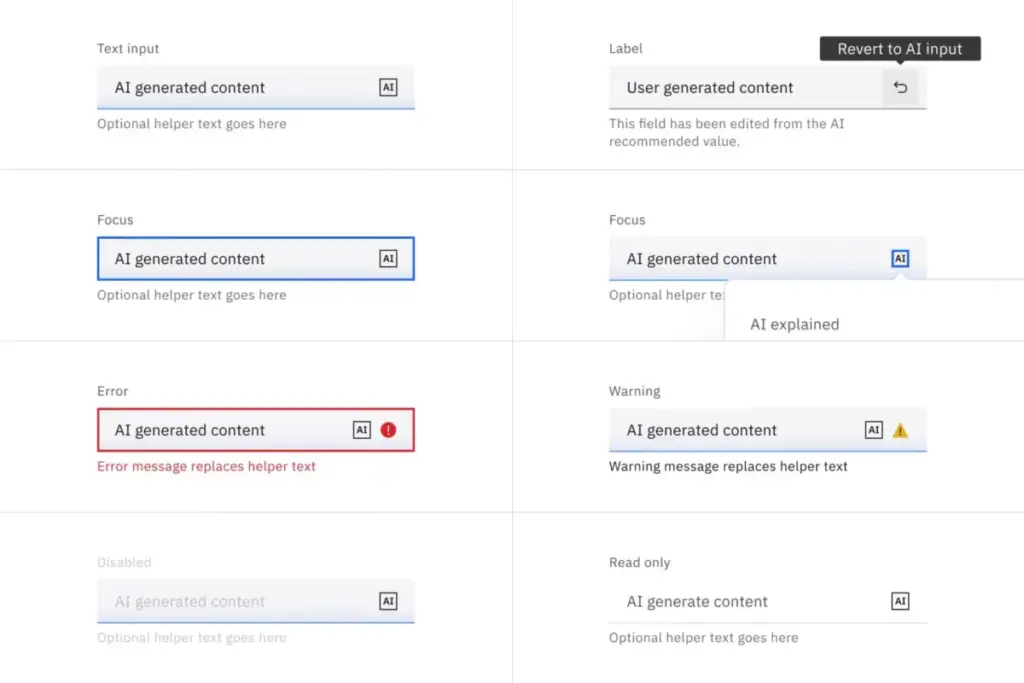
A central question facing designers and developers is precisely where edited AI content stops being considered artificial content. When a business form, document, or piece of writing is initially pre-filled by an AI model, but a human user subsequently edits it, does it still retain its classification as AI output? The European Commission’s official guidance on this matter leaves some room for interpretation.
Small, routine assistive edits—such as basic spellcheck, grammar correction, formatting adjustments, minor cropping, color correction, and AI-generated language translation—do not count as standalone AI generation. In contrast, heavy AI-generated text summaries, complex composite imagery, substantive content rewrites, or the digital addition and removal of elements from a photograph are strictly considered AI generation. In practice, fine-tuning a sentence written by a human is acceptable, but generating the core sentence independently requires proper public disclosure.

Furthermore, a superficial editorial workflow where a human merely skims a fully automated text before publishing does not qualify as a valid editorial review. The European Commission is explicit that the human intervention must be substantive, featuring a named person who maintains actual editorial control and accountability. The fine line ultimately lies between intentional manual intervention and automated generation, with the latter always requiring clear disclosure, with narrow exceptions made for closed business-to-business environments.
AI Sparkles and Visual Icons Are Probably Not Enough
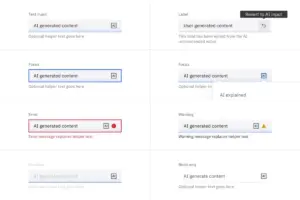
As an essential part of its broader Code of Practice, the European Commission has published an official EU AI icon set. This includes a specific, standardized "AI" mark rather than the generic sparkle symbols that many consumer products currently rely on to signal smart features. The signal must be clear, distinct, and unambiguous.

The traditional sparkle symbol is often considered too ambiguous to signal AI content effectively. Primarily, it is frequently used across software interfaces to mean "this is an AI-powered feature," rather than communicating the precise message that "this specific piece of content was generated by artificial intelligence." That exact ambiguity is what the EU guidelines are attempting to eliminate.
Regulators have made it explicit that simply utilizing a standard icon does not establish legal compliance on its own. A barely visible icon, a disclaimer note buried deep within a webpage footer, or a label that flashes momentarily on screen are all considered non-compliant. The official icon should be clearly visible, accompanied by a plain-language text label, and fully accessible to assistive technologies. A safe design approach is to pair any visual icon with plain text explicitly stating that the material is AI-generated, ensuring the disclosure persists even if the content is downloaded or reshared across external platforms.

A Global Regulatory Pattern
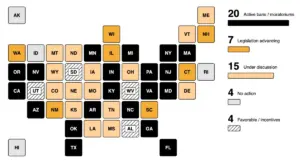
While these requirements can easily feel like yet another complex regulatory burden originating from Brussels, they mirror a broader global shift. Similar transparency regulations and legislative proposals have emerged recently in various jurisdictions worldwide, reflecting a growing international consensus on artificial intelligence governance.
These developments point toward an overarching global regulatory pattern rather than an isolated coincidence. Organizations shipping software products featuring artificial intelligence capabilities are strongly advised to establish internal governance conversations regarding what content will be explicitly labelled and what will remain unlabelled.

Ultimately, these emerging transparency rules are much broader than existing domestic laws on AI disclosure in regions like the United States, where state-level statutes typically target specific applications such as synthetic human performers, political advertising, or narrow commercial interactions.
Rather than prompting widespread panic, the regulations stem from a straightforward principle gaining traction globally: when artificial intelligence content can easily be mistaken for human-created material, creators and deployers must say so clearly, obviously, and unambiguously. Sections of digital interfaces that rely on synthetic generation must disclose their nature, helping users better distinguish between authentic human work and automated output to the benefit of the entire digital ecosystem.