The Model Context Protocol has undergone a significant structural evolution, introducing a stateless core architecture that fundamentally changes how modern clients and servers interact. Spearheaded by the July 2026 specification update, the core protocol no longer requires modern clients to establish an explicit protocol session before initiating requests. Furthermore, servers are no longer bound to rely on traditional session identifiers like Mcp-Session-Id for standard interactions, paving the way for seamless scalability behind conventional HTTP infrastructure.
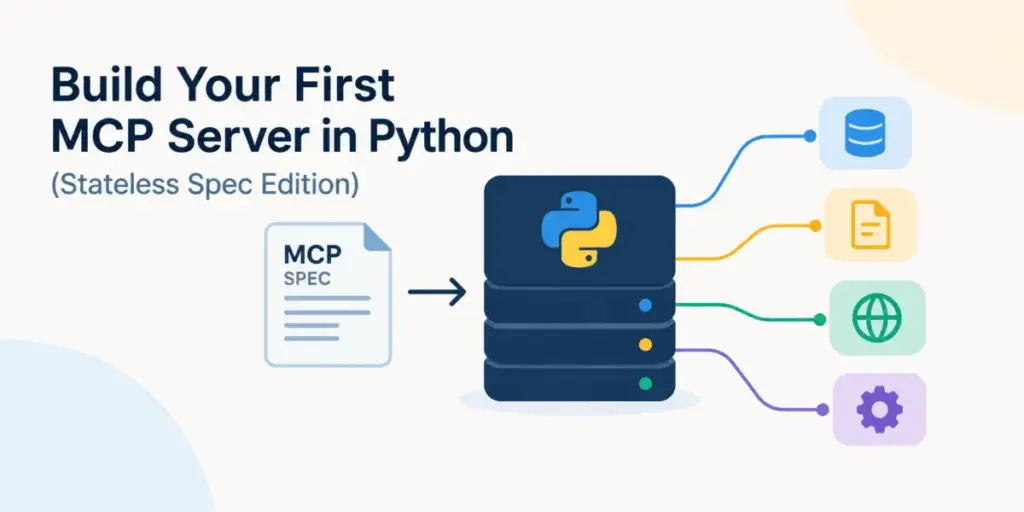
Alongside this architectural shift, the official Python SDK has advanced to version 2 as its primary stable release line. This update introduces a higher-level application programming interface, known as the MCPServer class, designed to streamline the definition of tools, resources, and prompts using standard Python functions. This development simplifies the process of building robust, network-accessible integrations for large language model applications without sacrificing architectural flexibility.
Redefining Server-Side Integration and Tool Definition
At the heart of the v2 Python SDK is a developer experience that leans heavily into native language features. By eliminating the need for manual JSON schemas, explicit tool manifests, and custom argument parsers, the updated framework derives necessary protocol definitions directly from standard Python function signatures and type hints. Parameters with default values automatically translate into optional components within generated schemas, allowing developers to write ordinary functions that double as dynamic model-callable tools.
This approach extends across the three core primitives supported by the protocol: tools, resources, and prompts. While tools act as action-oriented capabilities invoked autonomously by a model, resources function similarly to read-only endpoints, exposing data that host applications can inject directly into context. Prompts, meanwhile, offer reusable templates designed to guide user-or-host-initiated interactions. By unifying these primitives under a decorator-oriented server interface, the SDK removes much of the historical boilerplate associated with protocol implementation.
Transitioning to a Stateless Request-Response Model
The architectural shift toward a stateless core addresses historical scaling bottlenecks associated with persistent session management. Under previous protocol iterations, HTTP clients were required to complete an initialization handshake, after which subsequent requests relied on sticky routing or shared session infrastructure to maintain continuity across multi-instance deployments.
The revised specification replaces this paradigm with a self-contained request-response model. Because modern requests carry all necessary context within themselves, incoming traffic can be distributed freely across multiple worker instances using standard load-balancing techniques. This change removes the requirement for specialized infrastructure to keep sessions warm, aligning protocol deployment with standard cloud-native web application practices.
Despite the stateless nature of the protocol itself, application-level state remains fully achievable. Architectural patterns under the updated specification encourage developers to manage state explicitly within the application layer, utilizing unique identifiers passed directly through tool parameters rather than hiding state within a protocol session. This explicit-handle pattern ensures that distributed workers can process requests independently while maintaining distinct user or operational sessions where necessary.
Enterprise Deployment and Ecosystem Impact
With the integration of Streamable HTTP support, modern applications can expose endpoints natively or embed them within broader ASGI frameworks such as Starlette or FastAPI. This interoperability allows engineering teams to blend protocol endpoints into existing enterprise web architectures without introducing specialized proxy layers.
As the ecosystem adapts to the updated specification, the transition from stateful handshakes to stateless execution signifies a maturing developer tooling landscape. By reducing infrastructural overhead and aligning protocol interactions with standard web engineering patterns, the updated framework lowers the barrier for engineering teams looking to integrate deterministic tools and knowledge bases into large language model workflows.