In a significant move to bridge the gap between cloud infrastructure and frontend development, Vercel has announced a new integration that brings Amazon Simple Storage Service (Amazon S3) directly into the Vercel Marketplace and v0. This update allows developers to provision, manage, and connect S3 storage resources—including specialized S3 Tables and S3 Vectors—without ever leaving the Vercel dashboard. By streamlining the configuration of policies and credentials, the integration aims to simplify the creation of performant, scalable web and AI-powered applications while maintaining the robust security and durability standards of the AWS ecosystem.
For years, developers building on Vercel have enjoyed a seamless deployment experience for their frontend code, but managing backend storage often necessitated a shift in context. Previously, setting up an S3 bucket required navigating the AWS Management Console, configuring complex IAM policies, and manually managing credentials. This friction often acted as a barrier to rapid prototyping and deployment. By moving this functionality directly into the Vercel developer experience, the platform now handles resource provisioning and connection configuration automatically. This development complements existing integrations for services like Amazon Aurora, Amazon DynamoDB, and Amazon OpenSearch Serverless, effectively allowing developers to build a complete application stack—from the database layer to object, vector, and open table storage—within a single, unified environment under one AWS account and billing statement.
The integration caters to three distinct, high-demand workloads: everyday general-purpose storage, data analytics, and artificial intelligence. By leveraging these services directly through the Vercel interface, teams can ensure that their storage backend is as agile as their frontend code.

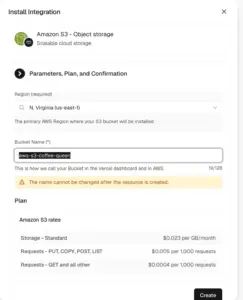
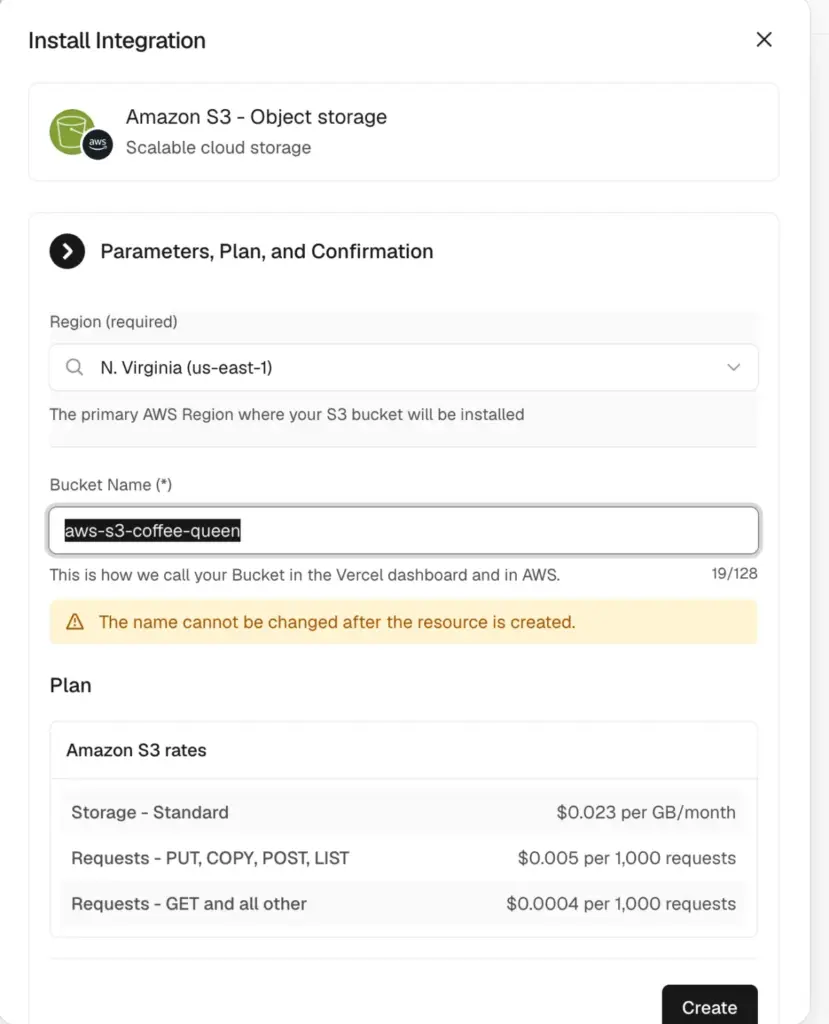
To get started, developers simply navigate to the Storage tab within the Vercel dashboard and select the Create option. After choosing AWS as the provider, users can pick their desired S3 bucket type, select a geographic region, and initiate the provisioning process. Once the bucket is created—a process that takes only a few seconds—the developer can link it to a specific project. Utilizing the Vercel CLI, developers can pull the necessary environment variables, such as AWS_REGION, AWS_ROLE_ARN, and specific bucket identifiers, into their local development environment.
A critical aspect of this integration is its commitment to security. Rather than storing static keys, which can pose a risk if mishandled, the integration utilizes the awsCredentialsProvider from the @vercel/functions/oidc library. At runtime, this mechanism exchanges a short-lived OIDC token with the AWS Security Token Service (AWS STS) to generate temporary, scoped credentials. This ensures that the application has only the minimum necessary permissions to interact with the storage resource, adhering to the principle of least privilege without requiring the developer to manage long-term security credentials manually.
For standard object storage, the process of interacting with an S3 bucket has been simplified to a few lines of code. Whether a developer is building a file upload feature or a document management system, the use of the AWS SDK for JavaScript allows for straightforward execution of commands like PutObjectCommand, ListObjectsV2Command, and GetObjectCommand. This ease of use ensures that developers can focus on application logic rather than the underlying plumbing of cloud storage.

The inclusion of S3 Tables marks a major enhancement for developers working with data-heavy applications. S3 Tables are purpose-built for analytics, offering a fully managed environment for Apache Iceberg tables. As data volumes grow, these tables are designed to automatically optimize query performance through automated table maintenance and compaction. Because they are compatible with any Apache Iceberg REST Catalog-compliant engine, developers can easily integrate tools like DuckDB within a Vercel Function to perform lightweight, high-speed analytical queries. By attaching the table bucket via its Amazon Resource Name (ARN), developers can execute complex SQL queries against their data directly from their serverless functions, providing a powerful way to handle clickstream data, user metrics, or financial records without the overhead of a traditional, separate data warehouse.
Furthermore, the introduction of S3 Vectors directly into the Vercel stack provides a streamlined path for developers building AI agents and RAG (Retrieval-Augmented Generation) applications. S3 Vectors offer cost-optimized storage designed specifically for the high-performance requirements of AI inference and semantic search. While S3 Vectors do not generate embeddings themselves—leaving that to the developer’s model of choice—they provide a native, efficient way to store and query these vectors. This removes the need for a separate, dedicated vector database, simplifying the architecture of AI applications. Developers can use the S3VectorsClient to perform semantic similarity searches, allowing them to build intelligent support bots, personalized recommendation engines, and sophisticated content retrieval systems with minimal architectural complexity.
The integration is further enhanced by its compatibility with v0 by Vercel, the company’s AI-powered generative interface. Developers can now use natural language prompts to describe the functionality they wish to build, and v0 will automatically provision the necessary AWS resources. For example, a request for a "photo gallery where users upload images" will result in the provisioning of a general-purpose S3 bucket, while a request for a "support bot that answers questions from my PDFs" will trigger the setup of S3 Vectors. v0 not only provisions the infrastructure but also generates the boilerplate code required to connect the application to these services, significantly accelerating the path from concept to production.
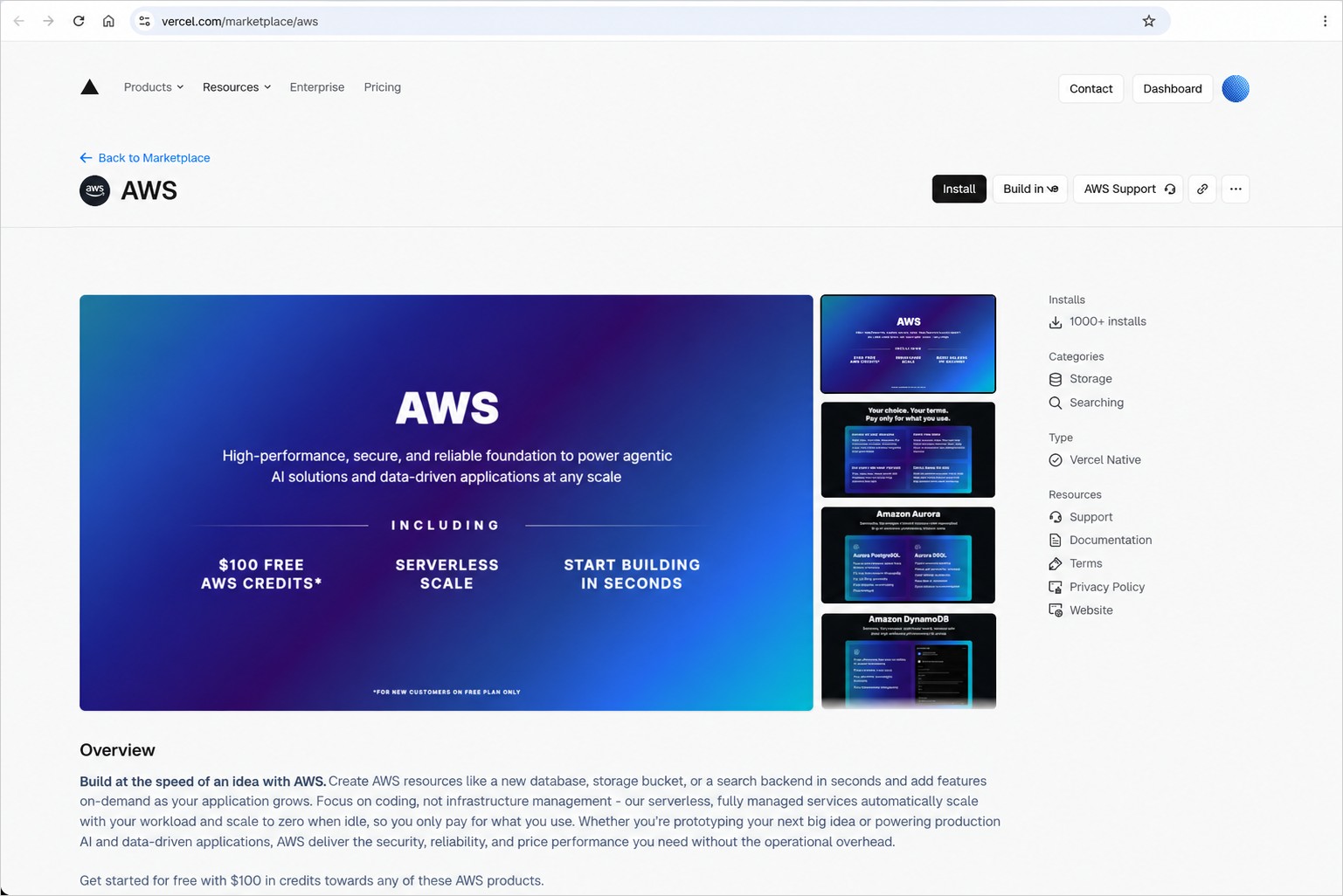
Because every AWS service integrated into Vercel shares the same account and authentication model, developers can combine these services with ease. File metadata can be stored in Amazon Aurora while the actual files reside in S3, or document text can be managed in DynamoDB while its corresponding vector embeddings are indexed in S3 Vectors. This synergy allows for the creation of sophisticated, highly scalable architectures that remain easy to manage.
Vercel provides flexibility for those already embedded in the AWS ecosystem. Users can either create a new AWS account through the Vercel integration or link an existing AWS account to keep their current billing and management structures intact. While Vercel manages the interaction with new buckets created through its platform, the resources remain within the user’s own AWS account, ensuring that developers retain full access to native AWS tooling and management capabilities.
The integration is available at no additional cost, with users paying only the standard Amazon S3 pricing for the resources they consume. To encourage adoption, new AWS accounts created via the Vercel platform are eligible for $100 in AWS credits, valid for six months. This, combined with the availability of the service in all commercial AWS Regions supported by Vercel, provides a low-barrier entry point for developers looking to modernize their infrastructure. For those seeking further technical guidance, AWS has made resources available through the AWS MCP Server and various plugins, enabling developers to query APIs and search documentation directly from their preferred AI-assisted development tools. As the ecosystem continues to evolve, this integration represents a significant shift toward a more unified, developer-centric approach to cloud-native application building.