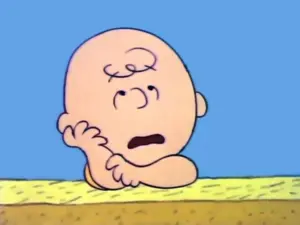










During the height of its syndication in the 1980s and 1990s, The Far Side stood as a singular, often jarring presence on the newspaper funny pages. While its contemporaries often relied on domestic tropes, workplace grievances, or mild physical comedy, Gary Larson’s work dared to peer into the abyss. For readers accustomed to the relatively gentle stakes of Charles Schulz’s Peanuts—where the height of cruelty was Lucy van Pelt pulling a football away from Charlie Brown—or the mild, recurring slapstick of Jim Davis’s Garfield, where a cat merely shoves a dog off a table, Larson’s panels offered something far more subversive.
Larson possessed a unique penchant for finding humor in the macabre. Death was not a taboo subject in his world; it was a frequent punchline. His panels often featured hangings, grizzly murders, and the everyday absurdity of the afterlife. While he occasionally turned his satirical lens toward the pearly gates of Heaven, it was the underworld that clearly captured his creative imagination. Satan became a recurring character in his universe—a weary, bureaucratic administrator of eternal suffering—appearing far more frequently than almost any other single figure in the strip’s run. For Larson, the Devil was not just a symbol of malice; he was a relatable, often exasperated manager overseeing a chaotic, deeply personalized hell.
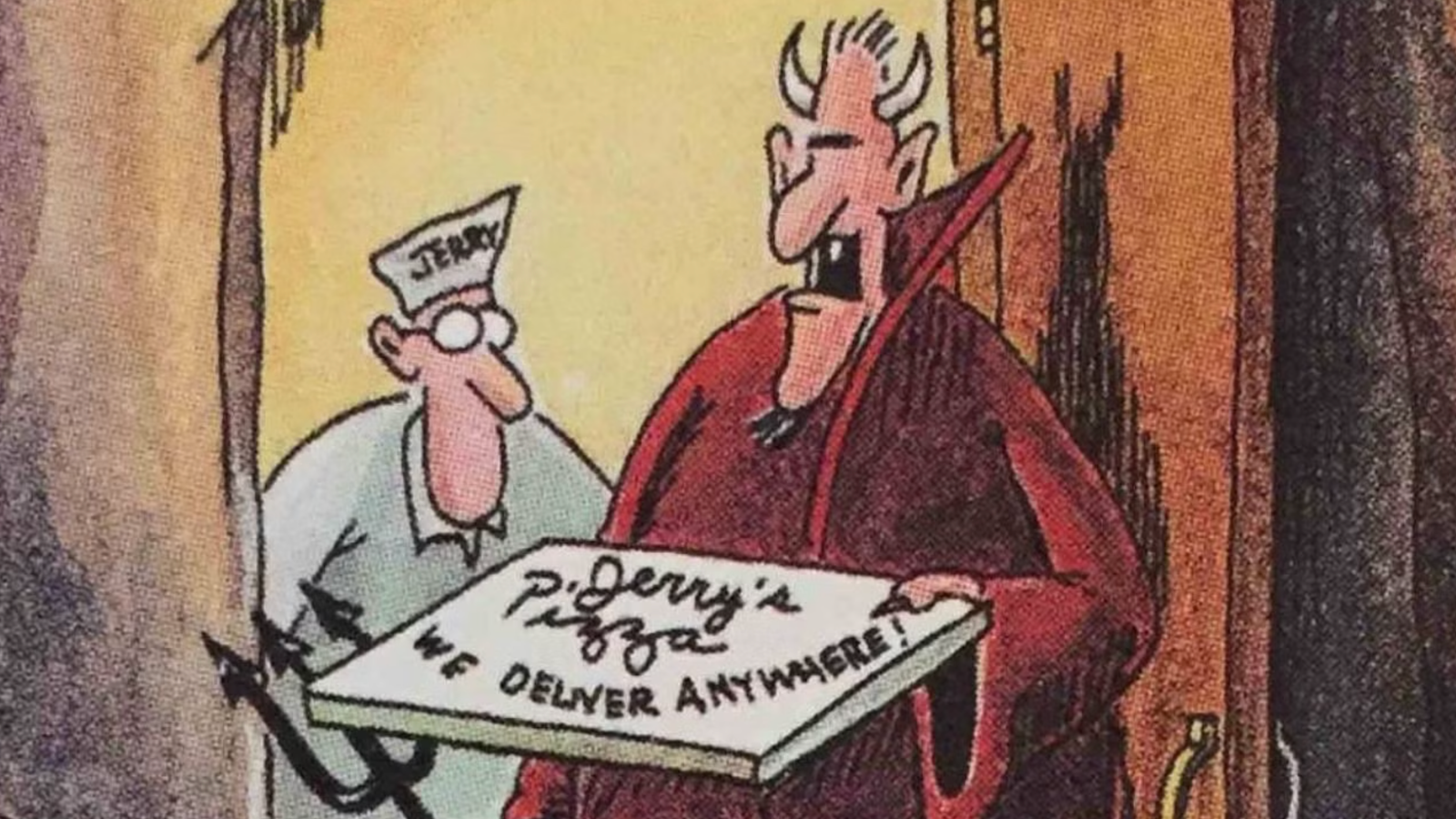
“We Deliver Anywhere”
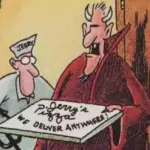
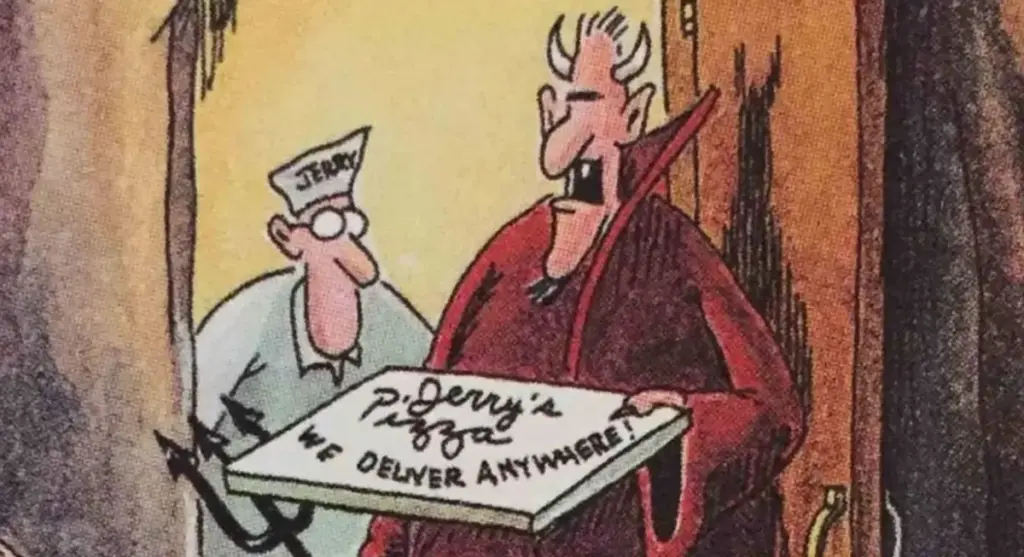
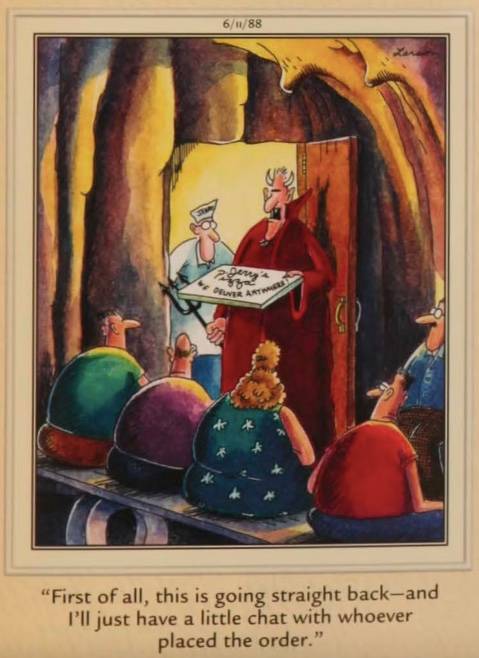
Larson’s ability to blend the mundane with the supernatural was perhaps best exemplified in his June 11, 1988, strip. In the panel, a pizza delivery arrives at the gates of Hell, and the reaction from the Devil is one of profound annoyance. Rather than enjoying a demonic feast, the ruler of the underworld is incensed by the intrusion. “First of all, this is going straight back—and I’ll just have a little chat with whoever placed the order,” he declares.
The brilliance of the joke lies in the peripheral detail: the slogan on the pizza box, which reads, “Jerry’s Pizza: We Deliver Anywhere.” The humor stems from the commitment to the bit—Jerry, the proprietor, is a person of her word, even when the destination is eternal damnation. It is a classic Larson setup, inviting the reader to contemplate the logistics of a delivery service that operates across dimensions. Beyond the joke, there is a certain irony in the premise. Pizza is one of the most beloved culinary creations on Earth, a comfort food that seems entirely out of place in a realm of fire and brimstone. Larson plays with the idea that even in a place equipped with perfect-looking pizza ovens at every turn, the one thing the residents are denied is the actual, completed product.

The Very Literal Gary Larson
A cornerstone of Larson’s comedic methodology was the hyper-literal interpretation of common idioms and metaphors. By taking a figure of speech and stripping away its figurative meaning, he exposed the absurdity of the language we use every day. This was a technique he applied to his depictions of the afterlife just as readily as his observations of nature or historical events.
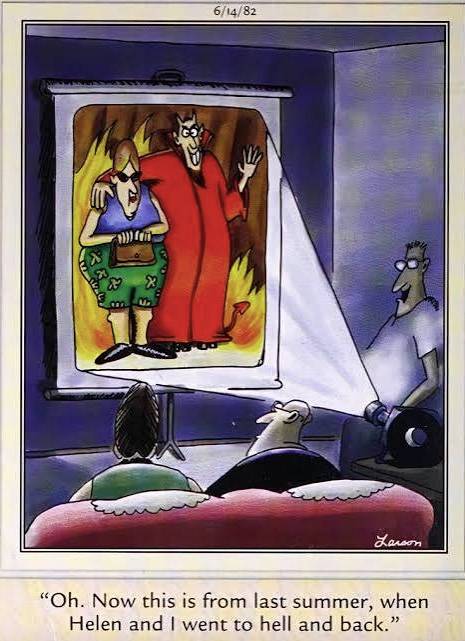
In a 1992 comic, Larson addressed the phrase “ride off into the sunset” by depicting a cowboy who had taken the directive far too literally, appearing as a scorched, ruined figure after attempting to ride into the sun itself. Similarly, in a 1985 strip, he interpreted the phrase “dressed to kill” by showing sharks decked out in formal evening wear. This penchant for literalism reached its peak when he turned his gaze toward the phrase “to Hell and back.” In a 1982 panel, the underworld is transformed into a mundane tourist destination. A man stands in his living room, projecting vacation slides for his guests; one slide captures his wife posing with the Devil. The contrast is sharp: the husband is proud of his travelogue, the Devil seems to be playing along with the tourism theme, and the wife looks entirely bored, as if a trip to the inferno were nothing more than an underwhelming excursion to a national park.
Splitsville
Larson’s vision of the afterlife was rarely a monolith. Instead, he frequently depicted a highly personalized version of hell, one tailored to the specific neuroses, hobbies, or failures of its inhabitants. He understood that the most effective torture is the one that relates directly to the victim’s own obsessions.
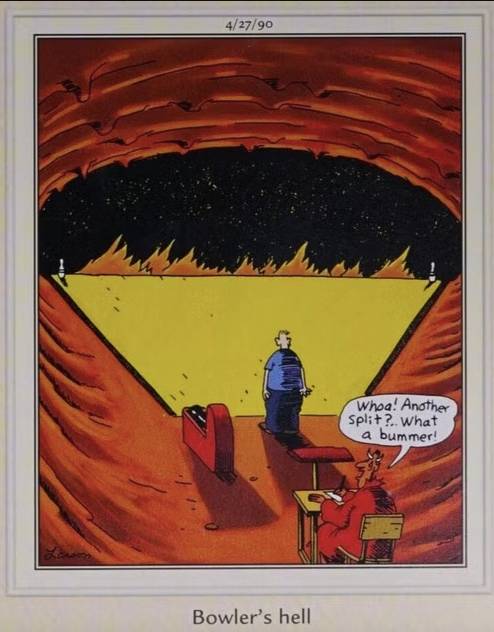
A 1990 strip titled “Bowler’s Hell” captures this perfectly. It depicts a bowler who has just thrown the ball, only to find himself faced with an impossible-to-hit split. The Devil, standing by, remarks with a casual, almost sympathetic tone, “Whoa! Another split?… What a bummer!” For a bowler, the recurring, unavoidable split is the ultimate frustration, and Larson posits that eternal damnation for such a person would not be fire or pitchforks, but an endless cycle of missing the mark by the narrowest of margins. It is a testament to Larson’s character work; he didn’t just write jokes about the Devil, he wrote jokes about the people who found themselves stuck in his domain.
Gary Larson on Banjos
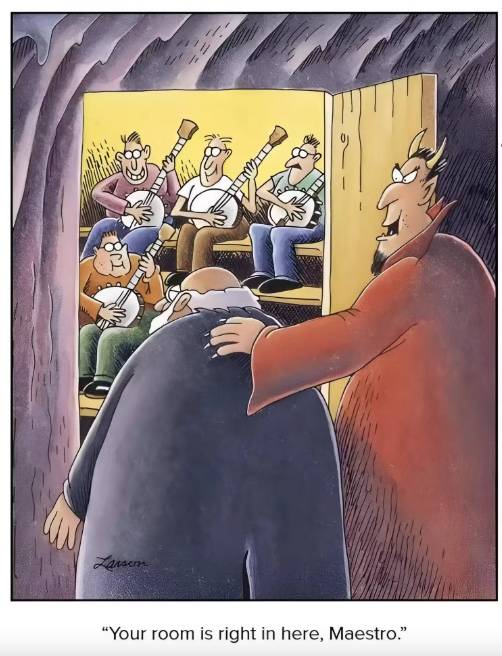
The specificity of Larson’s hell extended into his musical preferences. He often treated certain instruments—most notably the banjo—with open disdain. To a musician, particularly a classical conductor, a symphony orchestra is a temple of precision and harmony. In Larson’s world, a conductor’s vision of hell would be an orchestra composed entirely of banjos, a chaotic, twanging cacophony that would drive any lover of classical music to madness.
Larson’s animosity toward the instrument was a recurring motif. In another strip, set in the mortal world, a conductor is sent into a panic by the sudden, intrusive sound of a banjo, frantically shouting, “Stop! Stop! What’s that sound?” While the banjo seemed to represent a specific brand of musical irritation in Larson’s comics, it is worth noting that he considered it slightly less offensive than the accordion, which he depicted as the standard-issue instrument for new arrivals in Hell. One can only imagine the reactions of banjo and accordion enthusiasts of the era, who found their chosen instruments consistently maligned in the funny pages.
See?
The contrast between the heavenly and the infernal provided some of Larson’s most memorable imagery. In one particular strip, the distinction between the two realms is reduced to the equipment provided to new arrivals. Upon entering Heaven, one is issued a harp, the classic symbol of celestial peace. Conversely, the strip reveals that every new inhabitant of Hell is issued an accordion. It is a simple, visual gag that speaks volumes about Larson’s sense of humor. He wasn’t interested in grand theological statements; he was interested in the idea that the afterlife, like any bureaucratic system, would be defined by the quality of the gear it handed out.
All Dogs Don’t Go to Heaven?
One of the more poignant, if darkly humorous, entries in Larson’s hell-themed catalog involves the canine experience. In a 1986 strip, he depicts a group of dogs in the underworld, forced to perform the most tedious and dreaded task imaginable: working as mailmen. It is a subversion of the age-old trope of the dog chasing the mail carrier, turning the tormentor into the tormented.
For years, many readers assumed this strip was a satirical response to the 1989 animated film All Dogs Go to Heaven, directed by Don Bluth. The film, which features a heartfelt and imaginative take on the canine afterlife, carries a tone of genuine sincerity that stands in stark contrast to Larson’s cynical wit. However, the timeline renders that interpretation impossible; Larson’s comic predates the film by three years. It remains a fascinating coincidence that both creators felt compelled to explore the canine afterlife, though they arrived at vastly different conclusions. While Don Bluth offered a narrative of redemption and warmth, Larson offered a scenario of irony. Regardless of the artistic intent, the cultural conversation surrounding the fate of our pets persists, though most dog lovers would likely side with Bluth’s sentimentality over the prospect of their pets being forced to deliver mail for all eternity. Larson, for all his dark humor, ultimately touched on the things we care about most, even if he did so with a smirk and a pitchfork.