







The landscape of local artificial intelligence development has shifted following the release of Inkling 2 Mini by Thinking Machines Lab. Positioned as a serious American contender to established models like Qwen3.8-27B, this newly launched open-weight model matches its prominent rival on the Artificial Analysis Intelligence Index. Furthermore, it demonstrates superior performance across several demanding benchmarks covering coding, agentic workflows, and tool-use capabilities.
The significance of this release lies heavily in its remarkable operational efficiency. While Inkling 2 Mini boasts 26 billion parameters, its underlying Mixture-of-Experts architecture, paired with an innovative looping mechanism, enables it to produce high-caliber results without demanding expensive, enterprise-grade hardware infrastructure. Engineered for swift inference, the model can achieve additional speed enhancements through the application of speculative decoding techniques.
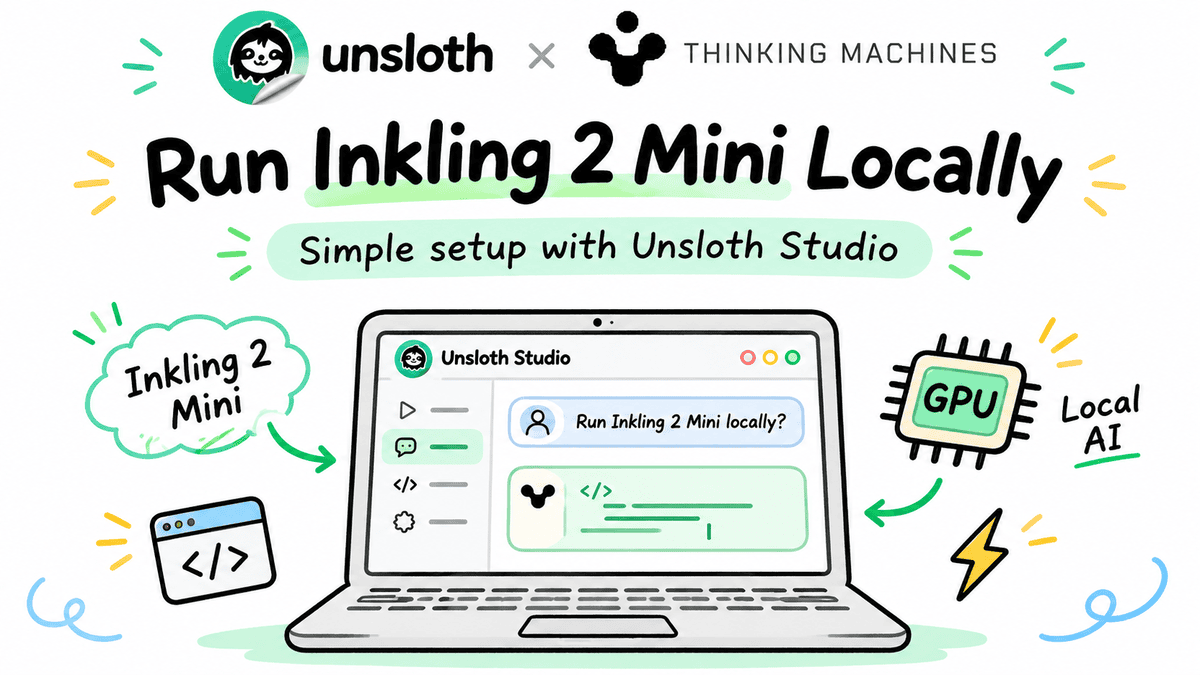
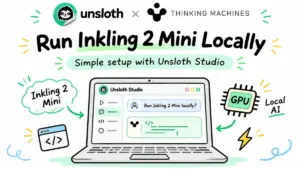
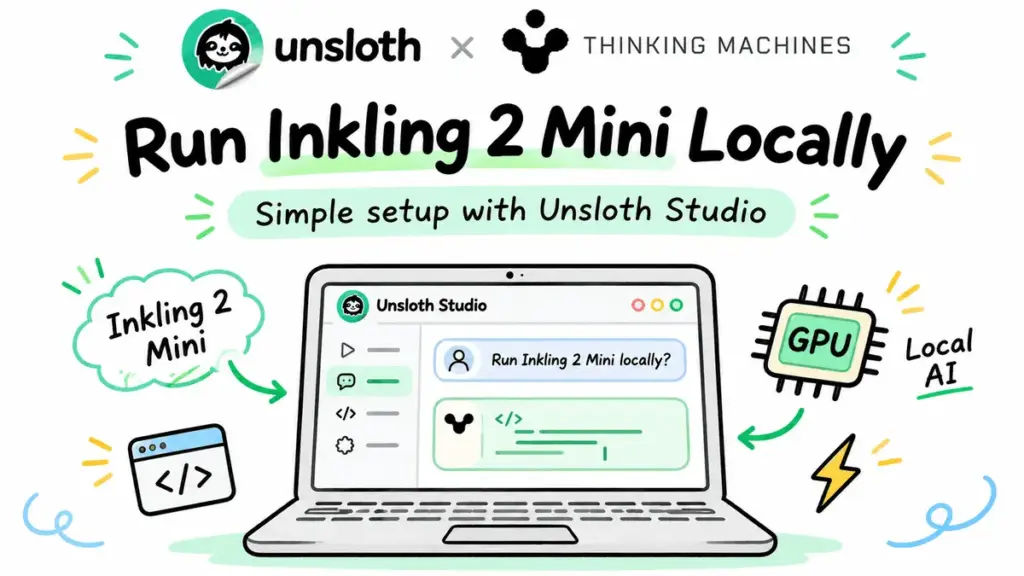
For developers and independent builders, a primary highlight of the release is accessibility. Running a 4-bit quantized iteration of the model on a single consumer-grade NVIDIA RTX 3090 featuring 24GB of VRAM is entirely feasible. This hardware compatibility opens up new avenues for engineers seeking robust local capabilities independent of recurring paid cloud APIs. Real-world testing of Inkling 2 Mini involves deploying it through Unsloth Studio, an interface designed for managing and running local AI models, and subjecting it to practical engineering tasks such as building financial dashboards, developing playable 2D games, and integrating with terminal-based coding agents like Pi.
Installing and Configuring Unsloth Studio for Local Deployment
Managing and executing advanced AI models locally often requires navigating complex technical environments, but tools like Unsloth Studio simplify this process by offering streamlined interfaces for downloading, running, and configuring language models. While heavy enterprise GPUs are frequently associated with running large open-weight architectures, optimized quantization allows developers to utilize consumer hardware such as the NVIDIA RTX 3090.
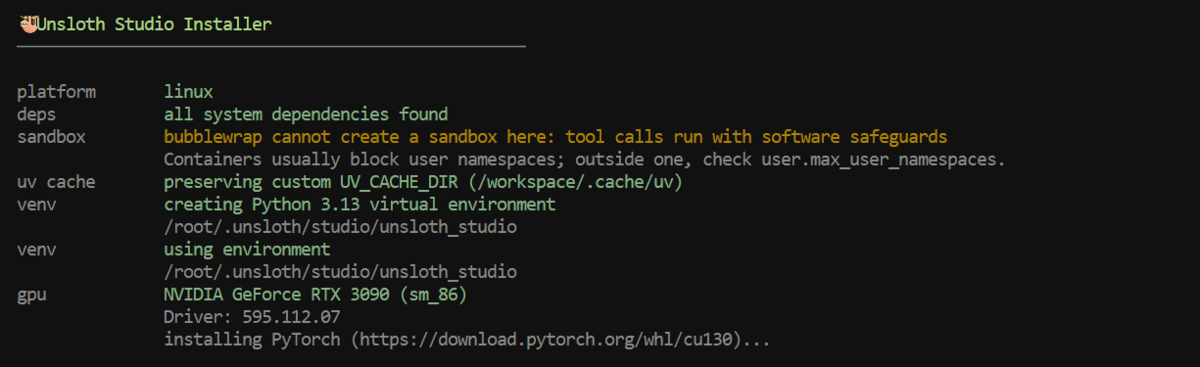
The installation workflow begins via a terminal environment using automated setup scripts provided by the platform. The installation utility detects host system configurations and provisions necessary dependencies. Following a standard shell refresh to integrate newly installed command-line utilities, operators typically configure custom directory paths for storing cached models and Hugging Face home files. Because large language models require substantial storage capacity, directing cache variables to dedicated directories ensures system drives remain unburdened.
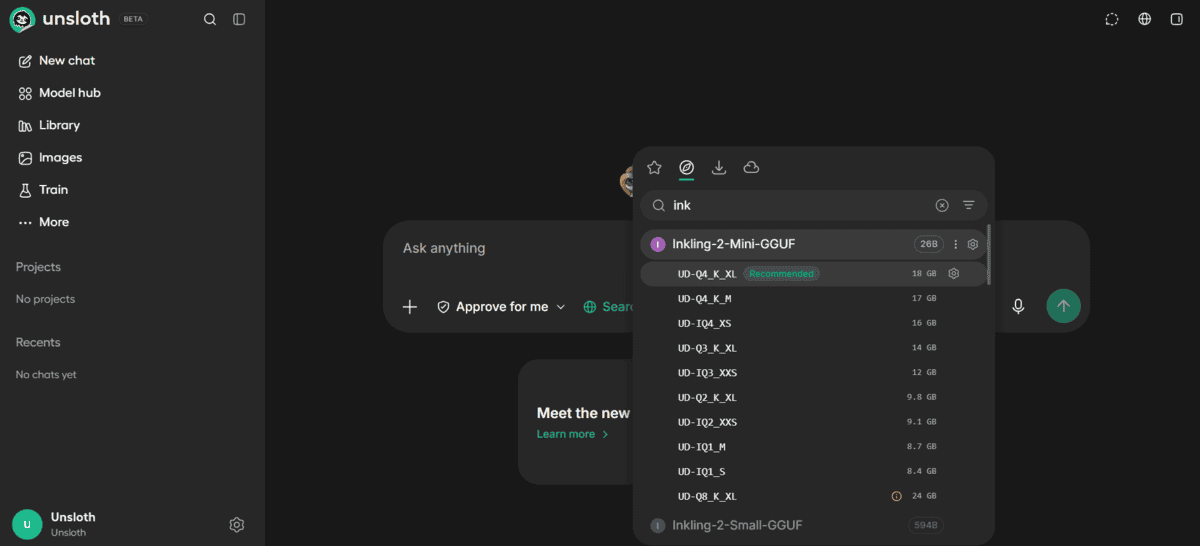
Once the storage paths are established, launching the Unsloth Studio server initializes the web management interface on a designated local port. Upon initial startup, administrative credentials secure access to the control panel. Navigating to the local browser address reveals a dashboard where users can search for available model weights, monitor resource consumption, and manage active instances. For systems equipped with 24GB of VRAM, loading a 4-bit quantized version of Inkling 2 Mini provides an optimal balance between execution speed and output fidelity.

Evaluating Performance, Web Search Integration, and Dashboard Generation
Operating Inkling 2 Mini within a local environment reveals significant processing speeds alongside advanced reasoning capabilities. When loaded via Unsloth Studio using the UD-Q4_K_XL quantization profile, the model demonstrates impressive token generation metrics on an RTX 3090, averaging around 52 tokens per second. This performance level ensures a responsive user experience during interactive chat sessions and complex generation tasks.
Beyond raw text generation, the model supports integrated web search functionality, allowing it to retrieve and synthesize real-time data from external sources. Testing this feature with complex research prompts—such as evaluating stock market outlooks—shows that the model can successfully gather information across multiple domains and synthesize coherent, well-structured financial summaries locally.
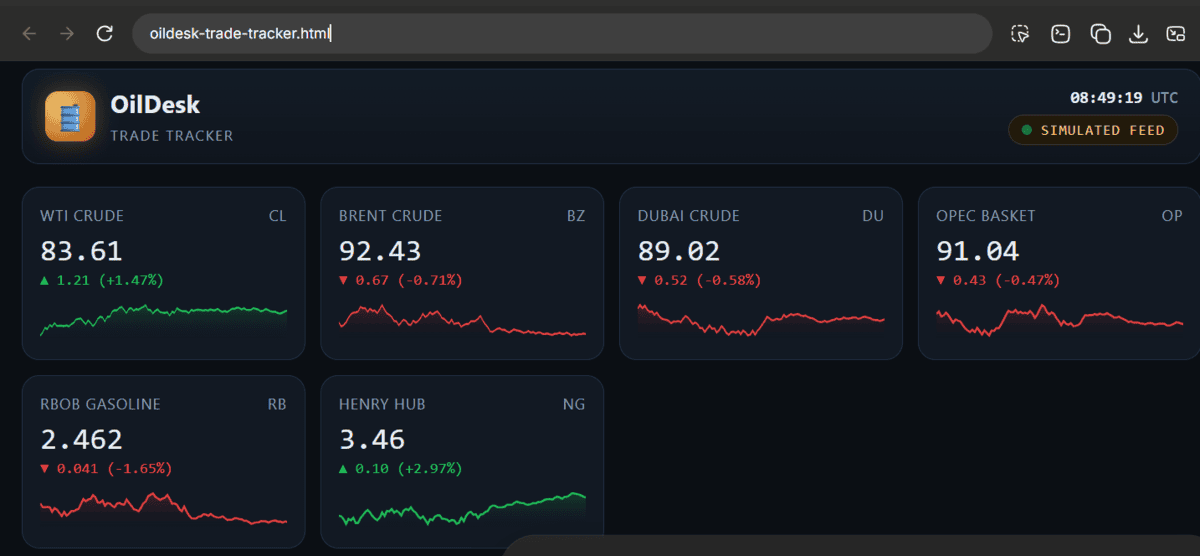
When tools are disabled to test native generation capabilities, Inkling 2 Mini excels at front-end development tasks. Instructed to design a comprehensive oil market dashboard, the model generates clean, functional HTML, CSS, and JavaScript code. The resulting application displays interactive market indicators, charts, and simulated price fluctuations that mimic live trading environments, highlighting the model’s aptitude for rapid prototyping and user interface design.
Integrating with Coding Agents for Application Development
The utility of a local model extends beyond simple chat interfaces when paired with specialized developer tools like the Pi coding agent. Pi is a lightweight, terminal-based assistant that enables developers to construct applications, write source code, and manage software projects directly from the command line. Connecting a local model to such agents bridges the gap between conversational AI and practical software engineering.

Establishing this connection involves retrieving API credentials and connection endpoints from Unsloth Studio and passing them to the coding agent environment. Once configured, developers can leverage the local model to handle ambitious programming tasks. For instance, prompting the agent to build a sophisticated 2D endless-runner game inspired by arcade classics yields a fully realized codebase incorporating HTML5 Canvas, CSS styling, and JavaScript logic.
The resulting application features complex mechanics, including multi-lane movement, obstacle generation, collectible items, and visual particle effects, all optimized for high-frame-rate browser play. Generating these complete software artifacts within minutes demonstrates the practical value of combining efficient open-weight models with local coding assistants. Developers can transition quickly from conceptual ideas to functional prototypes without routing sensitive code through third-party cloud infrastructure.
The broader ecosystem surrounding Inkling 2 Mini reflects a growing enthusiasm within the open-source community for local model optimization. Developers across various platforms continue to experiment with custom builds of llama.cpp, alternative inference engines, and specialized hardware tuning to maximize execution speeds, occasionally pushing generation rates significantly higher depending on specific hardware configurations. By combining flexible open-weight architectures with adaptable tooling and local deployment frameworks, engineers retain comprehensive control over their development pipelines while narrowing the performance gap with proprietary alternatives.