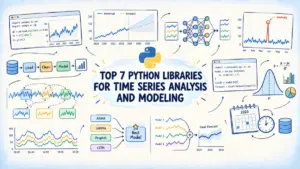









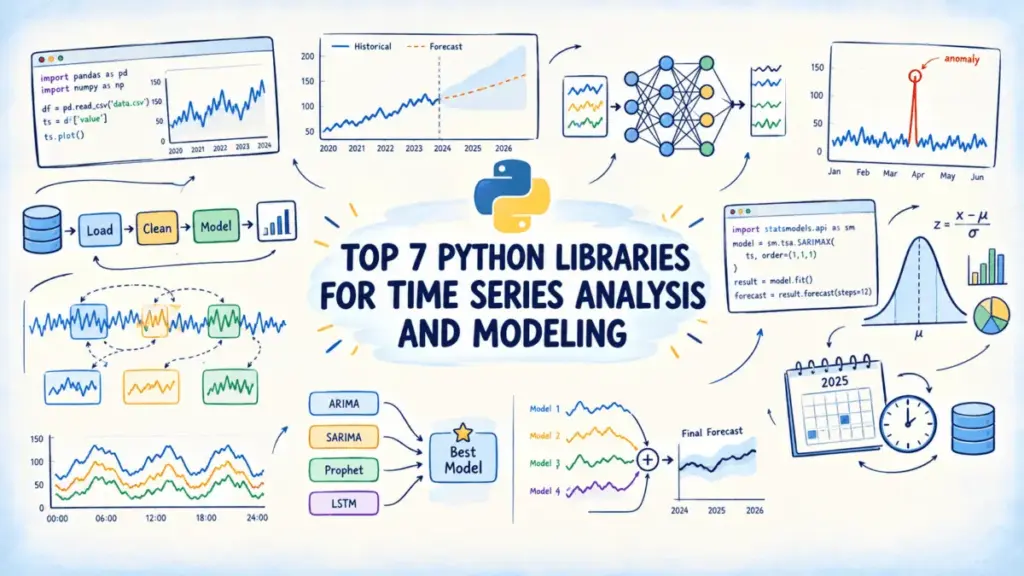
Time series analysis remains one of the most structurally fragmented domains within the Python data science ecosystem. Depending on whether an engineer or data scientist needs classical statistical forecasting, modern machine learning pipelines, deep learning architectures, or unsupervised anomaly detection, they are often forced to pivot between entirely different tools. Each of these solutions typically arrives with its own unique application programming interface, expected data formats, and underlying assumptions about the nature of the underlying data problem.
To bridge this operational gap, industry practitioners frequently rely on a combination of packages that collectively span the full spectrum of time series work. A close examination of seven key Python libraries reveals how modern data teams tackle everything from basic autoregressive forecasting to complex neural network architectures and automated pattern discovery.
Building Statistical Forecasting Models with Statsmodels
When interpretability holds just as much weight as raw predictive accuracy in a production environment, statsmodels remains an indispensable foundation. As the historical bedrock of classical time series analysis in Python, it implements the robust statistical models that have served as operational workhorses across economics, finance, and operations research for decades.

The library is widely valued for providing deep statistical rigor, offering comprehensive diagnostic tests, parameter confidence intervals, and clear p-values that allow analysts to understand the exact mechanics driving their forecasts. It is the go-to resource when stakeholders demand transparency and mathematical justification for every prediction made by a model. Through its dedicated time series module, practitioners can implement classical frameworks such as autoregression, moving averages, and seasonal ARIMA variants while maintaining full control over the underlying statistical assumptions.
Automating Model Selection with Pmdarima
While classical statistical models offer unmatched interpretability, manually identifying the correct order for parameters—specifically the p, d, and q values in an ARIMA model—is notoriously tedious and computationally demanding. To mitigate this bottleneck, the pmdarima library brings the automated functionality of R’s popular auto.arima procedure directly into the Python ecosystem. By wrapping statsmodels under the hood, the library streamlines the model selection process by automatically evaluating various parameter combinations to find the optimal fit based on information criteria such as AIC or BIC.
This automation acts as a powerful accelerator for teams needing rapid statistical baselines or looking to deploy automated forecasting pipelines across hundreds or thousands of individual time series simultaneously. However, as development cycles evolve, practitioners are advised to monitor community activity and repository updates, ensuring that dependencies remain stable when integrating the package into long-term production pipelines.
Unifying Machine Learning Workflows with Sktime
Addressing the core fragmentation issue that historically plagued Python’s time series landscape, sktime provides a unified framework designed to handle a vast array of learning tasks under a single consistent interface. Rather than forcing developers to adapt to disparate syntaxes for different operations, sktime spans forecasting, classification, regression, clustering, and temporal annotation.
The library successfully bridges classical statistical approaches with modern machine learning and deep learning methodologies. By standardizing the API across these diverse modeling families, sktime enables data science teams to build systematic, highly reproducible workflows. This structural uniformity makes it straightforward to benchmark and compare models of entirely different origins on the exact same dataset, significantly reducing the engineering overhead typically associated with model experimentation.
Scaling End-to-End Forecasting with Darts
Taking a slightly different approach to ecosystem unification, the Darts library provides a comprehensive toolkit that implements classical, machine learning, and deep learning models directly within its own framework, rather than merely wrapping external packages. The library places a strong emphasis on probabilistic forecasting, allowing organizations to generate predictions accompanied by quantified uncertainty bounds rather than single-point estimates.
Darts excels in multi-series scaling, enabling data architectures to handle massive collections of temporal sequences concurrently. Its extensive model catalog spans traditional exponential smoothing and ARIMA variants right alongside modern gradient-boosted regression trees and sophisticated deep learning architectures. This broad coverage allows engineers to experiment fluidly across disparate model paradigms within a single, coherent development environment.
Detecting Temporal Patterns with Stumpy
While the vast majority of time series libraries focus squarely on forecasting the future, stumpy addresses the equally critical challenge of understanding the present and past through pattern discovery. Instead of predicting what comes next, stumpy computes the matrix profile—a data structure that records the precise distance between every subsequence in a time series and its nearest neighbor.
This mathematical representation unlocks powerful capabilities such as motif discovery, which identifies recurring patterns, and discord detection, which flags anomalous subsequences without requiring historical labeled data. Because it operates in an unsupervised manner, stumpy frequently serves as an essential complement to forecasting libraries, particularly in automated production monitoring systems where engineers need to understand structural anomalies and hidden behaviors within streaming data.
Scaling Anomaly Detection with PyOD
For outlier detection across tabular and multivariate feature matrices, PyOD stands out as one of the most comprehensive libraries available in the Python ecosystem. Its major releases incorporate a vast collection of detection algorithms under a unified application programming interface, having expanded well beyond traditional tabular constraints to accommodate time series, graph, text, and multimodal data structures.
In practical applications, PyOD is most frequently deployed on engineered feature matrices rather than raw sequential data directly. By transforming raw time series into representations that capture rolling statistics, lag features, and frequency components, data teams can leverage PyOD’s extensive algorithmic suite to detect sophisticated anomalies at scale.
Advancing Deep Learning with NeuralForecast
When traditional statistical techniques and gradient-boosted machine learning models reach their performance plateau, deep learning often provides the necessary leverage to improve predictive accuracy. Developed by Nixtla, NeuralForecast brings a wide array of advanced neural network forecasting architectures to Python in a format tailored for production environments.
The library is designed for global training, allowing a single neural network model to learn patterns across thousands of distinct time series simultaneously. This capability makes it particularly valuable for large-scale enterprise forecasting tasks where data is abundant and complex non-linear relationships cannot be adequately captured by linear models. NeuralForecast operates alongside complementary Nixtla packages designed for fast classical baselines and gradient-boosting pipelines, offering a modular approach to modern forecasting infrastructure.
Summary of the Time Series Landscape
Evaluating these libraries highlights how the Python ecosystem has matured to support the entire lifecycle of time series data. From statsmodels and pmdarima providing rigorous and automated statistical baselines, to sktime and Darts unifying machine learning and probabilistic pipelines, practitioners have access to robust tools for every scale. Meanwhile, specialized packages like stumpy and PyOD handle unsupervised pattern discovery and anomaly detection, while NeuralForecast pushes the boundaries of deep learning accuracy.
Ultimately, navigating this fragmented landscape depends heavily on the specific requirements of the project at hand, balancing the need for model interpretability against the demands of scale and predictive power. Applying multiple tools to the same dataset often yields the clearest understanding of both the data’s underlying dynamics and the operational trade-offs of each modeling approach.