









The battle for the modern smart home has entered a dramatic new phase, highlighted by contrasting hardware strategies from two of the industry’s biggest heavyweights. Following Apple’s major smart home showcase early this October—which introduced advanced Siri AI features, the company’s debut smart display called HomeView, and the long-awaited HomePod Mini 2—Amazon has fired back with a sweeping overhaul of its own Echo lineup.
The timing has set off an immediate wave of comparisons across the consumer technology landscape. What makes this rivalry particularly compelling is that Amazon has chosen an entirely different philosophical and structural path for its latest home devices, signaling a major shift in how tech giants envision our living spaces. Nowhere is this clearer than with the newly announced Echo Show 16, which is currently available for preorder and stands as a direct rebuttal to Apple’s design philosophy.
Amazon’s Echo Show 16 Is Everything the HomeView Is Not
Apple’s maiden voyage into the smart display market relies heavily on audio performance and Siri AI integrations, wrapped in a physical profile that bears some resemblance to compact displays like the Echo Show 11. However, industry observers quickly pointed out a fundamental design dissonance upon its announcement: the HomeView’s 7-inch screen is simply too small to comfortably consume feature-length movies, latest Apple TV series, or extensive visual media, even if its sound quality punches well above its weight class.


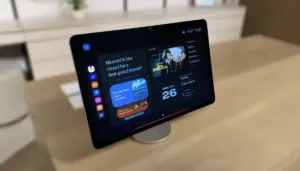
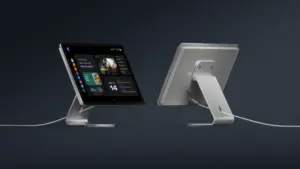
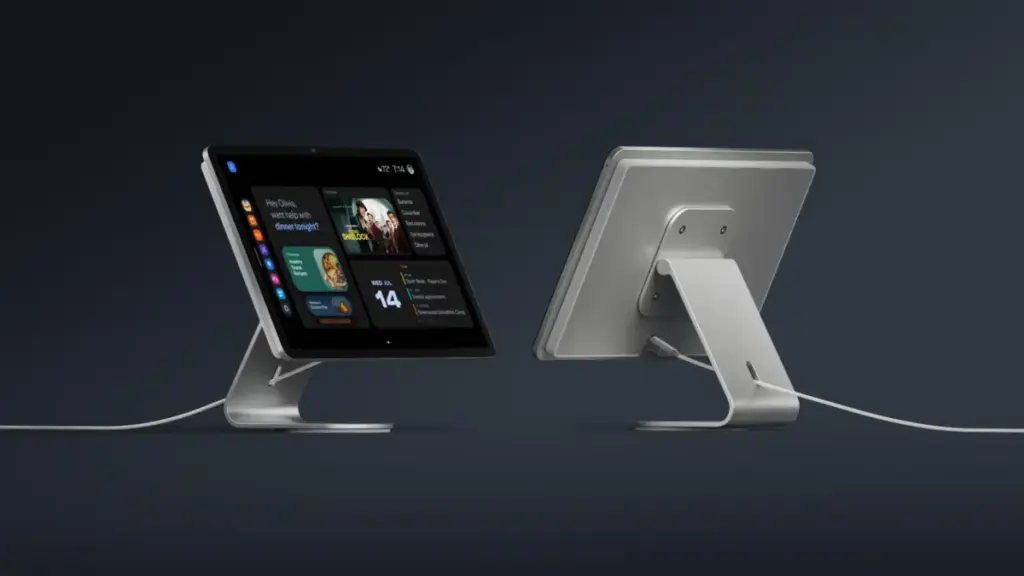
This exact limitation is what has driven companies like Amazon to steadily increase the screen real estate of their flagship smart displays over the years. With the introduction of the Echo Show 16, Amazon is fully embracing the concept of a secondary television for high-traffic zones like the kitchen or hallway. Interestingly, this new iteration completely strips away the bulky, room-filling standalone speaker design of past models, opting instead for a streamlined array of small woofers and tweeters paired with a physical stand design that appears pointedly reminiscent of Apple’s iconic Mac computers.
While real-world audio testing will ultimately determine how the sound profile holds up, Amazon appears to be pivoting away from 360-degree acoustic dispersion in favor of an experience that mimics a traditional television. At the same time, the device retains the foundational touchscreens, high-definition cameras, and microphone arrays expected of modern smart displays, with flexible wall-mounting hardware included for users who prefer to bypass the desktop stand.
Underpinning this expanded hardware footprint is a fully integrated Fire TV platform—a feature previously restricted to larger, wall-mounted Echo Show variants. The inclusion of Fire TV does much more than simply streamline access to Amazon Prime content; it significantly enhances the device’s ability to run third-party applications and manage complex smart home ecosystems with the fluidity of a dedicated streaming box.

For dedicated cinephiles and sports fans, Amazon is also offering an upgraded Nanomatte display option engineered specifically to minimize glare and maximize color accuracy. While Apple has remained relatively tight-lipped regarding the full scope of third-party application support outside of its proprietary Apple TV ecosystem, Amazon’s lineup boasts out-of-the-box compatibility with major streaming services including Netflix, Disney Plus, YouTube, HBO Max, Peacock, Tubi, and Pluto.
Yet, this surge in advanced technology comes with a steep financial hurdle—a pain point that prospective Apple HomeView buyers will recognize all too well. While the compact Apple HomeView starts at $299, Amazon’s baseline Echo Show 16 opens at $499.99, with the anti-glare Nanomatte display pushing the base cost to $569.99. When factoring in mandatory or optional accessories like dedicated stands—which range anywhere from $69.99 to $150—the total investment climbs rapidly. This high price tag poses a challenging value proposition for households that already own functional smart displays, though it may attract consumers explicitly searching for a streamlined second television screen for smaller rooms.
Amazon Adds an Echo Camera to Compete With the HomePod Mini 2
The Echo Show 16 was merely one piece of a much larger product rollout designed to challenge Apple’s autumn hardware offensive. Amazon also debuted a refreshed Echo Studio model, starting at $249.99, positioning it as a direct competitor to Apple’s HomePod Mini 2. However, Amazon introduced a major hardware twist: the latest Studio incorporates a discreet, nearly invisible home security camera seamlessly integrated into its chassis.

According to Amazon, the embedded camera is designed to feed visual intelligence data back to Alexa. While this capability raises predictable data privacy discussions among consumers, it theoretically empowers the voice assistant to provide contextual answers regarding activity within a room while residents are away, effectively functioning as a compact indoor security camera.
Whether consumers will embrace a camera embedded inside a living room or bedroom speaker remains to be seen, but the addition successfully distinguishes the Studio from the $149 HomePod Mini 2, preventing casual shoppers from viewing the two audio devices as direct equivalents.
Complementing the high-end Studio, Amazon introduced a more affordable, camera-free Echo Dot priced at $99.99. This refreshed model benefits from a custom-designed AZ3 silicon chip engineered to drastically accelerate local Alexa response times, alongside a dedicated children’s variant.

Furthermore, while Apple demonstrated how portable devices like the iPhone Duo could double as impromptu bedside alarm clocks, Amazon countered with a dedicated hardware solution: the Echo Time. Sporting a circular, dial-inspired smart display profile, the device is explicitly tailored for nightstands and integrates advanced wake-up routines powered by upgraded software. True to Amazon’s pricing strategy for this product cycle, however, the specialized clock carries a premium price tag of $199.99.
Alexa Plus Is Ready to Duel With Siri AI
No hardware refresh from either tech giant would be complete without software advancements, bringing the next-generation generative capabilities of Alexa Plus into direct conflict with Apple’s Siri AI. Both ecosystems introduce sophisticated ways to interact with smart displays and connected appliances, though their underlying approaches diverge significantly. Apple’s Siri AI focuses heavily on native home automation controls and contextual information retrieval pulled seamlessly from personal communications sources like emails and text messages on connected iPhones.
Alexa Plus, meanwhile, introduces a completely overhauled interface for the Echo Show 16. The legacy transcription visualizer has been retired in favor of an interactive, dynamic canvas that pulls up relevant visuals, video clips, calendar events, and real-time controls mid-conversation. To improve multitasking, individual conversations generate distinct card icons, allowing users to pause and seamlessly resume past dialogues. Additionally, a newly introduced Home Map mode provides a live, interactive floor plan of the entire home, granting users granular room-by-room control over connected smart devices with a glance.

The ongoing rivalry between the two assistants also highlights differing financial models for artificial intelligence features. Apple has indicated that its most advanced Siri AI capabilities will require an active iCloud Plus subscription, though precise pricing and packaging details remain sparse. Amazon, conversely, bundles core Alexa Plus features into its existing Amazon Prime membership framework, though non-subscribers face a substantial monthly fee of $20 to unlock the assistant’s full suite of capabilities.
Ultimately, Apple is treading relatively conservative waters with its first-ever smart display, prioritizing audio and minimalist design despite the ergonomic compromises of a smaller screen. Amazon, on the other hand, is placing a massive bet that consumers actively desire a secondary television experience integrated directly into their kitchen and hallway displays, even if it commands a luxury price. With both companies deploying radically different visions, advanced artificial intelligence integrations, and divergent hardware form factors this holiday season, the smart home market has rarely felt so divided or so competitive.