








The latest wave of advancements in agentic AI is shifting the industry conversation away from raw model capability and toward the critical issue of reach. While the prowess of a Large Language Model (LLM) is undeniably important, the real-world utility of an AI agent is often defined by its ability to interface with existing enterprise infrastructure without requiring a complete architectural overhaul. Last week, AWS demonstrated this focus by evolving how agents interact with the vast ecosystem of services that businesses already trust.
The integration of AWS Step Functions into the agentic toolkit serves as a prime example of this trend. By enabling Step Functions—which already orchestrate more than 220 AWS services—to be called as a native tool, AWS has effectively bridged the gap between intelligent reasoning and established business logic. Teams no longer need to rewrite their complex workflows to accommodate an AI; they simply describe what exists, allowing the agent to discover and execute those processes when appropriate. This theme of seamless integration was mirrored in reports from the AI community, where platforms are exposing hundreds of internal API operations to agents, fundamentally changing how developers view system accessibility.
Beyond connectivity, cost-efficiency remains a top-tier priority for enterprises scaling their AI operations. The arrival of OpenAI’s newest "Terra" model on Amazon Bedrock, priced significantly lower than its predecessors, signals a broader market shift toward making high-performance AI more accessible for everyday workloads. Simultaneously, the introduction of post-quantum cryptographic tools reflects a forward-looking strategy, addressing security deadlines that are already appearing on the horizon of long-term infrastructure planning.
Headlining Developments: GPT-6.1 Terra and Agentic Workflows
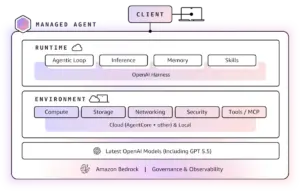
The most significant headline from the past week is the general availability of OpenAI’s GPT-6.1 Terra on Amazon Bedrock. Positioning is the key here; Terra is designed specifically for the "everyday-workload" segment of the GPT-6 family. According to OpenAI’s internal "Agents’ Last Exam" evaluation, Terra represents a substantial leap in performance, scoring 15 percentage points higher than the GPT-5.6 Terra while matching the performance of the more advanced GPT-6 Astra. Most impressively, OpenAI reports that the model completes tasks more than three times faster than its counterparts. From a cost perspective, the model is compelling, with input and output token prices at least 50% lower than those of the GPT-6.1 Sol and GPT-5.6 Terra models. With support for up to 1 million input tokens across text and image modalities, this model is now accessible via Bedrock APIs, ChatGPT Work, and Codex.
Parallel to this model release is the integration of AWS Step Functions workflows as AI agent tools via the Amazon Bedrock AgentCore Gateway. This integration leverages the Model Context Protocol (MCP) to standardize how agents interact with external tools. The philosophy here is a clear division of labor: the AI agent serves as the decision-maker, determining when a workflow is necessary and what inputs are required, while Step Functions handles the execution, ensuring that steps like eligibility checks or manager approvals occur in the strictly defined, audited order that businesses require. Because this capability applies to existing Standard and Express workflows, organizations can empower their agents with complex, multi-step processes immediately without modifying the underlying business logic.
Security and Infrastructure Enhancements
The past week also saw critical updates to security and infrastructure, most notably regarding post-quantum preparedness. AWS Key Management Service (KMS) now supports ML-KEM for post-quantum key encapsulation. This allows organizations to establish shared secrets using post-quantum algorithms, with private keys secured in FIPS 140-3 Level 3 validated Hardware Security Modules (HSMs). This is a proactive measure against the "harvest now, decrypt later" threat, where adversaries record encrypted traffic today with the intent of decrypting it once quantum computing reaches maturity. This capability is available across most AWS regions and is complemented by the addition of post-quantum TLS key exchange in Amazon Aurora PostgreSQL versions 18 and higher.
Identity management has also received a significant boost with AWS IAM Identity Center’s new support for cross-Region trusted identity propagation. Previously, architectural constraints forced developers to either consolidate services into a single region or rely on broad, less granular IAM roles to handle cross-region requests. Now, a user’s identity can travel with their request across regions, allowing for fine-grained access control based on user and group membership, significantly simplifying audits and security postures without additional cost.
For those managing high-performance compute workloads, Amazon ECS now supports GPU sharing using NVIDIA Multi-Process Service (MPS). This is a practical response to workloads that only utilize a fraction of a GPU’s total capacity, such as small-model inference. By declaring memory requirements for each container, ECS can place multiple tasks on a single GPU, maximizing hardware utilization. On ECS Managed Instances, the service even monitors the health of the MPS control daemon, ensuring system reliability at scale.
Containerized application deployment is also becoming more efficient through the expansion of Seekable OCI (SOCI) lazy loading to AWS Lambda. By allowing Lambda to fetch only the necessary files for startup rather than pulling the entire container image, AWS reports up to a 70% reduction in startup times. Similar efficiencies have been noted in Amazon SageMaker AI, where benchmarks show that image size becomes less of a factor, with startup times remaining consistent even for massive datasets.
Finally, Amazon EKS Auto Mode has expanded its capabilities to include support for the Kubernetes Gateway API. This enables developers to declare traffic routing—including HTTP/gRPC routing, weighted splitting, and header-based routing—without the need for external controllers. The underlying AWS load balancing infrastructure is managed automatically, and the system is designed to coexist with existing Ingress workloads, making it an additive improvement rather than a disruptive migration.
Real-World Applications and Operational Insights
The utility of these tools is best illustrated by how they are being deployed in production. Nubank, for instance, has leveraged the AWS DevOps Agent to automate disaster recovery, cutting testing cycles from over four hours to less than 40 minutes. By handing off the tedious process of evidence collection and report generation to the agent, the company was able to quadruple its flow coverage in 2026, managing complex synthetic traffic tests that produce the exact documentation required by regulators.
In another case, MoEngage successfully integrated over 400 internal REST API operations into the AgentCore Gateway. Faced with the challenge of managing diverse APIs across multiple regions and VPCs, the team avoided a massive manual documentation effort by teaching the agent to search for tools based on task descriptions rather than cataloging them individually. This approach, which saved an estimated six months of platform engineering time, highlights the importance of semantic tool discovery in modern AI systems.
Storage management also continues to evolve, with organizations using S3 Storage Lens and Storage Class Analysis to drive cost savings. One case study involved moving 5.8 petabytes of logs from S3 Standard to Glacier Instant Retrieval based on access patterns, resulting in a 70% reduction in monthly storage costs. This demonstrates that effective cost optimization is increasingly driven by data-backed evidence rather than speculative policy changes.
As the industry prepares for the upcoming AWS re:Invent in Las Vegas, the focus on these agentic and efficiency-oriented tools will likely take center stage. With the event catalog now live and reserved seating open, developers have a clear path to engage with these technologies directly. The 2026 season for AWS Community Days is also drawing to a close, providing one final opportunity to connect with local leaders before the major announcements in late November. As always, the rapid pace of these updates highlights the importance of staying informed through the official AWS channels, ensuring that builders can take advantage of these new tools as they reach general availability.