








The intersection of classical machine learning and modern generative artificial intelligence has entered a new phase of practical application. Developers and data scientists frequently encounter the challenge of processing lengthy, unstructured, and noisy text data using traditional, lightweight machine learning classifiers. These conventional models often struggle to extract clean signals from verbose inputs without extensive preprocessing. To address this friction, researchers have explored innovative ways to combine the precision of large language models with the efficiency and reliability of established machine learning frameworks.
A recent architectural approach demonstrates how to seamlessly integrate large language model text summarization directly into traditional scikit-learn pipelines. Developed by AI expert and writer Iván Palomares Carrascosa, this technique allows LLM-driven text distillation to coexist alongside traditional data preprocessing, training, and inference stages. Crucially, the architecture can be implemented using exclusively free developer tools, opening up accessible pathways for practitioners looking to harness generative AI without incurring heavy per-token API costs.
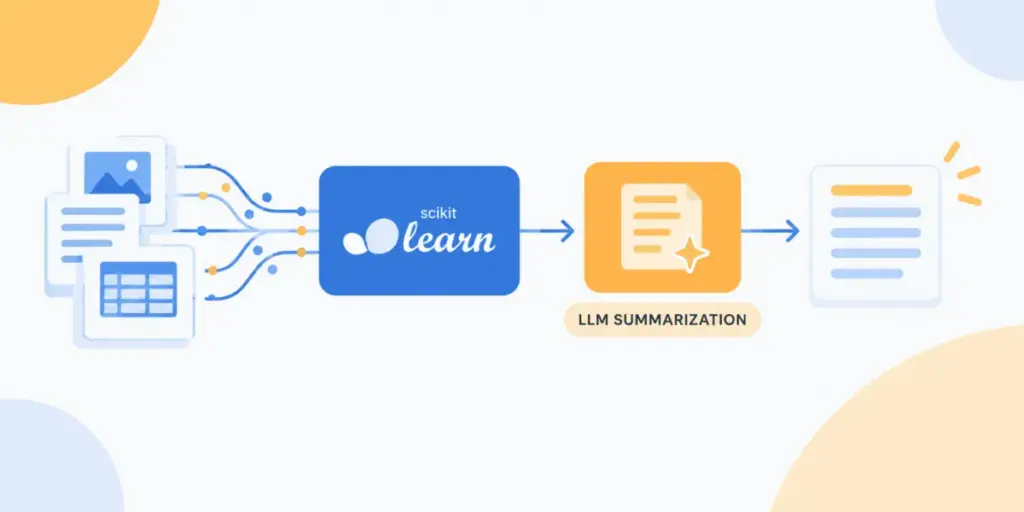
By blending Scikit-LLM estimators with classic scikit-learn methods, developers can build a unified pipeline capable of ingesting raw, messy text and producing accurate classifications through a streamlined, multi-step process. This methodology bridges the gap between prompt-based text understanding and classical numerical modeling, offering a hybrid solution that brings together the best of both technological eras.
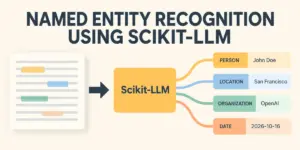
Integrating LLM-Driven Summarization in a Machine Learning Pipeline
The implementation of this hybrid architecture relies on an ecosystem that combines Python, Google Colab, and the Groq LLM API to leverage free-tier, pre-trained language models. By utilizing Groq’s high-performance infrastructure, developers can bypass the standard financial barriers typically associated with commercial large language model endpoints. Setting up the environment involves acquiring an API key from the provider and securely storing it within the cloud development environment as an encrypted secret variable.
Once the foundational environment is secured, the process begins by installing Scikit-LLM, a specialized library designed to bridge the gap between scikit-learn and modern language models. The Python code configuration routes subsequent requests through the provider’s OpenAI-compatible endpoint rather than relying on default commercial defaults. This configuration step ensures that the system communicates efficiently with the chosen pre-trained models while maintaining full compatibility with standard Python data structures.
The architecture’s operational logic starts with the definition of training data, consisting of a small, representative set of verbose documents alongside their corresponding class labels. In real-world data science scenarios, raw text documents are often lengthy and laden with conversational or structural noise. Directly transforming such text into numerical representations for machine learning classifiers inevitably propagates this noise, degrading overall model performance.
To counteract this, the architecture introduces a preliminary summarization stage. Rather than engaging in resource-intensive fine-tuning of the large language model itself, the system operates on a few-shot principle. A minimal set of training examples is sufficient to guide the model on how to distill the text, leveraging its pre-existing reasoning capabilities without requiring actual weight updates to the LLM.
The core of the architecture lies in its structured, multi-step pipeline. The framework employs a dedicated summarizer object encapsulating a compatible model to condense long documents into concise, focused summaries. Following this text distillation phase, the pipeline applies a term frequency-inverse document frequency vectorizer to convert the cleaned summaries into numerical representations. Finally, a standard logistic regression classifier trains on these refined vectors, learning to associate the distilled semantic signals with the target category labels.
Fitting the entire pipeline end-to-end demonstrates a fascinating interplay between the generative model and the classical classifier. Observers might initially question how a classifier trained on only a handful of examples can accurately generalize across complex categories such as energy, finance, and healthcare. The secret lies in the synergistic mechanics of the pipeline stages. The large language model acts as a precise semantic filter, stripping away extraneous noise and condensing rambling prose into canonical keywords and core concepts.
Once the text is reduced to its essential elements, the downstream vectorizer naturally restricts its vocabulary to those few remaining distinctive words. Consequently, the classification task transforms into a streamlined, highly effective pattern-matching exercise. Inspecting the intermediate summaries generated during this phase confirms that the language model successfully extracts the vital details from each document while discarding irrelevant background information.
When unseen test documents are introduced to the pipeline, the system automatically processes them through the established sequence. The raw, verbose inputs are first summarized by the language model, converted into TF-IDF vectors by the vectorizer, and finally evaluated by the logistic regression classifier. Tests involving diverse domains—such as medical breakthroughs in vaccine development, renewable energy innovations in sodium-ion battery technology, and market fluctuations driven by semiconductor earnings—consistently yield accurate categorical predictions.
This seamless integration proves that developers do not need massive computational infrastructure or costly commercial APIs to achieve sophisticated text understanding. By coupling prompt-based text distillation with lightweight classical models like logistic regression, practitioners can construct efficient, interpretable, and cost-effective machine learning solutions. As the artificial intelligence landscape continues to evolve, methodologies that harmonize classical data science tools with modern generative capabilities will likely play an increasingly pivotal role in real-world application development.