








HELSINKI — China closed out the month of September with its ninth and tenth orbital launch attempts, deploying a mixture of national low Earth orbit broadband infrastructure and electromagnetic environment detection satellites. The rapid back-to-back missions highlight an unprecedented launch tempo as the country pushes toward its goal of surpassing 100 orbital launches in a single calendar year for the first time in its history.
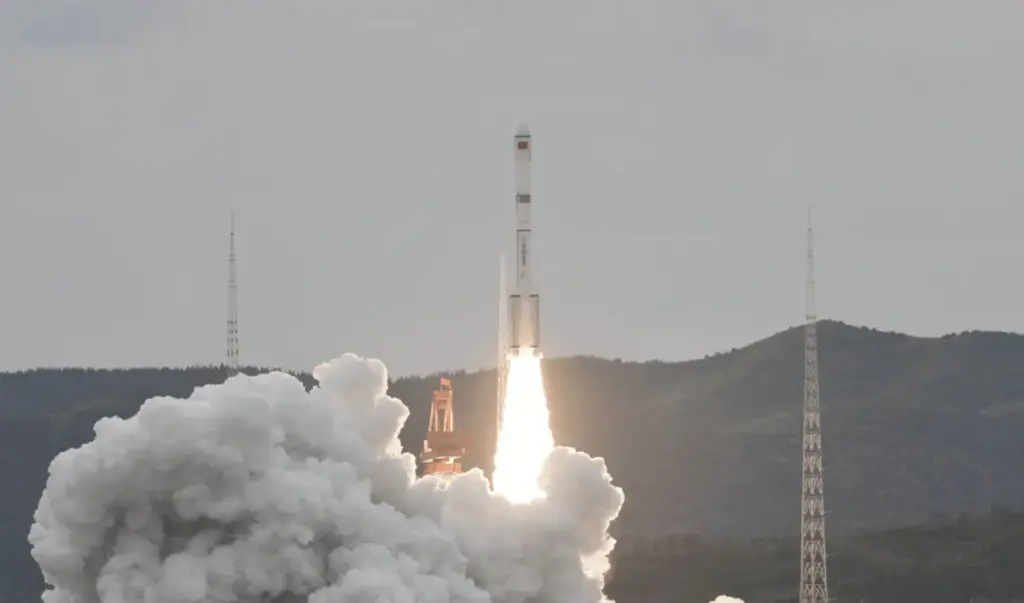
The recent flurry of activity began when a Long March 8A lifted off at 9:32 a.m. Eastern time on September 23 from the Hainan commercial spacecraft launch site. Encapsulated within the rocket’s payload fairing was the 26th group of satellites destined for China’s Guowang national low Earth orbit satellite internet project. Less than 24 hours later, operational momentum shifted to northern China, where a Long March 6A rocket successfully cleared the pad at 4:46 a.m. Eastern time on September 24 from the Taiyuan Satellite Launch Center, carrying the fourth group of Yaogan-40 remote sensing satellites.
These missions provided a fitting bookend to an exceptionally busy September characterized by a relentless launch cadence. At various points during the month, Chinese launch providers maintained a pace that saw multiple orbital missions executed within mere days of each other. Most notably, the national program achieved a milestone by conducting four distinct orbital launches from three different spaceports within a tight 48-hour window on September 15 and 16.

Following the September 23 flight, officials at the China Aerospace Science and Technology Corporation (CASC) confirmed that the latest batch of Guowang satellites successfully entered their assigned operational orbits. Subsequent independent tracking data compiled by the U.S. Space Force verified that the spacecraft had established themselves in roughly circular orbits at an altitude of approximately 1,100 kilometers, inclined at 50 degrees. Development of this particular batch was overseen by the China Academy of Space Technology (CAST), CASC’s premier spacecraft manufacturing arm.
The Guowang constellation is managed by China SatNet, a state-owned enterprise established in 2021 to oversee the deployment of a massive, multi-vendor broadband network. The overarching blueprint for Guowang calls for a sprawling constellation comprising approximately 13,000 satellites. To meet this ambitious deployment target, China SatNet utilizes spacecraft sourced from multiple manufacturers and relies on a diverse fleet of launch vehicles. Among these, the Long March 8A—which made its maiden flight in February 2025—has quickly emerged as a reliable workhorse, launching with increasing frequency from the dedicated commercial pads established at the Hainan spaceport.

Just a day after the Guowang deployment, the Taiyuan launch of the Yaogan-40 (04) satellites added specialized capability to China’s orbital observation assets. State media outlet Xinhua reported that the trio of satellites will primarily be utilized for electromagnetic environment detection and related technological experiments, employing standardized nomenclature historically associated with the Yaogan series. Like their Guowang counterparts, these spacecraft were developed under the leadership of CAST.
Orbital tracking indicates that the new Yaogan-40 group successfully maneuvered into near-polar orbits at an altitude of roughly 800 kilometers, effectively joining three prior batches deployed into similar trajectories. Technical analysis conducted by Integrity ISR reveals that the individual Yaogan-40 groups are strategically positioned into orbital planes separated by 72 degrees in right ascension of the ascending node. This geometric spacing strongly suggests that a fifth and final group will be required to fully populate and complete this specific orbital constellation plane architecture.
The vehicle responsible for the Yaogan deployment, the Long March 6A, features a liquid oxygen and kerosene core stage augmented by multiple solid rocket boosters. It has become one of CASC’s primary medium-lift instruments for both national security payloads and commercial megaconstellation deployments originating from Taiyuan. Since its inaugural flight in March 2022, the Long March 6A has maintained a flawless record of reaching orbit across 27 flights. However, the vehicle’s upper stage has occasionally drawn international scrutiny following several recorded breakup events after payload deployment, which have added to the catalog of space debris in low Earth orbit.
With the successful completion of the Hainan and Taiyuan missions, China’s national space program has officially tallied 70 orbital launch attempts for the 2026 calendar year. To cross the threshold of 100 annual launches—a milestone no nation has achieved at this scale—the final quarter of the year will demand a historic operational tempo. Chinese launch providers completed 18 missions in the first quarter, followed by 26 in the second quarter and another 26 in the third quarter. To surpass the century mark, the program must execute a minimum of 31 launches during the fourth quarter, a challenge that aligns with historical trends showing that China’s annual launch schedules are heavily backloaded toward the final months of the year.
Anticipated Fourth-Quarter Milestones and Upcoming Missions
As the national space enterprise enters the final stretch of 2026, several high-profile missions are slated to dominate the fourth-quarter manifest. Among the most prominent civilian endeavors is the upcoming Shenzhou-24 crewed mission. Current projections point toward a November liftoff for the flight, which will utilize a Long March 2F launch vehicle operating from the Jiuquan Satellite Launch Center.

While official crew announcements remain pending, aerospace observers widely expect the flight roster to feature a foreign payload specialist. The candidate is reportedly chosen from a pool of two Pakistan Air Force pilots who have been undergoing intensive training at the Astronaut Center of China. If confirmed, the selected individual will make history as the first foreign astronaut to visit and work aboard the Tiangong space station.
Ahead of the Shenzhou-24 campaign, pre-launch press briefings may also offer clearer insights into the developmental timelines for other advanced crewed infrastructure. This includes anticipated updates regarding the inaugural flight of the Mengzhou next-generation spacecraft and the Long March 10A launch vehicle, both of which form the backbone of China’s long-term roadmap for crewed lunar exploration.
Commercial launch providers are likewise preparing for a busy end-of-year schedule featuring several potential maiden flights. Among the eagerly awaited debuts are Orienspace’s Gravity-2 medium-lift rocket, iSpace’s Hyperbola-3 featuring a planned first-stage booster recovery attempt, and Zenk Space’s Zhihang-1 vehicle, which previously targeted a mid-year debut. These upcoming commercial efforts will build upon a robust slate of 2026 debut vehicles that have already reshaped China’s industrial base, including the Tianlong-3 in April, Kinetica-2 in March, the Long March 12B in June, the heavy-class Long March 10B in July, and the Pallas-1 rocket that flew earlier in September.
In addition to these developmental flights, numerous dedicated missions are scheduled to support the ongoing buildouts of the Guowang and Qianfan megaconstellations. Additional payloads anticipated in the coming months include the Fengxing-1 spacecraft—destined for a Gravity-1 solid rocket—which could represent China’s first operational commercial orbital transfer vehicle, developed by Future Space. Various space computing payloads are also integrated into the upcoming manifest. Meanwhile, the schedule for the highly anticipated debut flight of the Haolong reusable cargo spaceplane, designed to supply Tiangong and slated to fly atop a Landspace Zhuque-3 rocket developed by AVIC, remains under evaluation as final integration milestones approach.