









In the contemporary business landscape, organizations continually grapple with the compounding complexities of fragmented data, labor-intensive reporting processes, and a persistent lack of real-time visibility into critical operational insights. Despite substantial investments in various enterprise technologies, a significant divide remains. While some companies continue to rely on legacy spreadsheets and disconnected systems that isolate departmental metrics, others have successfully deployed traditional business intelligence platforms yet still struggle to make advanced analytics genuinely accessible, intuitive, and actionable for everyday employees across the organization.
The root of this challenge often lies in the friction between data availability and user enablement. Business users frequently find themselves dependent on dedicated IT teams or specialized data analysts to answer operational questions that fall outside the scope of pre-built reports. Even advanced self-service BI tools frequently require users to possess a working familiarity with complex data structures, report builders, or proprietary query languages. Consequently, a straightforward, time-sensitive operational inquiry can easily transform into a protracted reporting request, delaying decision-making and placing an unnecessary burden on technical personnel.
Addressing these systemic inefficiencies requires a fundamental shift in how organizations leverage modern analytics. By integrating artificial intelligence into enterprise business intelligence architectures, companies are beginning to unlock new pathways that streamline how employees interact with information, derive meaningful conclusions, and execute operational responses.

How AI Can Improve Business Intelligence
The ultimate value of enterprise data has never been solely about accumulation; rather, it is measured by how effectively an organization can leverage that information to understand performance trends and agilely respond to shifting market demands. Artificial intelligence introduces unprecedented opportunities to enhance the synergy between human expertise and automated data processing, fundamentally transforming the user experience within modern analytics environments.
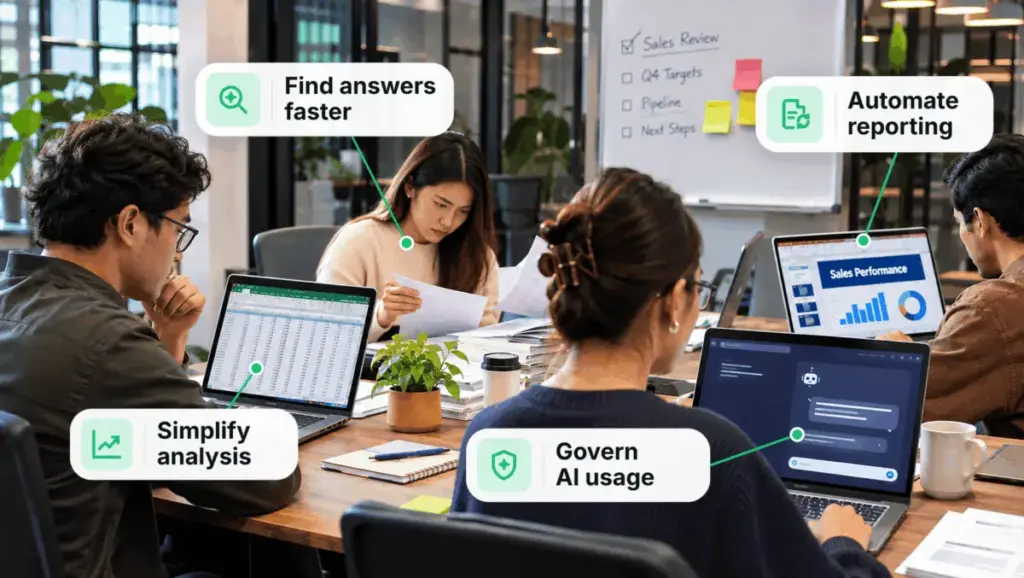
One of the most immediate impacts of AI integration is the simplification of access to complex business information. Through the implementation of natural language interfaces connected directly to enterprise datasets, organizations can empower employees to retrieve information conversationally. For instance, an operations manager seeking to evaluate daily throughput can simply ask a system how many orders are awaiting fulfillment, and subsequently request a breakdown by specific warehouse locations. The underlying intelligence interprets these natural language queries and presents the precise figures instantly, entirely bypassing the need to write complex SQL code or construct bespoke reports from scratch.
However, merely accessing data is only the first hurdle; deriving deep insights that inform timely strategic decisions represents an entirely separate challenge. Enterprise teams frequently find themselves inundated with comprehensive dashboards yet remain unable to synthesize findings across disparate business functions to understand broader enterprise implications. AI-assisted analytics bridges this gap by simultaneously examining multiple performance metrics, proposing plausible explanations for observed anomalies, and helping users evaluate potential courses of action.
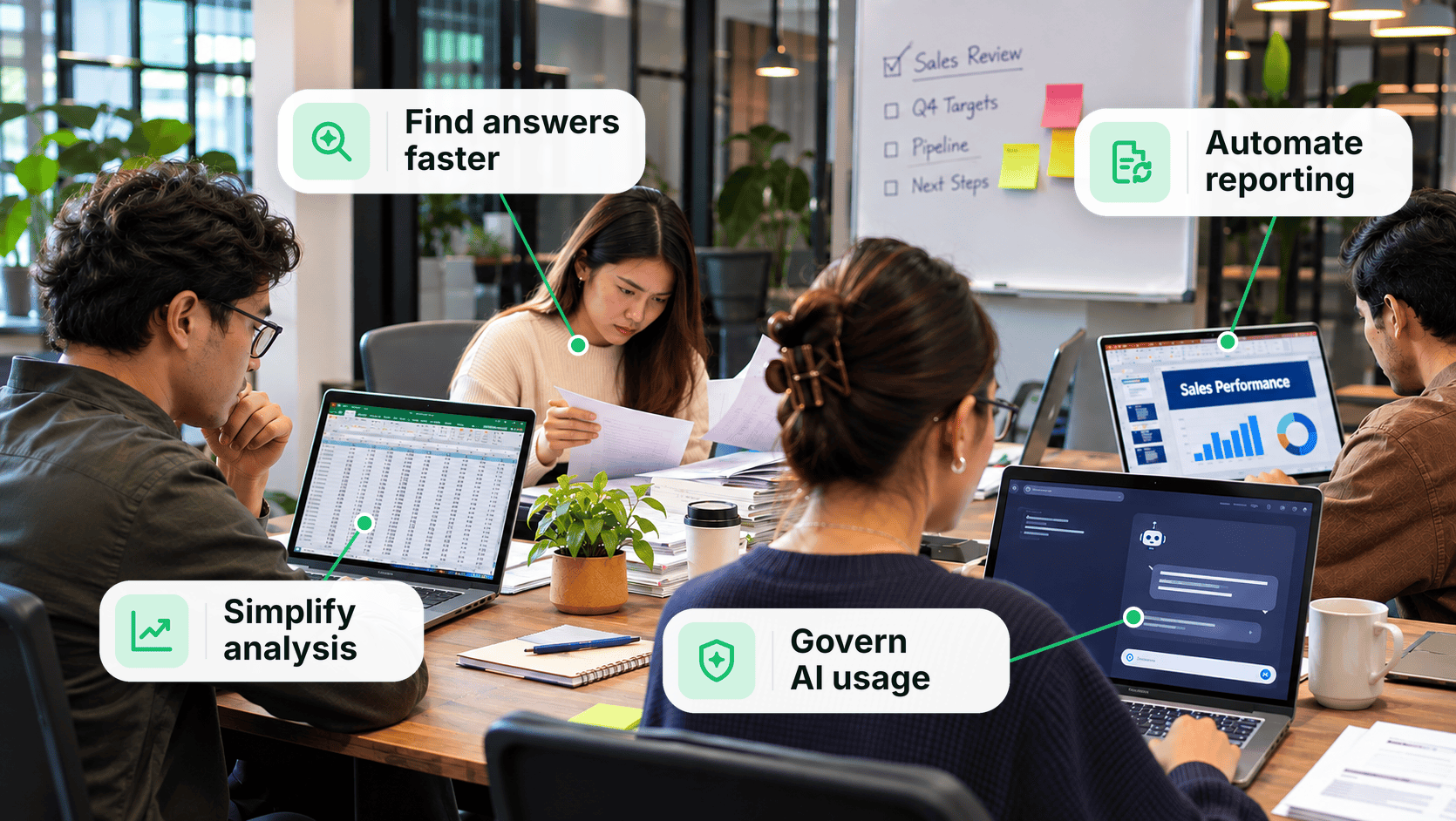
Consider a retail enterprise experiencing recurring stockouts despite maintaining adequate overall inventory levels. In a modern AI-enhanced BI environment, the system can automatically analyze complex demand patterns, evaluate warehouse stock distribution across regions, and assess supplier lead times. By synthesizing these variables, the platform can highlight likely operational bottlenecks and suggest optimized replenishment priorities long before human analysts might manually uncover the correlation.
Furthermore, time-sensitive analytical findings frequently go unaddressed simply because teams struggle to communicate their broader significance or notify the specific personnel required to execute a response. AI assists in overcoming this communication barrier by automatically translating complex analytical findings into cohesive, narrative formats that teams can easily share, discuss, and utilize to coordinate next steps. Modern systems can proactively flag emerging operational issues and instantly alert the appropriate stakeholders, embedding these vital data stories directly within daily BI dashboards to maintain organizational focus on immediate priorities.
Guardrails for Adopting AI in Enterprise BI
While artificial intelligence holds the profound potential to make business analytics infinitely more accessible and responsive, the ultimate utility of any AI-driven insight remains inextricably linked to the underlying data and governance frameworks that support it. Incomplete information, inconsistent metric definitions, or lax security protocols can severely undermine trust in automated systems, rendering otherwise powerful features counterproductive.
Modern business intelligence platforms offer a distinct structural advantage in addressing these concerns. By leveraging established managed data connections, rigorous analytical models, robust enterprise security, and standardized reporting practices, organizations can establish a reliable foundation for AI-enabled analytics.
Ensuring accuracy begins with grounding AI models in trusted, current business data. An AI-generated response that appears precise holds little operational value if it relies on outdated or incomplete underlying records. For example, an automated comparison between today’s incoming orders and historical sales figures can yield dangerously misleading conclusions if the underlying data extract has not been properly refreshed. Comprehensive BI platforms mitigate this risk by seamlessly connecting core operational systems, automating data preparation, and strictly managing refresh schedules to ensure AI applications always operate from an accurate and dependable picture of the enterprise.
Achieving consistency across the organization additionally requires the standardization of core business metrics and definitions. If one corporate department defines revenue exclusively as gross sales while another calculates it based on net sales, an AI interface querying the enterprise data model could easily return conflicting answers to seemingly identical questions. Governed metrics and semantic models within modern BI platforms anchor AI responses to the exact same calculations and standardized terminology utilized in official corporate reporting, eliminating ambiguity.

Security and access controls represent another paramount consideration during implementation. Natural-language access mechanisms must be designed to simplify information retrieval without inadvertently compromising data privacy or regulatory compliance. A regional sales representative, for instance, should never gain unauthorized access to restricted financial statements or sensitive employee records simply by phrasing a query in a novel way. Robust BI platforms inherently support granular role-based access and data-level permissions, which must be strictly enforced across any natural language interface, alongside careful monitoring of what specific data elements are transmitted to external AI services.
To maintain organizational trust, AI-generated results must also remain verifiable. When an AI system suggests that a sudden decline in regional performance correlates with a specific customer segment, users must retain the ability to inspect the underlying figures, raw data points, and operational assumptions. Integrated BI reports, governed calculations, and multi-level drill-down views provide the essential reference points required to validate any automated finding before leadership commits to strategic action.
Ultimately, technological automation cannot replace human context and accountability. An AI platform might mathematically suggest reducing inventory levels immediately prior to an unpublicized promotional campaign. By utilizing shared enterprise BI reports as a common operational reference, cross-functional teams can weigh automated evidence against broader strategic plans and commercial initiatives to determine the most prudent course of action. The platform supports collaborative discussion and analysis, but human leadership remains firmly accountable for the final decision.
Continuous monitoring of accuracy, adoption rates, and tangible business value ensures that these deployments deliver sustainable long-term returns. Tracking metrics such as the speed of information retrieval, reductions in routine IT reporting requests, and the velocity of operational responses helps establish a clear baseline of success. Simultaneously, dedicated AI monitoring protocols help isolate potential accuracy drifts, integration bottlenecks, and infrastructure costs, ensuring that the convergence of artificial intelligence and enterprise business intelligence continues to serve strategic organizational objectives effectively.