The global notebook computer market, which experienced a period of relative stabilization and recovery throughout 2026, is now bracing for a more challenging landscape in 2027. According to the latest industry research from TrendForce, manufacturers are poised to navigate a complex environment defined by rising component costs, shifting consumer demand, and the exhaustion of favorable market conditions that bolstered performance in the previous year. The forecast suggests that global notebook shipments could see a contraction in the coming year, with projections ranging from a low-single-digit to a high-single-digit percentage decline, depending heavily on the strategic pricing decisions made by major hardware brands.
Brands Face Difficult Trade-offs
The primary risk factor identified for the 2027 market represents a significant pivot from the challenges of recent years. Where the industry previously grappled with severe supply chain constraints and logistical bottlenecks, the looming threat is now centered on the intersection of soaring component prices and the resulting impact on consumer purchasing power. As hardware manufacturers contend with the rising cost of essential internal components—specifically CPUs, DRAM, and SSDs—they are forced to make a series of difficult, interconnected decisions regarding their product pricing and profit margins.
The crux of the issue lies in whether manufacturers choose to absorb these mounting costs internally, thereby sacrificing their gross margins, or pass the financial burden on to consumers in the form of higher retail prices. TrendForce analysts indicate that the industry’s ability to navigate this tightrope will be the primary driver of shipment volumes next year. If brands opt to shift the costs to the end-user, the resulting increase in retail pricing is expected to extend consumer replacement cycles. Consequently, a segment of the market that might have otherwise upgraded their hardware will likely choose to hold onto their existing devices for longer, potentially deepening the year-over-year shipment decline toward the high-single-digit range.


The Aftermath of 2026 Market Dynamics
To understand the current forecast, one must first look at the factors that supported the notebook industry throughout 2026. The previous year was characterized by a healthy convergence of improved CPU availability and a surge in proactive purchasing. Manufacturers were able to leverage a more stable supply of processing units to meet demand, while consumers and enterprise buyers alike contributed to a cycle of accelerated replacements, effectively pulling demand forward from future periods.
However, this period of robust activity has created a "hangover" effect for the industry. Because a significant volume of purchases that might have naturally occurred in the latter half of 2026 or early 2027 were completed ahead of schedule, the baseline for replacement momentum has effectively weakened. As this front-loaded demand dissipates, the industry is left with a smaller pool of immediate replacement candidates. Compounding this issue is the gradual depletion of low-cost component inventories. As brands exhaust the reserves of parts purchased at previous, lower price points, they are increasingly exposed to the current, more volatile market pricing for critical components.
The High Cost of Mainstream Computing
The sensitivity of the notebook market to specific hardware costs cannot be overstated. Data from the third quarter of 2026 highlights the vulnerability of the average consumer device: approximately 68% of the total bill of materials for a typical mainstream notebook—defined as a machine with a manufacturer’s suggested retail price of roughly $900—is accounted for by just three components: the CPU, the DRAM, and the SSD.
Because these three items represent such a substantial portion of the production cost, even minor fluctuations in their market pricing have an outsized impact on the final retail price of the device. If the prices of these components remain elevated throughout 2027, as analysts currently anticipate, brands will find themselves in a corner. The available options are stark: they can raise prices and risk a sharp drop in consumer demand, they can absorb the costs and erode their own profitability, or they can engage in "spec-down" strategies—reducing the quality or capacity of secondary components to keep retail prices attractive. While reducing specifications might help maintain price parity, it risks making the products less competitive in a market that has grown accustomed to specific performance standards.
Supply Constraints and Market Outlook
The outlook for component supply remains mixed as the industry looks toward 2027. TrendForce reports that DRAM supply is expected to remain tight throughout the year, driven largely by the insatiable demand for AI-integrated hardware across the broader technology sector. This "AI-related demand" is creating a competitive environment for memory, where PC manufacturers must compete with server and mobile sectors for limited supply growth. This scarcity is expected to keep DRAM pricing firm, placing sustained pressure on notebook margins.
Conversely, the situation for NAND Flash is expected to improve. Analysts anticipate that current supply constraints will begin to ease in the second half of 2027 as new manufacturing capacity comes online. This could provide some relief to manufacturers, though the timing of this relief may be too late to offset the pressures faced during the first half of the year.

Ultimately, the consensus among industry researchers is that brands will be unable to maintain the "holy trinity" of consumer-facing variables: pricing, product specifications, and profitability. Maintaining all three simultaneously is becoming increasingly untenable. Consequently, the extent to which a brand is willing to prioritize one over the others will dictate their market performance in the coming year. A company that prioritizes aggressive pricing may see higher volume but lower margins, while one that maintains high-end specifications at a higher price point may see its shipment volumes shrink as consumers gravitate toward more budget-conscious options or delay their purchases entirely.
Geographic Shifts in Manufacturing
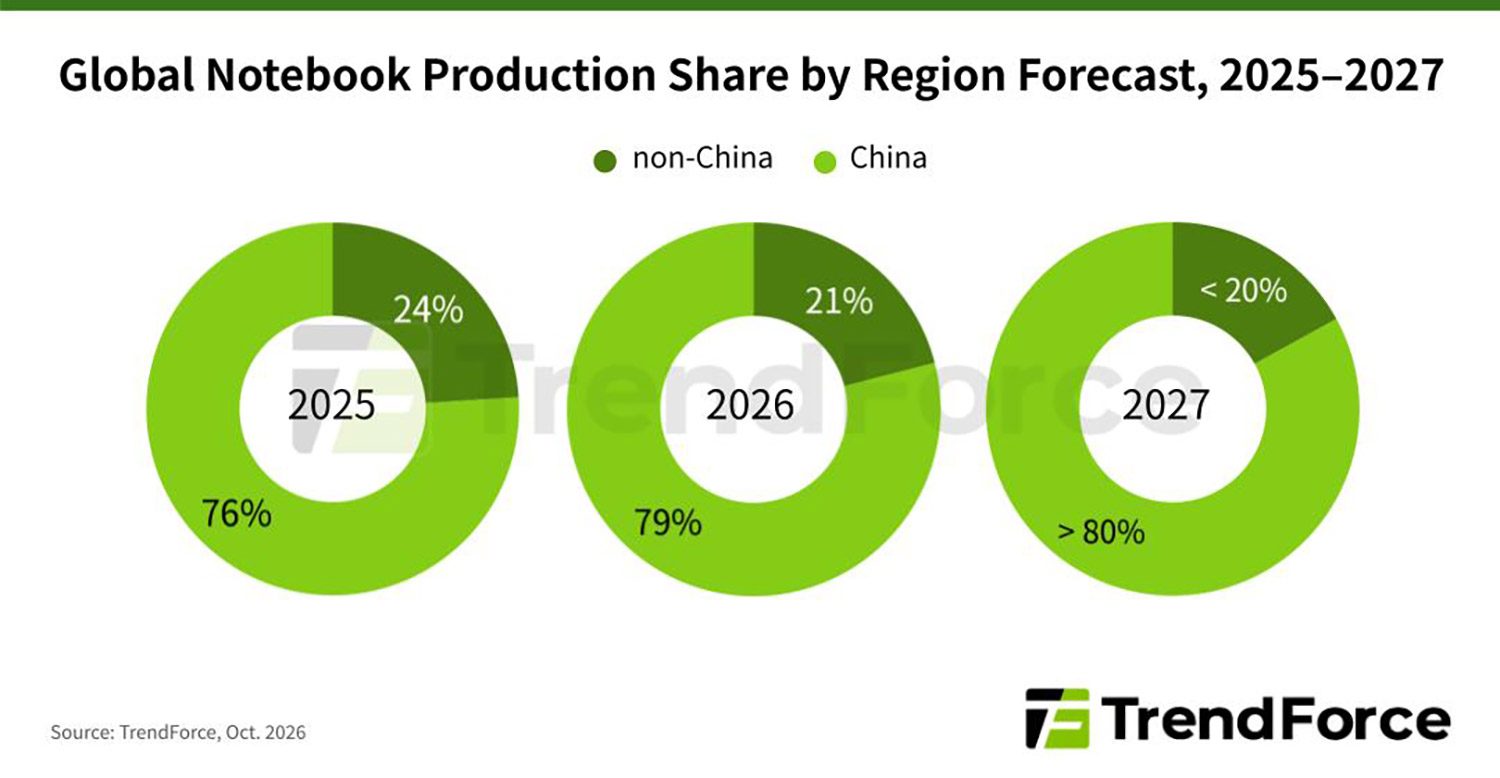
Beyond the immediate challenges of components and pricing, the geography of production remains a point of strategic interest. The industry continues to monitor the impact of global trade policies and tariff pressures on production centers. If the current regulatory landscape remains stable and does not see an escalation in tariff barriers, there is an observable trend toward the consolidation of manufacturing back into China.
TrendForce estimates indicate that China’s share of global notebook production, which sat at 76% in 2025, rose to 79% by the end of 2026. Projections suggest this trend could continue, with China potentially accounting for over 80% of global notebook production by the end of 2027. This move is largely driven by a desire to optimize supply chain efficiency and reduce costs in a period where every dollar of margin is critical. By leveraging the existing infrastructure and supplier ecosystems within China, manufacturers aim to mitigate some of the financial pressures caused by rising component costs.

As the industry moves into 2027, the focus for major brands will shift from the sheer volume of production to the efficiency of their operations and the agility of their pricing strategies. With the market moving away from the post-shortage boom, the success of major notebook manufacturers will depend on their ability to read the consumer landscape accurately and balance the conflicting pressures of a high-cost environment against the necessity of maintaining market share. For the end-user, this may translate to a period of more static product lineups and a more cautious approach to hardware pricing across the board.