








Text classification has long remained a cornerstone of natural language processing, yet real-world applications frequently introduce a persistent logistical hurdle: processing raw text data written across multiple, disparate languages. Before any downstream machine learning model can accurately categorize or interpret incoming inputs, data scientists must typically normalize the multilingual text into a single, unified language. This preprocessing requirement has traditionally demanded complex translation pipelines, external API integrations, or specialized translation models that complicate machine learning architectures.
A recent development by AI practitioners seeks to streamline this challenge by bridging the gap between traditional machine learning workflows and modern generative artificial intelligence. Leveraging the open-source library Scikit-LLM, developers can now seamlessly integrate large language models directly into standard scikit-learn pipelines. Rather than treating translation and classification as entirely separate engineering problems, this framework allows practitioners to construct a unified architecture where multilingual text is first translated and subsequently categorized using zero-shot classification principles—all while maintaining complete compatibility with the scikit-learn ecosystem.
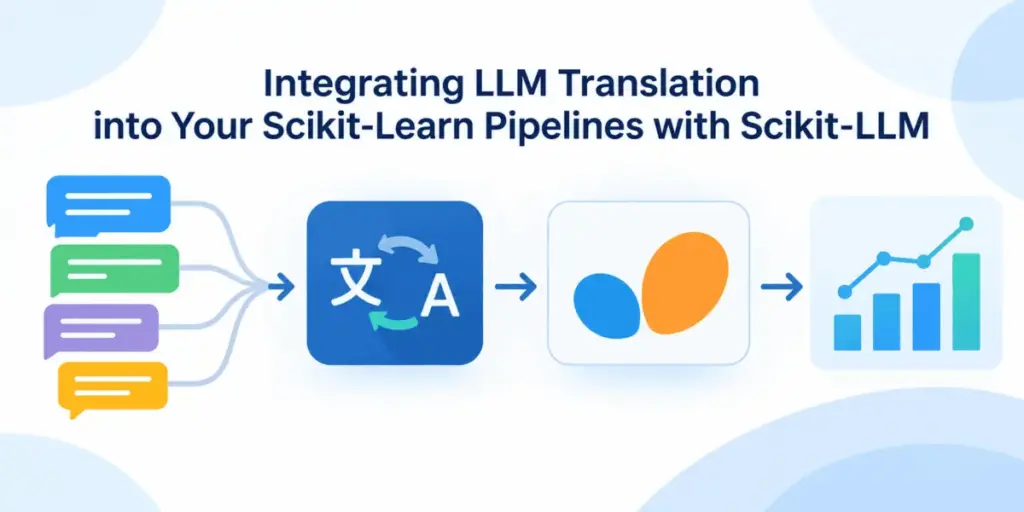
The core advantage of this methodology lies in its architectural flexibility and efficiency. Traditional text classification models often require extensive feature extraction steps, such as vectorization and TF-IDF transformations, followed by the training of statistical classifiers on large, balanced datasets. In contrast, zero-shot classification powered by large language models bypasses the need for voluminous training data. By simply defining a unique set of target classification labels, the model can interpret and categorize unseen text without prior model retraining. When paired with an automated translation step, the resulting pipeline can ingest raw text in languages such as French, German, Spanish, or Italian, translate the content into a common language like English, and accurately assign it to predefined categories in a single, fluid operational sequence.
Implementing this advanced machine learning pipeline has also become increasingly accessible due to modern cloud-based development environments and cost-effective API routing. Developers can execute these workflows within collaborative environments like Google Colab while utilizing cost-efficient or free-tier language model APIs, such as those provided by Groq. By configuring the environment to route requests through high-speed, OpenAI-compatible endpoints, practitioners can bypass the prohibitive per-token costs traditionally associated with enterprise-scale large language model deployments. This setup requires only basic credential management, where users securely store their API keys as environment variables before initializing the Scikit-LLM configuration framework.
The operational mechanics of the pipeline rely on specialized, task-specific classes provided by Scikit-LLM that mirror the familiar application programming interface of scikit-learn. The architecture utilizes a two-stage sequential workflow managed by a standard scikit-learn Pipeline object. The first stage employs a dedicated translation wrapper, designed to adapt a base large language model specifically for text-to-text translation tasks. This component ingests multilingual inputs—ranging from French commentary on solar energy technology to Spanish financial reports on market downturns—and normalizes them into English. The second stage utilizes a zero-shot classification wrapper, which adapts another instance of the base model to evaluate the translated text against a predefined list of operational categories, such as energy, finance, or healthcare.
Crucially, because the zero-shot classifier relies on semantic understanding rather than traditional numeric feature mappings, the model initialization process requires only a minimal placeholder dataset to satisfy the architectural constraints of the scikit-learn fit method. Once the pipeline is instantiated and configured with the target classification labels, it functions as a unified predictive engine. When unseen multilingual documents are introduced—such as Italian articles detailing clinical vaccine trials or Portuguese reports on corporate technology earnings—the pipeline automatically executes the intermediate translation step before delivering the final categorical prediction.
This streamlined integration represents a significant shift in how developers handle multilingual data in production environments. By encapsulating complex large language model capabilities within standard machine learning pipelines, practitioners can drastically reduce the engineering overhead typically required for multilingual text analysis. The approach eliminates the boundaries between traditional statistical modeling and generative artificial intelligence, offering a scalable, adaptable solution for modern data science applications. As the artificial intelligence landscape continues to mature, frameworks that bridge established libraries like scikit-learn with state-of-the-art language models are expected to play an increasingly vital role in enterprise data processing architectures. The advancement was highlighted by AI researcher and industry adviser Iván Palomares Carrascosa, who emphasizes the practical utility of harnessing such tools for real-world artificial intelligence implementation.