For data scientists and machine learning engineers who have spent years building and refining text classification models, the workflow has long followed a familiar and rigorous path. Traditionally, developing a reliable classifier required collecting hundreds or even thousands of meticulously labeled examples, scrubbing raw text of noise and inconsistencies, converting unstructured data into numerical representations through techniques like TF-IDF vectors or complex embeddings, and finally training conventional algorithms such as logistic regression or random forest classifiers.
The advent of large language models (LLMs), however, fundamentally disrupted this traditional paradigm. Modern artificial intelligence has made it possible to classify text simply by prompting an LLM to evaluate content and return a designated label. Despite this revolutionary capability, transitioning operational workflows from classical machine learning pipelines to prompt engineering presents distinct practical challenges. Developers often face friction when trying to integrate asynchronous, API-driven language models into existing codebases built around standardized machine learning libraries.
Enter Scikit-LLM, an innovative open-source Python library designed to bridge the gap between these two worlds. By wrapping the sophisticated capabilities of pre-trained large language models behind the familiar, standardized interface of scikit-learn—specifically utilizing core methods like fit() and predict()—the library allows practitioners to harness generative AI without abandoning established software architectures. Authored by AI expert and industry adviser Iván Palomares Carrascosa, the framework demonstrates how modern AI tooling can streamline complex tasks such as few-shot classification, making advanced language intelligence accessible through straightforward, conventional syntax.
To fully understand the significance of this development, it helps to examine how few-shot classification operates within the broader ecosystem of modern text categorization. Following the widespread adoption of transformer architectures, zero-shot classification gained immense popularity because it allowed models to categorize text without requiring any prior task-specific examples. By leveraging their broad pre-training, zero-shot models can infer categories strictly from natural language instructions.
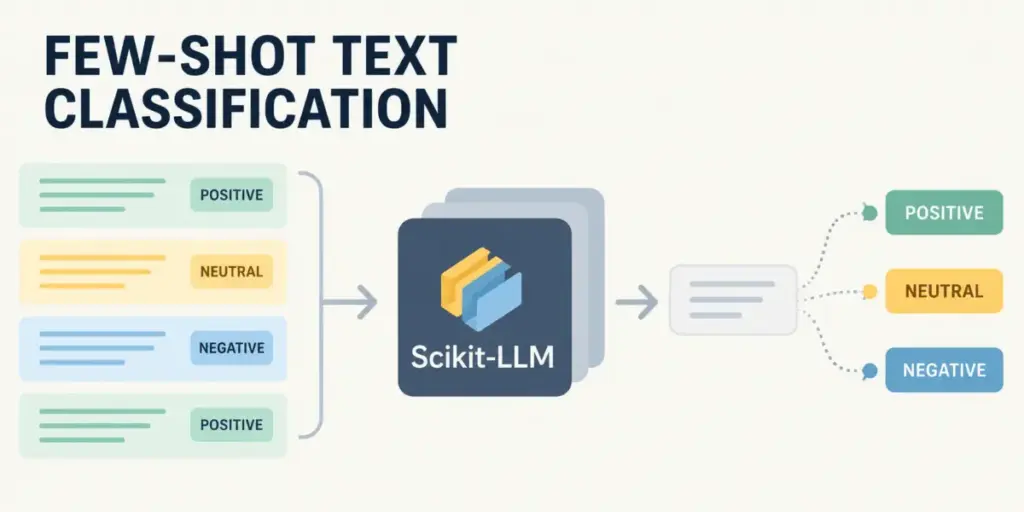
Nevertheless, zero-shot classification often falls short when applied to highly specialized, domain-specific text tasks. Content laden with industry jargon, subtle edge cases, or nuanced sentiments frequently requires contextual guidance that a generalized zero-shot prompt cannot reliably supply. This is where few-shot classification proves superior. By providing just a small handful of labeled examples—typically between three and five instances—developers can effectively teach a pre-trained LLM the specific classification rules, formatting preferences, and nuanced boundaries required for high-accuracy performance. Crucially, this optimization happens entirely through contextual priming rather than heavy model retraining or fine-weight adjustments, saving substantial computational time and financial resources.
Integrating this methodology into real-world applications has historically required writing custom orchestration code to manage API payloads, prompt templates, and error handling. Scikit-LLM simplifies this entire operational lifecycle. Operating within flexible development environments such as Google Colab, engineers can leverage cost-effective or free-tier infrastructure, such as the LLM application programming interfaces provided by Groq, to execute sophisticated classification pipelines with minimal overhead.
The setup process requires obtaining an API key from a supported provider and securely storing it within the environment’s credential manager. Once configured, installing the Scikit-LLM package via standard Python package management unlocks the core classification classes. The library is designed to seamlessly interface with OpenAI-compatible endpoints, ensuring broad compatibility with various hosting providers and model architectures while maintaining a consistent programming interface.
Rather than assembling massive corpora of training data, implementing a few-shot classifier with the library relies on defining a concise, representative set of anchor examples paired with their corresponding labels. For instance, in an IT support ticketing scenario, an engineering team can define a small training set consisting of brief user complaints regarding hardware malfunctions, software errors, or access restrictions. Alongside these training inputs, developers specify a set of unseen test texts representing incoming support requests that require automated sorting.
The core mechanism relies on importing the specialized FewShotGPTClassifier class from the library’s classification module. This class wraps an underlying language model—such as the open-source architectures hosted on accessible developer platforms—within a task-specific wrapper that mirrors standard machine learning estimators. Initializing the classifier and invoking the training method does not initiate traditional gradient descent or weight optimization. Instead, the fit() operation constructs an organized few-shot prompt memory, embedding the provided labeled examples into a structured context that the underlying language model references during subsequent inference calls.
When the model receives incoming unseen text via the prediction method, it evaluates the target data against the established few-shot memory framework, applying the contextual rules learned from the initial examples. In practical deployments, this approach consistently yields highly accurate categorization results for domain-specific tickets, successfully routing hardware issues, authentication roadblocks, and software crashes to the appropriate operational queues without requiring extensive dataset curation.
The integration of libraries like Scikit-LLM highlights a broader evolution in software engineering and artificial intelligence, where the boundaries between classical machine learning workflows and generative AI continue to blur. By embedding powerful pre-trained models within familiar programming paradigms, developers can deploy sophisticated natural language processing solutions rapidly, efficiently, and with minimal friction.