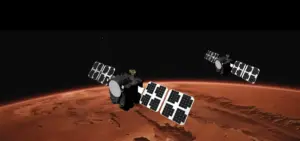










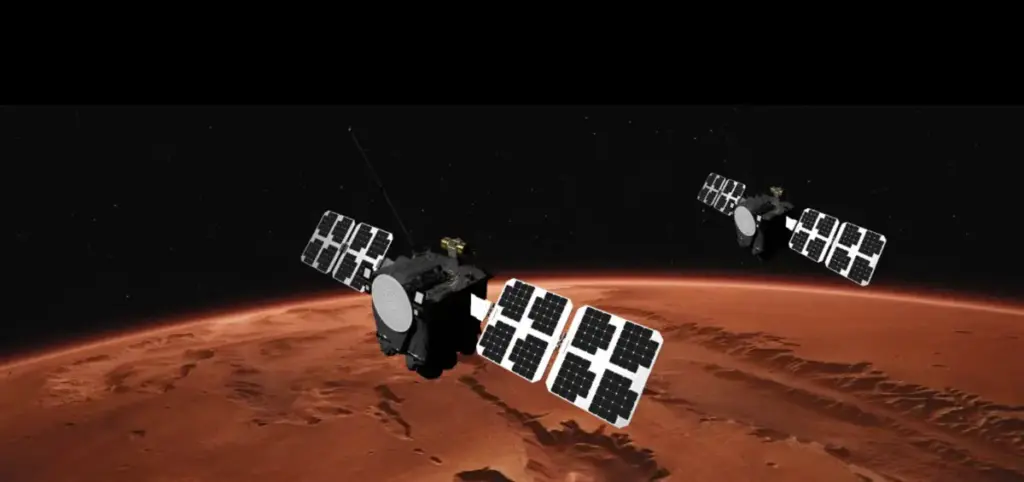
WASHINGTON — In a milestone that marks a significant departure from traditional interplanetary travel, a pair of NASA smallsats are now officially hurtling toward the Red Planet. Nearly a year after lifting off from Earth, the twin spacecraft have successfully completed a daring and unprecedented series of Earth flybys, utilizing a powered gravitational maneuver to set them on a precise, multi-year course for Mars.
The second of the two Escape and Plasma Acceleration and Dynamics Explorers, or ESCAPADE, spacecraft—affectionately nicknamed "Gold"—executed its closest approach to Earth at approximately 6 a.m. Eastern Time on November 9. During this high-stakes pass, the spacecraft swept within roughly 1,050 kilometers of the planet’s surface. This maneuver occurred just over 48 hours after its twin, spacecraft "Blue," completed a similar trajectory adjustment at an altitude of approximately 1,600 kilometers.
Both spacecraft, expertly engineered and manufactured by Rocket Lab, leveraged a critical physical principle during their respective flybys known as the Oberth effect. By firing their onboard engines at the exact moment of closest approach, the spacecraft maximized the efficiency and overall performance of the propulsion maneuver. According to mission leadership, this historic event represents the first time NASA has ever utilized a powered Earth flyby to propel spacecraft directly toward Mars.

"This is the first time NASA has used a powered Earth flyby to propel a spacecraft toward Mars, and we’ve now executed this maneuver twice, flawlessly, in just two days," said Asal Naseri, acting associate flight director in NASA’s heliophysics division, in an official agency statement detailing the operation.
The journey to this point has been anything but conventional. Rather than adhering to the rigid orbital mechanics that dictate traditional Mars mission launches—which require taking advantage of brief alignment windows that open roughly every two years—ESCAPADE adopted an innovative, highly flexible trajectory. The mission launched last November as a secondary payload on the second flight of Blue Origin’s massive New Glenn rocket.

Following their successful launch, the twin spacecraft spent nearly a year loitering in the vicinity of the Earth-Sun L-2 Lagrange point. This extended parking phase served a strategic purpose, allowing the mission team to position the smallsats perfectly for their final, sweeping return toward Earth and the subsequent gravity-assist trajectory burn.
The intricate trajectory was meticulously developed by Advanced Space as a pioneering method to open up brand-new launch opportunities for planetary science missions outside of standard interplanetary windows.
"This method provides the flexibility to launch almost anytime and then use Earth’s gravity to get a boost to Mars, rather than waiting every two years to launch there directly when the planets are aligned," explained Jeff Parker of Advanced Space in a statement reflecting on the novel orbital design.
While the trajectory offered unprecedented launch flexibility, it demanded absolute precision from the spacecraft navigation and propulsion systems. Because the gravity assist alone was not enough to inject the probes onto their final interplanetary highway, the success of the entire mission hinged on the execution of precise, high-stakes engine burns during the peak of the flybys.
"These burns were critical in the same way a Mars orbit insertion burn is," noted Rob Lillis, the principal investigator for ESCAPADE, during a November 9 meeting of the Mars Exploration Program Analysis Group. Addressing the technical hurdles and the anxiety leading up to the event, Lillis added, "I’m happy to report that they went well. They were executed perfectly."
With the engine burns successfully completed, both the Blue and Gold spacecraft are now on stable, well-defined trajectories toward Mars. The twin probes are scheduled to arrive at the Red Planet just two days apart in September 2027. Upon arrival, each spacecraft will be required to perform a critical 11-minute burn of its main engine to successfully capture into orbit around Mars, after which they will gradually maneuver into their final, highly coordinated science orbits.

Once operational in orbit, the ESCAPADE mission will focus heavily on space weather dynamics at Mars. The twin probes will examine in detail how the unpredictable solar wind interacts with the Martian magnetosphere and its thin, fragile atmosphere. Initially, the spacecraft will perform simultaneous observations from the same orbit, separated from one another by up to 30 minutes. This unique configuration will allow researchers to measure rapid variations in space weather over localized timeframes. Later in the mission, the two probes will shift into distinct, complementary orbits—with one spacecraft positioned to monitor the incoming solar wind directly, and the other stationed to observe the resulting atmospheric and plasma effects on Mars.
Despite its current momentum, ESCAPADE carries broader significance within NASA’s planetary science portfolio as the last surviving mission of the SIMPLEx program—an acronym for Small Innovative Missions for Planetary Exploration. Created to foster low-cost, high-value planetary science missions using small satellite architectures, NASA originally selected ESCAPADE for development in 2019 alongside two other ambitious SIMPLEx endeavors: the Janus asteroid flyby spacecraft and the Lunar Trailblazer lunar orbiter.
However, the broader SIMPLEx program has faced severe headwinds over the years. NASA was forced to cancel the Janus mission in 2023 following persistent delays in the launch of the Psyche asteroid mission, on which Janus was slated to fly as a secondary rideshare, ultimately rendering its planned asteroid flyby targets unreachable. Meanwhile, the Lunar Trailblazer mission encountered a critical malfunction shortly after its launch in February 2025. Despite extensive recovery efforts by engineers on the ground, the issues proved insurmountable, leading NASA to formally write off and end the lunar mission five months later.
These recent setbacks compound earlier struggles within the smallsat program, including two previous CubeSat-class SIMPLEx missions, LunaH-Map and Q-PACE, both of which suffered mission-ending failures following their respective launches. Amid tightening federal budgets and mounting financial pressures across the agency, NASA has notably refrained from soliciting proposals for new SIMPLEx missions and has indicated no plans to reinstate the program anytime in the foreseeable future, placing even greater scientific weight on the shoulders of the resilient ESCAPADE twins as they make their historic trek across the inner solar system.