










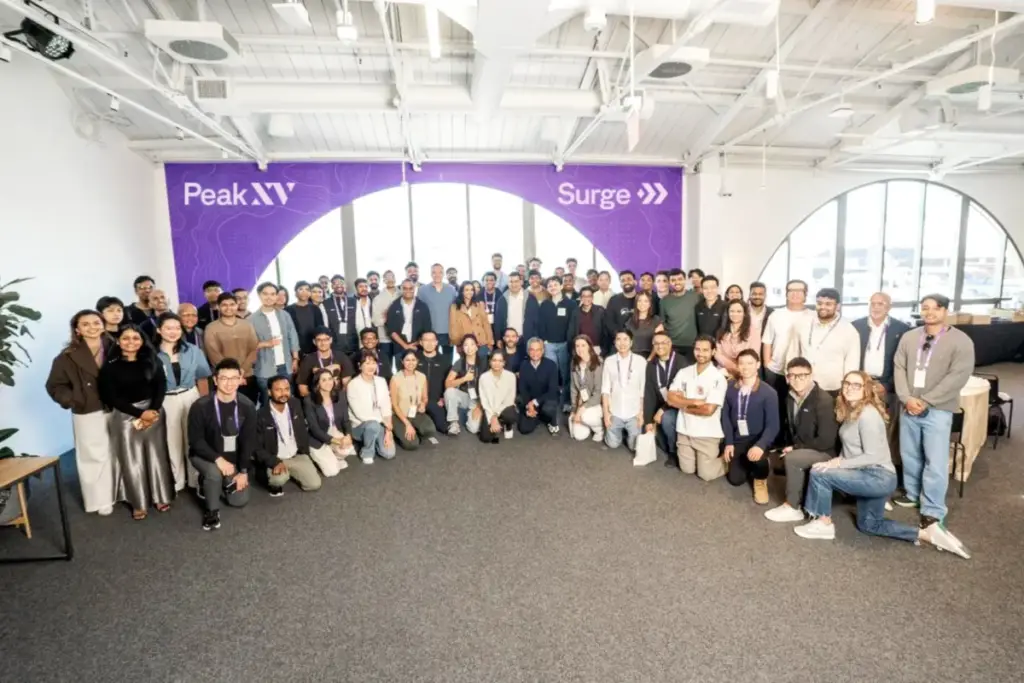
Peak XV Partners, one of the most influential venture capital firms operating across India and Southeast Asia, has signaled a significant shift in its early-stage investment strategy. Managing over $10 billion in assets, the firm has officially increased the capital allocation for its renowned seed-stage accelerator platform, Surge. This development, which coincides with the unveiling of its 12th cohort, reflects a broader adjustment to the evolving economic landscape and the rising costs of building high-potential, capital-intensive technology companies.
The new batch, known as Surge 12, marks a pivotal moment for the program. It is the first cohort to operate under a raised investment ceiling, allowing Peak XV to deploy up to $5 million per startup—a notable jump from the previous $3 million cap. According to data released by the firm, Peak XV has invested more than $50 million across these 18 companies. Collectively, the cohort has already secured over $90 million in seed funding, underscoring both the firm’s conviction in these founders and the appetite of the broader investor ecosystem. While Peak XV declined to disclose the specific median investment figure per company, they confirmed that it has risen in tandem with the new ceiling.
Navigating the Higher Bar for Growth
The decision to provide more capital per startup is not merely an internal policy change but a calculated response to external market pressures. Rajan Anandan, managing director at Peak XV, emphasized in an interview that the fundraising environment for early-stage companies has fundamentally shifted.
"The bar to raise a Series A has gone up pretty significantly," Anandan observed. He noted that the transition from a seed-stage venture to a Series A-ready business now requires more substantial milestones, proof of product-market fit, and, in many cases, more complex technical development. This is particularly evident in the deeptech sector, where companies require significant upfront capital to develop proprietary hardware, complex AI models, or specialized robotics before they can generate meaningful revenue. By increasing its check size, Peak XV is positioning itself to provide the necessary "runway" for its founders to navigate these more demanding market conditions.
The firm’s approach to Surge has also become increasingly global. Since its inception in 2019—when the firm operated under the Sequoia Capital India and Southeast Asia brand—Surge has supported over 180 startups led by entrepreneurs from more than 18 different nationalities. The latest cohort continues this trajectory, with founders based in hubs ranging from San Francisco to Sydney. Interestingly, while more than half of the companies in the new cohort are headquartered in India, only five of the 18 are exclusively focused on the domestic Indian market. The remaining 13 are targeting global markets from day one, highlighting a strategic divide between where these startups are engineered and where they intend to find their primary customer base.
The success of the program’s past efforts is reflected in the scale of its portfolio. Peak XV reports that the 10 largest companies to emerge from previous Surge cohorts now generate more than $1 billion in combined annual revenue. This track record of success has solidified Surge’s role as the firm’s primary gateway for seed-stage investing. Anandan noted that the firm’s relationship with these startups is designed to be long-term, with Peak XV often continuing as an investor as companies progress through subsequent funding rounds.
The profile of the founders backing these ventures typically reflects a mix of seasoned repeat entrepreneurs, specialized technical experts, and industry veterans. Approximately 50% to 60% of a typical Surge cohort is composed of individuals who have previously held significant operating roles at established, high-growth technology companies, bringing a level of institutional experience that accelerates their progress.
A Diverse Range of Disruptive Technologies
The Surge 12 cohort covers a sprawling technological spectrum, including artificial intelligence, robotics, space exploration, consumer products, healthcare, music, and fintech. The diversity of the ideas suggests that while AI remains a dominant force, founders are finding niche, high-value applications for the technology in sectors that were previously underserved.

Among the notable startups in this group is Alma, co-founded by Nischith Shadagopan M N and Vinod Ganesan. Leveraging their backgrounds at Microsoft Research and as founding engineers at the Bengaluru-based Sarvam AI, the pair is developing a personal computing platform designed to make computing significantly faster and more accessible.
In the healthcare space, August AI, founded by IIT-BHU alumnus Anuruddh Mishra, is tackling the challenge of medical accuracy. Born out of the founder’s own experience with a medical misdiagnosis in 2022, the company provides a platform that integrates AI with physician-led care. It has already achieved a massive scale, reaching over 9 million users across 160 countries.
The cohort also features companies leveraging AI for consumer-facing solutions. Ditto, led by UC Berkeley dropouts Allen Wang and Eric Liu, is an AI-powered matchmaker integrated directly into iMessage. Aimed at the college student demographic, the app moves away from traditional swipe-based interfaces to foster more meaningful in-person connections. The startup’s potential was recognized early by Peak XV, which led a $9.2 million seed round for the company earlier this year. Similarly, Tribe Money, co-founded by Himanshu Arora and Nikhil Shanker, provides a sophisticated AI-driven personal finance platform, helping users navigate complex investment decisions and financial planning.
The B2B and enterprise side of the cohort is equally robust. HiLoop, founded by Jad Ghalayini, Karan Brar, and Thomas Boser, offers a post-training platform that allows AI companies to adapt general-purpose, open-weight models for specific applications. The team, which includes a Cambridge computer science PhD, is targeting the urgent need for model optimization. Meanwhile, Reinforce Labs, led by former Google director and AI team leader Anish Das Sarma, provides critical tools for the enterprise market, focusing on red-teaming, evaluating, and remediating AI systems to ensure safety and performance.
The cohort also demonstrates the breadth of hardware and deeptech innovation. Puralink, founded by Harrison Crowe-Maxwell, Shyeon Delnawaz, and Thien "Long" Tran, is developing autonomous robots capable of navigating and inspecting complex underground pipe networks. The technology is rooted in the founder’s lifelong passion for robotics and university-led research. In a different corner of the deeptech landscape, ULOOK is building autonomous satellite systems for radio-frequency sensing and spectrum intelligence. Founders Adheesh Boratkar and Siddhesh Ravindra Naik bring extensive experience from over 12 satellite missions to this global market-focused venture.
Other startups in the cohort are rethinking traditional industries. GameStock, founded by Antoine Mistico, Easton Dana, and Vivek Indlebele Narasimha Prasad, is gamifying the financial markets to make trading a more competitive, engaging experience. Kindling, led by Adam Miller and Sachin Shah, is building a "storytelling operating system" that utilizes AI to automate communications and content production for startups. Rosella, co-founded by Chris Dwyer and Sean Stuart, is tackling the manual, slow-moving world of commercial insurance by building an AI-native brokerage for U.S. businesses. Hoola Health, founded by Deeksha Senguttuvan, offers an all-in-one platform for pediatric and family care, drawing on the founder’s deep industry knowledge from her family’s hospital group. Finally, Riffle, co-founded by Anurag Choudhary and deo, is streamlining the music production process with a browser-based platform for collaboration, and Wingit, founded by Nikunj Kothari and Saksham Khandelwal, is targeting the premium consumer market in India through a specialized beauty platform.
Beyond these 15 identified companies, Peak XV disclosed that three other startups within the cohort are currently operating in stealth mode, focusing on education, applied AI, and medical technology, and will reveal their identities in the future.
As Surge 12 begins its journey, the increased investment from Peak XV underscores a clear commitment to supporting high-ambition founders despite the tightening requirements for growth in the current macroeconomic climate. With more than $50 million deployed and a diverse array of sectors under its umbrella, the program continues to serve as a vital engine for the next generation of global technology leaders emerging from the Indian and Southeast Asian ecosystems.