












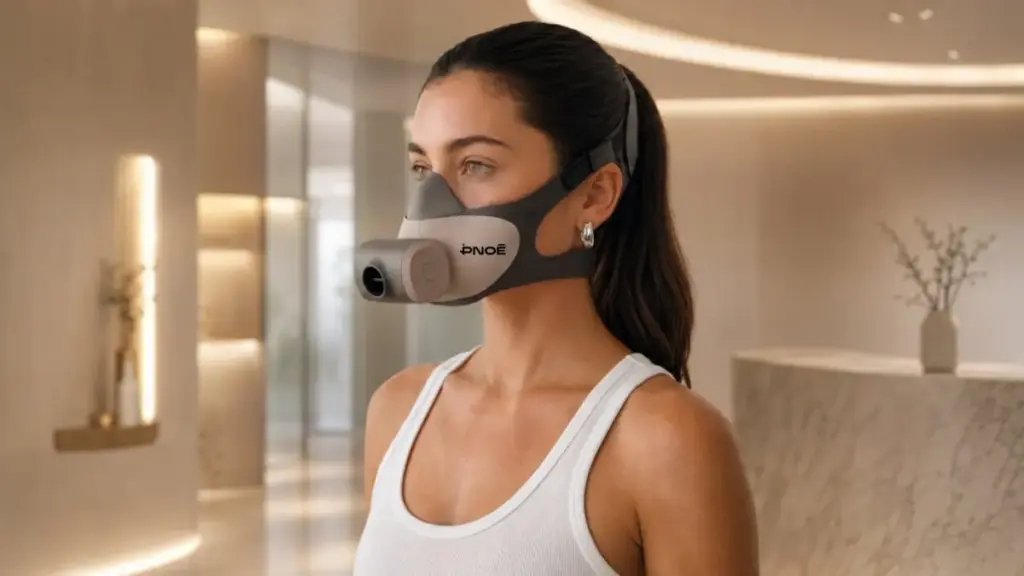
At first glance, the newest device from the health-tech startup Pnoe might strike an observer as something pulled straight from a comic book. With a design that covers the nose and mouth and secures firmly around the back of the head, the device bears a striking, if unintended, resemblance to the mask worn by Bane, the hulking, iconic nemesis of Batman. However, behind this intimidating aesthetic lies a purpose that is remarkably benign and deeply rooted in health science. The device is designed to measure the intricacies of human respiration—specifically, how much oxygen a user consumes and how much carbon dioxide they exhale. By translating this complex physiological data into actionable advice, Pnoe aims to help individuals refine their diet, optimize their training, and ultimately, improve their prospects for a longer, healthier life.
Based in Malden, Massachusetts, with significant operational headquarters in Athens, Greece, Pnoe is currently gearing up for a major milestone: the launch of the Pnoe 2.0 on October 1. While the core technology remains consistent with the company’s mission, the 2.0 model represents a pivotal shift in accessibility. The most significant advancement in this new iteration is the capability for users to administer the test themselves. According to co-founder and CEO Apostolos Atsalakis, the friction associated with professional metabolic testing is effectively eliminated. A user can walk into a gym, put on the mask, push a single button, and sit quietly for eight minutes. “That’s it,” Atsalakis said during a recent interview via Zoom from the company’s Athens office. “It’s that easy.”
This transition to a self-serve model is more than a mere convenience; it is a strategic expansion of the company’s footprint. The previous iteration of the Pnoe device required the presence of a trained operator, a logistical requirement that naturally constrained where and when the testing could be conducted. By removing the need for dedicated staff to oversee the process, the 2.0 version opens the door for fitness centers that lack specialized personnel to offer high-level testing. Atsalakis suggests that the technology could eventually become a fixture in pharmacies and other accessible wellness environments, democratizing a service that was once the exclusive domain of elite sports labs and research facilities.

The underlying science of Pnoe is not new, though its application is evolving. Metabolic testing—a process that analyzes respiratory gases to gauge how the body generates energy—has been a cornerstone of exercise physiology for over a century. For decades, it has served as the gold standard for determining VO2 max, the measure of the maximum amount of oxygen an individual’s body can utilize during intense exercise. VO2 max is widely recognized as a definitive indicator of cardiorespiratory fitness. However, the equipment required to conduct these tests has historically been bulky, expensive, and difficult to calibrate, limiting its use to high-end medical institutions and the training programs of professional athletes.
Pnoe’s decade-long mission has been to distill this laboratory-grade accuracy into a portable, user-friendly package. By pairing the hardware with intuitive software that translates raw data into meaningful recommendations, the company believes it has bridged the gap between clinical complexity and consumer accessibility. The company reports that its test captures 23 distinct biomarkers. Beyond VO2 max, these include resting metabolic rate—which calculates the number of calories a body burns while at rest—and metabolic flexibility, a measure of how efficiently the body transitions between burning fat and carbohydrates for fuel. Atsalakis argues that these specific metrics provide answers that traditional blood tests simply cannot, such as highly personalized caloric requirements and precise training intensity zones.
The timing for this expansion appears auspicious. VO2 max has emerged as a major buzzword among longevity enthusiasts and biohackers, fueled by a growing body of research that links higher levels of cardiorespiratory fitness to reduced mortality rates. Atsalakis views VO2 max as perhaps the strongest predictor of human longevity and believes his company’s data acts as an essential scorecard for the rapidly expanding wellness industry.
The Pnoe 2.0 device is smaller, more compact, and features fewer internal components than its predecessor, a design evolution that Atsalakis claims significantly enhances its reliability. The development process involved a close partnership with the Milan-based Design Group Italia. Atsalakis described the design phase as involving “a lot, a lot, a lot of iterations,” largely because the concept of a self-administered, clinical-grade metabolic testing device had never been successfully realized before.
Another critical consideration for the modern user is hygiene. In a post-pandemic world, the prospect of wearing a shared mask is a common concern. Pnoe has addressed this by ensuring that the delicate electronics are detachable from the silicone mask and head straps. This allows for a hybrid ownership model: the facility maintains the costly, durable hardware, while individual users retain their own personal mask and strap, ensuring that no two users ever share the same point of contact with their skin or breath.
Despite its clinical ambitions, Pnoe is careful to manage expectations regarding its role in the medical ecosystem. The device is not currently cleared by the U.S. Food and Drug Administration (FDA) for diagnostic use, and Atsalakis is clear that the company does not provide medical advice or prescriptions. Instead, Pnoe characterizes itself as a wellness device. “It’s like a body composition device, like a scale,” Atsalakis explains. “A doctor cannot prescribe medication based on our results.”
However, that landscape may shift in the future. There is ongoing research into whether the chemical compounds found in human breath can serve as early warning signs for diseases such as cancer. Atsalakis is optimistic that the vast, growing trove of data Pnoe is accumulating could eventually play a role in identifying health markers, though he acknowledges that full diagnostic capabilities are several years away. Regulatory hurdles, clinical validation requirements, and the need for rigorous peer-reviewed studies mean that for now, the company remains firmly planted in the wellness space. “We’re not there yet,” he admitted.
The origins of Pnoe trace back to Atsalakis’s PhD research into sensing technologies at the University of Cambridge. During that period, the wearable technology boom was in its infancy, and he became fascinated by the depth of information that could be gleaned from a person’s breath. He co-founded the company with his childhood friend, Panos Papadiamantis, who now serves as the chief product officer. The startup gained early momentum as part of Y Combinator’s Winter 2019 cohort, a time when the “longevity” industry was just beginning to take shape. Since then, Pnoe has raised approximately $22 million in funding, including a recent $11 million round from investors such as the firm 50 Years and Google Maps co-founder Lars Rasmussen, who resides in Athens.
Pnoe’s business model is strictly business-to-business (B2B). The company sells its systems to fitness clubs, luxury hotels, and health systems, which then provide the testing as a service to their own clients. Its impressive client roster includes the fitness giant Equinox—where the test is available at nearly all locations—as well as the Four Seasons hotel chain, Red Bull, the NBA, the Mount Sinai Health System, and the med-spa chain Restore Hyper Wellness.
Geographically, the United States remains the primary market, accounting for roughly 85% of Pnoe’s business. Atsalakis describes the U.S. as “by far the most advanced market globally” for the longevity sector, though the company is currently engaged in expansion efforts across Europe, Latin America, and Asia through various partnerships.
For businesses, the cost of entry is a subscription-based model, ranging from $400 to over $1,000 per month. This fee covers the hardware, the proprietary software, staff training, and marketing collateral—an all-inclusive package that Atsalakis describes as a “business in a box.” Pnoe’s software is designed to integrate seamlessly with the host facility’s offerings, allowing gyms or spas to recommend specific training sessions or nutritional plans based directly on the individual’s metabolic test results. Many clients incorporate the test during the onboarding process, positioning it as a sophisticated middle ground between the informal estimates provided by standard smartwatches and the exhaustive, expensive workups typically performed in clinical settings.
This “middle ground” is becoming an increasingly crowded space. Industry titans like Apple, Garmin, and Whoop offer estimates of VO2 max derived from heart-rate data, while consumer-facing devices like Lumen provide breath-based analysis of fat and carbohydrate oxidation. At the top end of the market, traditional metabolic carts continue to reign as the standard for labs and hospitals.
Pnoe, now employing a staff of 110, reports that it has recently achieved profitability, with a year-over-year growth rate exceeding 100%. As the company looks toward the next stage of its evolution, Atsalakis expects to initiate a Series B funding round within the next six to 12 months. With the launch of the 2.0 model, the company is focused on the singular goal of putting its mask—Bane comparisons and all—in front of as many faces as possible, aiming to make metabolic health a standard, measurable part of the human experience.