







JSON remains one of the most ubiquitous formats for data storage and exchange across modern Python applications. For small-scale files and lightweight data structures, Python’s built-in json module serves as an efficient and straightforward tool. Developers can easily read and parse files into memory with minimal code using standard methods like json.load(), allowing for rapid data retrieval and manipulation. However, as data scales into hundreds of megabytes or gigabytes, this traditional approach reveals severe performance bottlenecks that can destabilize production applications and overwhelm system resources.
The fundamental limitation of the standard json.load() method lies in its parsing mechanism. Rather than processing data incrementally, the function reads the entire JSON document into memory and constructs the corresponding Python objects—including complex dictionaries, lists, strings, and numerical values—before any analysis can begin. Consequently, a file that occupies a modest amount of disk space can expand exponentially once converted into native Python objects in RAM. This discrepancy between disk size and memory footprint often leads to sudden out-of-memory errors and sluggish application performance in data-heavy environments.
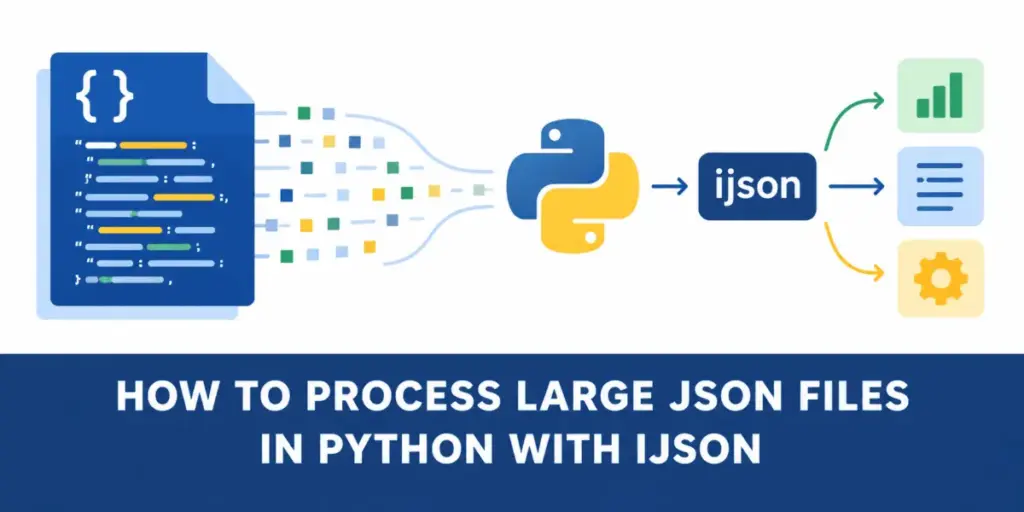
To address these memory constraints, developers are increasingly turning to alternative parsing strategies, such as iterative JSON parsers that enable incremental data processing. A prominent solution in the Python ecosystem is ijson, a streaming parser designed to handle massive datasets without requiring the entire file to reside in memory simultaneously. By processing data on the fly, streaming parsers allow applications to examine, filter, and discard records sequentially, keeping memory consumption stable regardless of the input file’s overall size.

The impact of parsing methodology becomes particularly evident when working with large geographic and spatial datasets, such as the San Francisco City Lots dataset. Widely used for urban analytics and mapping experiments, this dataset follows the standard GeoJSON FeatureCollection structure and spans approximately 181 megabytes on disk. Examining the structure of such files reveals a hierarchical arrangement where a root object contains a vast array of features. Each feature represents an individual land parcel containing descriptive metadata, or properties, alongside complex geometric coordinates that define its boundaries on a map.
When developers analyze these large files using conventional methods like json.load(), Python is forced to parse every single geometry array and coordinate pair, even if the analytical task requires only a fraction of the metadata. In benchmarking experiments using the San Francisco parcel data, loading the complete file into memory prior to processing pushes peak memory consumption to over 800 megabytes. This significant memory overhead occurs because every individual property, key, string, and nested coordinate array transforms into multiple distinct Python objects, expanding the memory footprint far beyond the file’s original size on disk.
In contrast, adopting an iterative parsing approach fundamentally alters how applications interact with large data files. Utilizing libraries that support streaming allows developers to target specific segments of a JSON document—such as individual items within a feature array—and process them one by one. As the parser evaluates each record, the application can extract the necessary information, update counters, and immediately release the record from memory before moving on to the next item in the sequence.
Memory profiling experiments comparing the two approaches highlight the efficiency of streaming parsers. While a traditional load operation consumes substantial RAM to maintain the entire dataset simultaneously, an iterative streaming workflow maintains a remarkably flat and stable memory footprint, often requiring a fraction of the system resources. For instance, processing the same 181-megabyte parcel dataset through a streaming parser keeps peak memory usage near baseline levels, eliminating the sharp memory spikes associated with full-file ingestion.
Industry practitioners emphasize that while streaming parsers offer immense advantages in memory stability, they do not necessarily guarantee faster execution speeds under all conditions. In environments with abundant RAM, traditional loading methods can sometimes parse documents rapidly. However, the primary value of iterative parsing lies in predictability and resource management, ensuring that application performance remains reliable as data volumes grow.
The broader implications for software engineering and data science workflows point toward a shift in how developers handle large-scale data serialization formats. As applications ingest increasingly voluminous data feeds from municipal portals, IoT sensors, and enterprise systems, relying solely on default loading functions can introduce silent scalability risks. By recognizing that memory consumption is largely dictated by processing patterns rather than the file format itself, developers can implement more resilient architectures that handle large datasets efficiently.
The growing adoption of iterative libraries reflects a broader industry movement toward memory-conscious programming in Python. Whether dealing with geospatial coordinates, financial transactions, or web logs, the ability to stream, process, and discard data incrementally remains a vital technique for maintaining high-performance applications in data-intensive domains.