










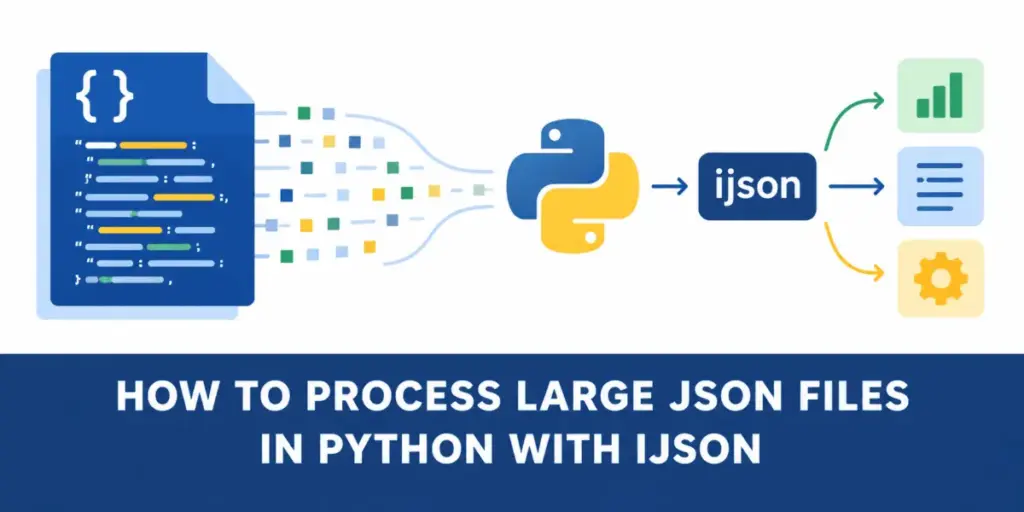
Data processing in modern applications frequently encounters the limits of traditional memory management, particularly when handling ubiquitous formats like JSON. While Python’s built-in json module offers a straightforward and reliable mechanism for small-to-moderate data files, engineers working with large-scale datasets often face severe performance bottlenecks and memory exhaustion. A common experiment utilizing San Francisco municipal land-parcel data highlights these challenges, demonstrating how incremental parsing techniques can resolve memory bloat without sacrificing data integrity.
JavaScript Object Notation, universally known as JSON, remains a cornerstone for storing and exchanging structured data across software ecosystems. For developers writing routine scripts or managing compact configuration files, Python’s native implementation executes the task smoothly by loading entire documents into memory via json.load(). However, this approach exposes a fundamental limitation when file sizes expand from kilobytes into hundreds of megabytes.
The core issue lies in the parsing mechanics of standard libraries. When json.load() is invoked, the interpreter reads the complete JSON document and constructs the corresponding collection of Python objects—dictionaries, lists, strings, and numeric values—in memory before any analytical operations can begin. Consequently, a file that occupies a modest amount of disk space can expand exponentially once translated into native runtime structures. This expansion frequently triggers out-of-memory errors or forces operating systems into aggressive paging, dragging down application performance.
To explore this phenomenon, developers can examine a practical benchmark utilizing the San Francisco City Lots dataset, a standard GeoJSON feature collection available via open-source repositories. Downloaded and inspected within interactive development environments like Google Colab, the raw file measures approximately 181 megabytes. While this scale falls well short of enterprise big data thresholds, it provides an ideal environment for demonstrating the stark contrast between loading an entire document versus streaming its contents iteratively.
Inspection of the dataset reveals a hierarchical structure composed of a top-level feature collection containing thousands of individual spatial parcels. Each feature encapsulates precise properties, such as block and lot numbers, street names, and complex geometric polygons with nested coordinate arrays. In many analytical workflows, a developer might only require basic string matching against a specific property—such as identifying parcels located along a particular thoroughfare. Yet, when using conventional loading methods, Python is forced to parse and retain every single geometric coordinate and polygon vertex, regardless of whether that spatial data is relevant to the query.
Approaching this task through conventional methods involves reading the entire file into a variable and iterating through the resulting list of features. While the syntax is clean and intuitive, the computational cost is immediate. Before the application evaluates a single record, the system must read the complete file, parse every individual object, instantiate hundreds of thousands of dictionaries and lists, and commit the entire payload to RAM.
Memory profiling tools reveal the true cost of this approach. When measuring resource consumption during the parsing of the San Francisco dataset, memory usage surges dramatically the moment the native loader executes. The memory footprint of the parsed objects routinely exceeds the physical size of the source file on disk. This discrepancy occurs because a concise JSON string representation expands significantly when converted into individual Python objects, where each key, value, and container structure incurs its own memory overhead. For applications running in resource-constrained containerized environments or cloud functions with strict memory limits, this overhead can cause sudden application crashes.
An alternative engineering pattern relies on iterative parsing libraries, such as ijson, which enable developers to stream data incrementally rather than loading it monolithically. Rather than reading an entire document into an expansive tree of nested dictionaries, an iterative parser reads the file as a continuous stream, yielding individual records or sub-elements on demand.
By targeting specific structural paths within the document—such as extracting individual items from the primary feature array—an iterative parser processes records in a continuous loop. The architectural pattern shifts fundamentally from loading everything into memory before processing, to a continuous cycle of reading a record, processing its attributes, and immediately discarding it from memory.
When applied to the San Francisco land-parcel dataset, the streaming approach yields identical analytical results to the traditional method while fundamentally altering the resource profile. Rather than experiencing a massive memory spike, the application maintains a remarkably stable and minimal memory footprint throughout the execution lifecycle. The active memory consumption remains largely flat, tied primarily to the parser’s internal buffer and the small subset of records or counters retained by the application logic.
Comparative benchmarks between the two paradigms underscore an important nuance in performance optimization. While iterative parsing dramatically reduces peak memory consumption, it does not automatically guarantee faster execution times. In environments where abundant RAM is readily available, monolithic parsers may complete execution swiftly due to optimized C-extensions. However, the primary advantage of streaming parsers lies in scalability and stability. As dataset sizes grow from megabytes to gigabytes, monolithic loading becomes entirely untenable, whereas streaming architectures continue to process data efficiently within predictable resource boundaries.
The broader implications for software engineering and data science workflows point toward a reassessment of data ingestion strategies. Large JSON files do not inherently require high-capacity server infrastructure or massive memory allocations. Often, the bottleneck stems not from the data format itself, but from the architectural assumptions made during the ingestion phase. By adopting streaming parsers for large-scale hierarchical data, developers can build robust, memory-efficient applications capable of handling substantial data volumes on standard hardware.