




For platform teams tasked with managing containerized applications at scale on Amazon Elastic Container Service (Amazon ECS), the operational burden of ingress networking has long been a significant friction point. As organizations grow, the requirement to configure and maintain networking infrastructure for every individual service often transforms into a logistical bottleneck. Each new service deployment necessitates the manual or automated provisioning of Application Load Balancers (ALBs), AWS Certificate Manager (ACM) certificates, AWS WAF web ACLs, and intricate security group rules. Keeping these disparate resources in sync as services scale, undergo updates, or transition through lifecycle changes introduces not only operational overhead but also a persistent risk of configuration drift.
To address these challenges and streamline the developer experience, Amazon has announced the launch of Amazon ECS Gateway, a new account-level resource designed to fundamentally simplify ingress networking for containerized workloads. By dynamically provisioning and managing the necessary infrastructure on behalf of the user, ECS Gateway aims to eliminate the per-service networking toil that has historically slowed deployment velocity. Importantly, this new capability ensures that all resources remain fully contained within the user’s own AWS account, maintaining the security and ownership standards required by enterprise environments.
Redefining Ingress Management
At its core, the ECS Gateway introduces a clear separation of responsibilities between platform teams—who oversee the underlying architecture and compliance—and application teams, who focus on the delivery of features. By moving the heavy lifting of load balancer management into a centralized, managed gateway, platform teams can ensure consistent networking patterns across their organization without needing to micromanage the lifecycle of individual service components.

The gateway architecture leverages host-based routing via Application Load Balancers, enabling up to 25 separate services to share a single ALB. This consolidation provides a significant boost to infrastructure efficiency, allowing organizations to optimize costs by reducing the proliferation of idle or underutilized load balancers. The system is designed for automation; Amazon ECS manages the entire lifecycle of the underlying infrastructure, provisioning the first ALB automatically when the initial service connects and dynamically scaling the count of ALBs as capacity thresholds are reached. Conversely, when services are decommissioned or capacity needs decline, the system gracefully removes unneeded resources. Furthermore, each service is automatically assigned a unique DNS hostname, providing developers with a ready-to-use endpoint the moment the provisioning process concludes.
Implementation and Control for Platform Teams
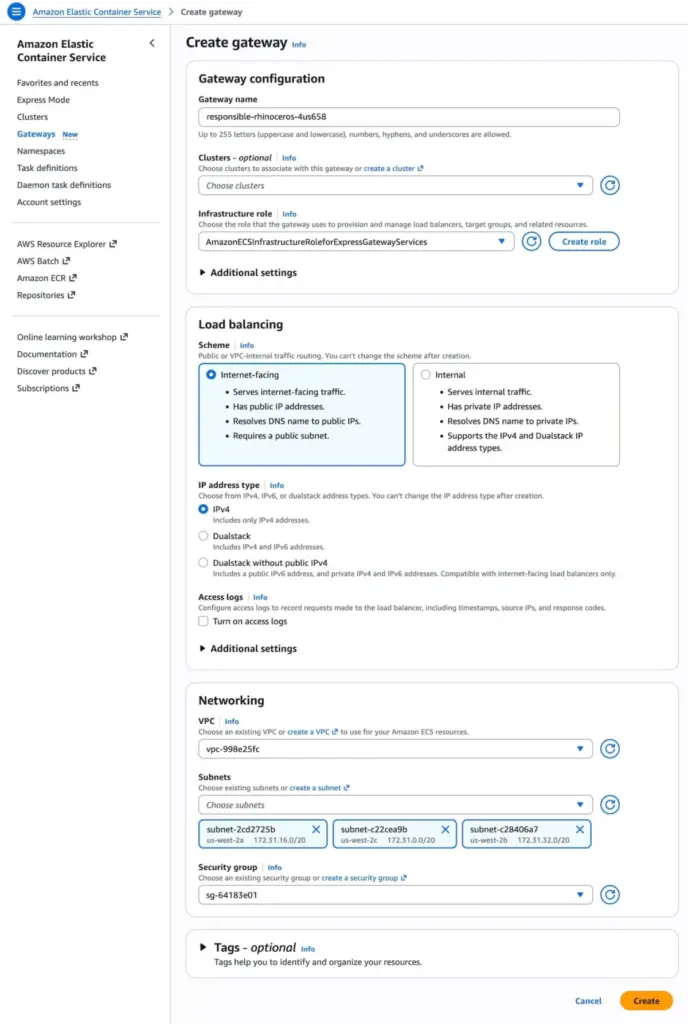
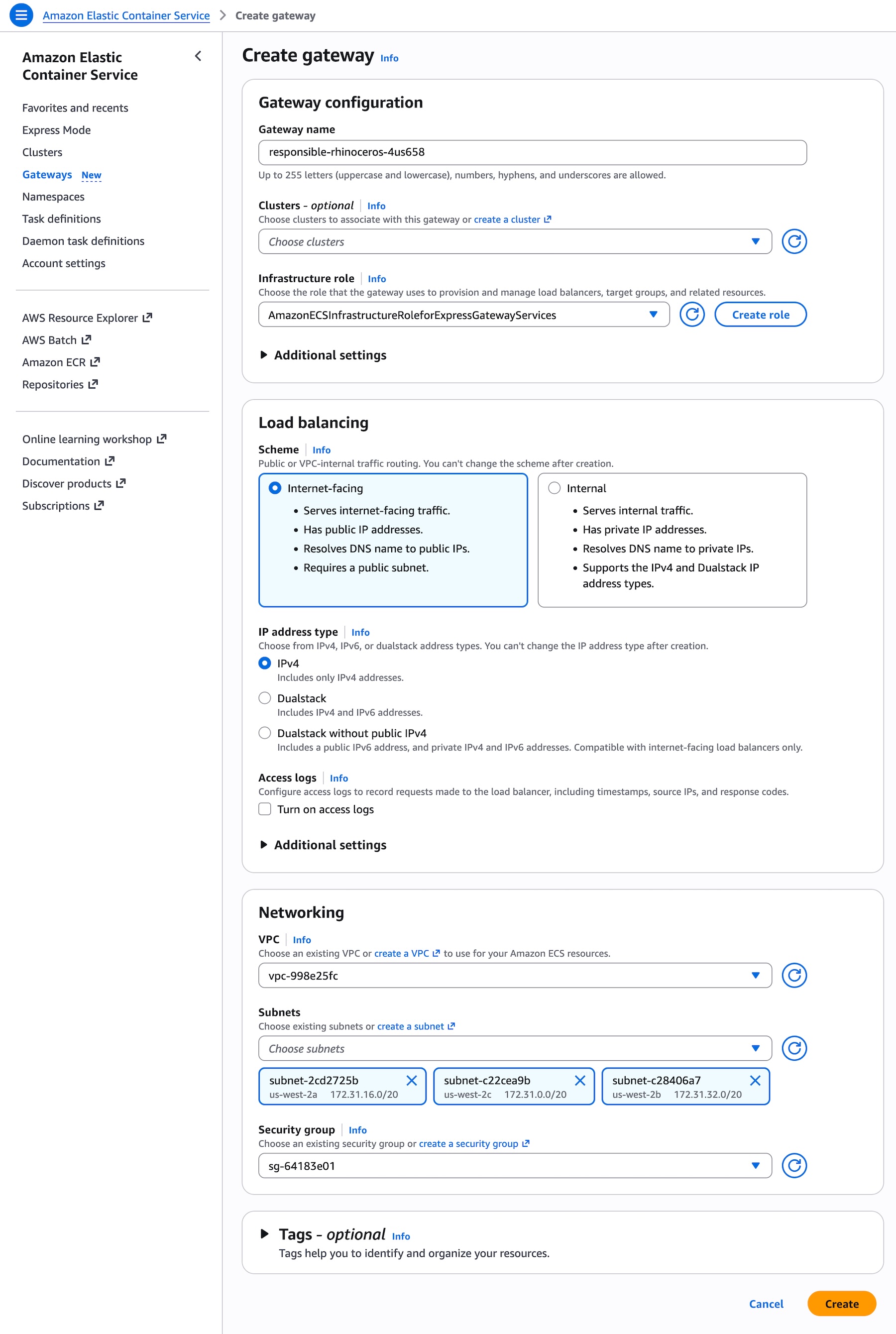
The management of ECS Gateway begins within the Amazon ECS console, where platform teams define the gateway’s configuration. A central component of this setup is the infrastructure role—an IAM role that Amazon ECS assumes to execute the provisioning and management of networking resources like ALBs, security groups, and certificates. To initiate a gateway, administrators provide a unique name and select this infrastructure role. Optionally, the gateway can be associated with ECS clusters either during the initial creation or at a later date, providing flexibility for organizations with varying cluster management strategies.
When configuring the gateway, teams must select a load balancing scheme, choosing between public or VPC-internal traffic routing. Advanced settings allow for the customization of listeners, ports, and the maximum number of load balancers the gateway is permitted to scale to. Additionally, administrators can integrate AWS WAF web ACLs directly into the gateway, ensuring that web applications are shielded by robust security policies from the outset. While many of these settings provide flexibility, certain core parameters—such as the gateway name, scheme, VPC, subnets, IP address type, and listener protocols—are fixed upon creation to maintain architectural integrity.

For teams that prefer programmatic management, the AWS Command Line Interface (AWS CLI) offers a straightforward method for interaction. By invoking the CreateGateway command with the required configuration object, teams can define their ingress standards in code. Notably, the system remains dormant and consumes no infrastructure until the first service is connected, ensuring that resources are only consumed when actually required. Once established, administrators can use the AssociateGatewayWithCluster command to link the gateway to specific ECS clusters, facilitating a many-to-many relationship. This architecture supports up to 10,000 clusters per gateway and up to five gateway associations per cluster, granting platform teams the agility to segment traffic by environment or purpose—such as separating public-facing traffic from internal service communication.
Developer Experience and Service Integration
For application teams, integrating a service with the ECS Gateway is a streamlined process. When defining a service through the CreateService or UpdateService API calls, teams simply add a gateway connector to the service definition. This declarative approach allows developers to specify their requirements without needing deep knowledge of the underlying networking infrastructure.
The transition to ECS Gateway is designed to be incremental. If an organization has an existing ECS service that utilizes its own legacy load balancer, the ECS Gateway can be adopted alongside the existing configuration. Both ingress paths can remain operational simultaneously, enabling teams to validate the gateway connection and ensure application readiness before opting to remove the older, manual load balancer configuration.
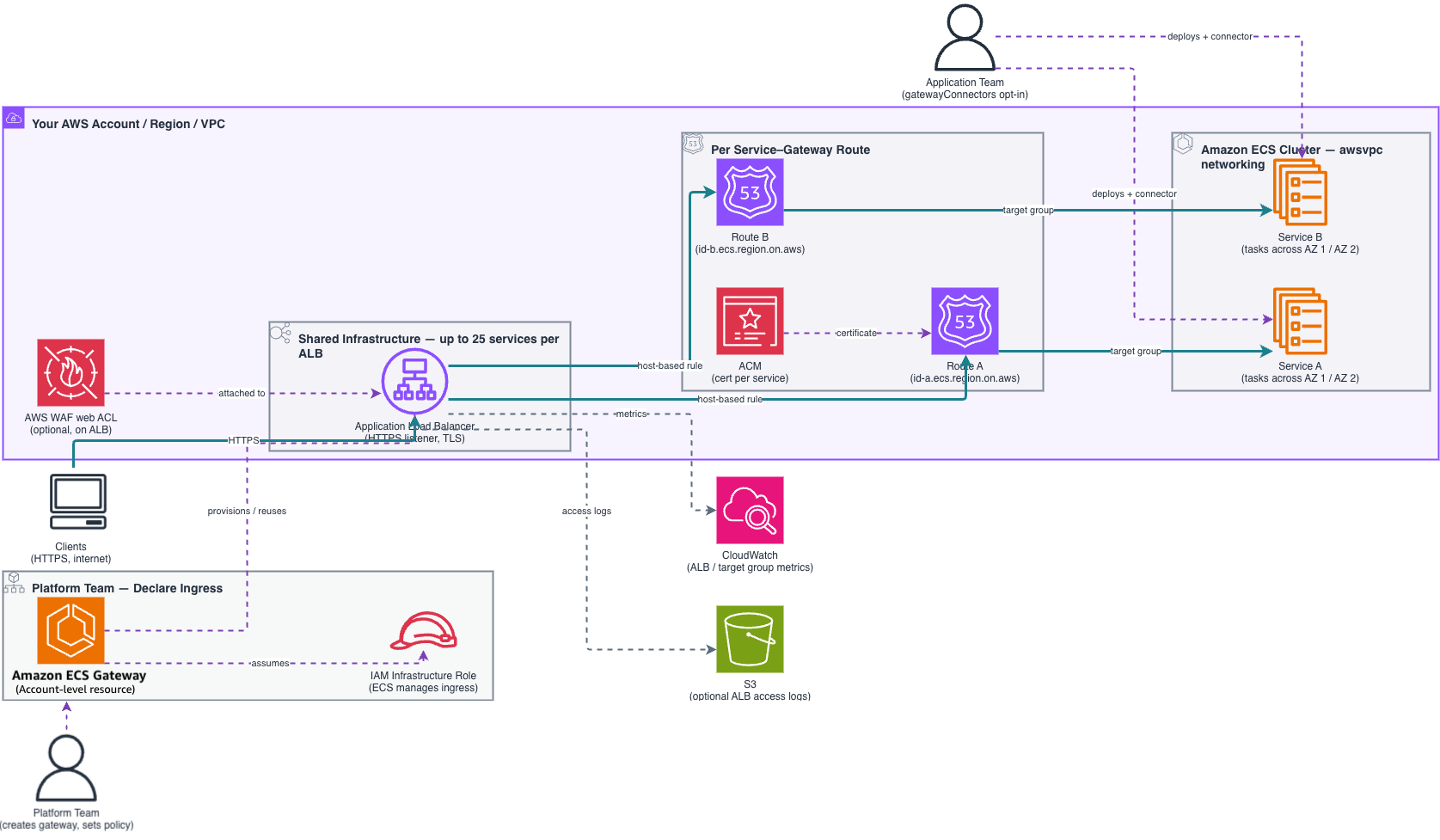
During deployment, Amazon ECS performs an intelligent evaluation of the gateways associated with the target cluster to identify a compatible connection. A gateway is deemed compatible if its access type aligns with the service’s connector filter, if it resides in the same VPC as the service, and if it encompasses all Availability Zones utilized by the service’s subnets. Upon confirmation, ECS provisions the required per-service resources, including the ACM certificate, a unique DNS hostname, the necessary listener rule, and security group adjustments. Once this orchestration is complete, the gateway route is marked as active, and the service becomes immediately reachable via its new URL.
Automation and Operational Reliability
ECS Gateway is built to handle common operational challenges automatically, reducing the need for manual intervention during traffic spikes or maintenance windows. The system handles the complex task of mapping hostnames to target groups, updating security group rules to allow ingress traffic only from the load balancer, and managing certificate renewal through ACM. By automating these tasks, the platform minimizes the risk of human error—such as misconfigured security groups or expired certificates—that often plague manually managed environments.
For teams looking to further automate their workflows, Amazon has ensured that ECS Gateway is compatible with modern AI-driven coding tools. By utilizing the AWS MCP Server and relevant plugins, developers can programmatically interact with gateway APIs and search documentation, accelerating the integration of these networking patterns into their CI/CD pipelines.
Availability and Economic Impact
Amazon ECS Gateway is available now in all commercial AWS Regions where Amazon ECS is supported. There is no additional premium or service fee for using the gateway itself; customers pay only for the standard underlying infrastructure provisioned in their accounts. This includes the usual costs associated with Application Load Balancers, CloudWatch logs and metrics, ACM certificates, and data transfer fees. This transparent pricing model ensures that as teams migrate from manual, per-service networking to the consolidated gateway approach, they see the benefits of infrastructure optimization reflected directly in their billing.
As organizations continue to embrace containerization as the standard for modern application development, the complexity of managing ingress networking has become a critical concern. With the introduction of ECS Gateway, Amazon is providing a path toward a more scalable, secure, and automated networking future. Platform teams can now establish guardrails that simplify the experience for their developers, while ensuring that the infrastructure remains compliant and cost-effective. For those ready to modernize their container networking, the first step is to explore the gateway configurations within the Amazon ECS console or via the AWS CLI, and join the conversation regarding these new capabilities through AWS support channels and the community-driven AWS re:Post platform.